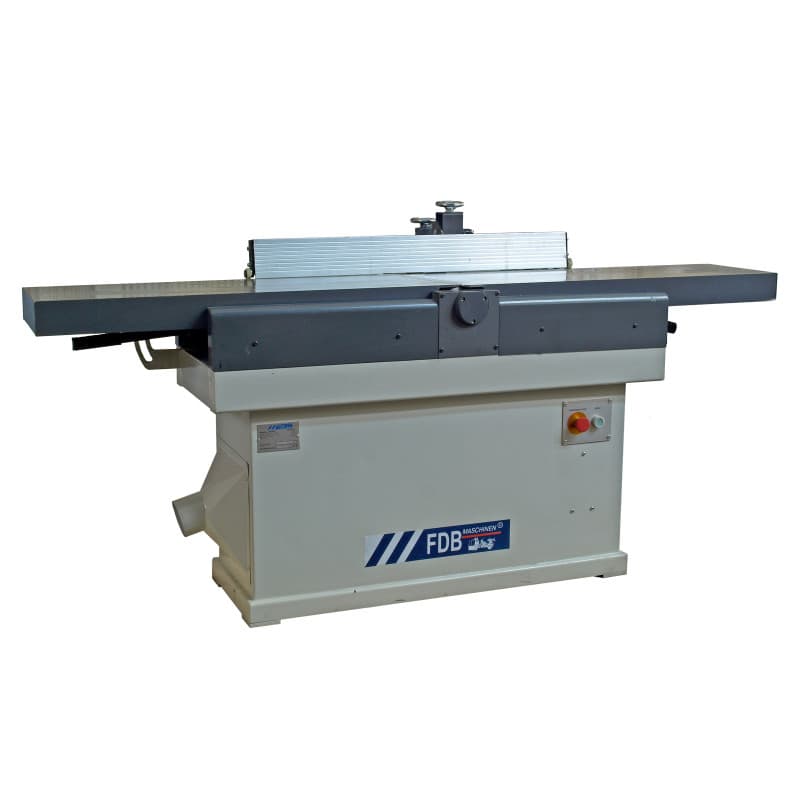
Jointers (Surface Planers) for Wood
A jointer flattens the first face of a board and squares its edge, after which the board is sized on a thicknesser. The range covers FDB Maschinen jointers: the MB150 and MB200 on 220 V for small workshops and the MB303 and MB524F on 380 V for joinery shops. Planing width runs from 150 to 410 mm, with three or four knives on the cutterblock.
4 products · from 29 900 ₴
All: Woodworking machinesWood milling machines8Panel saws and circular saws10Table saws6Wood band saws9Thickness planers8Jointers4Edge banding machines4Combination woodworking machines8Dust collectors4Wood lathes6
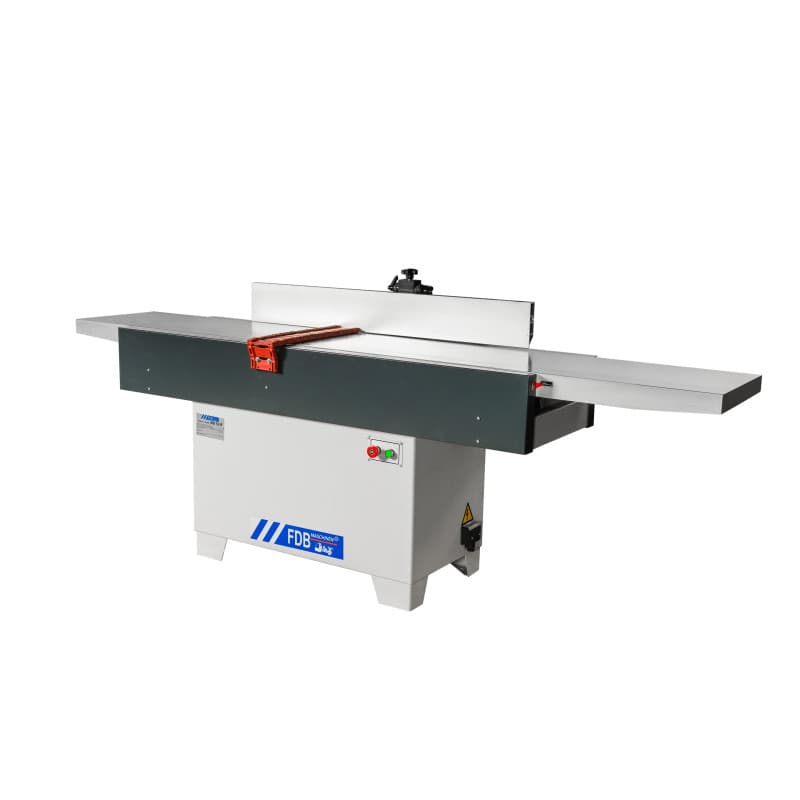
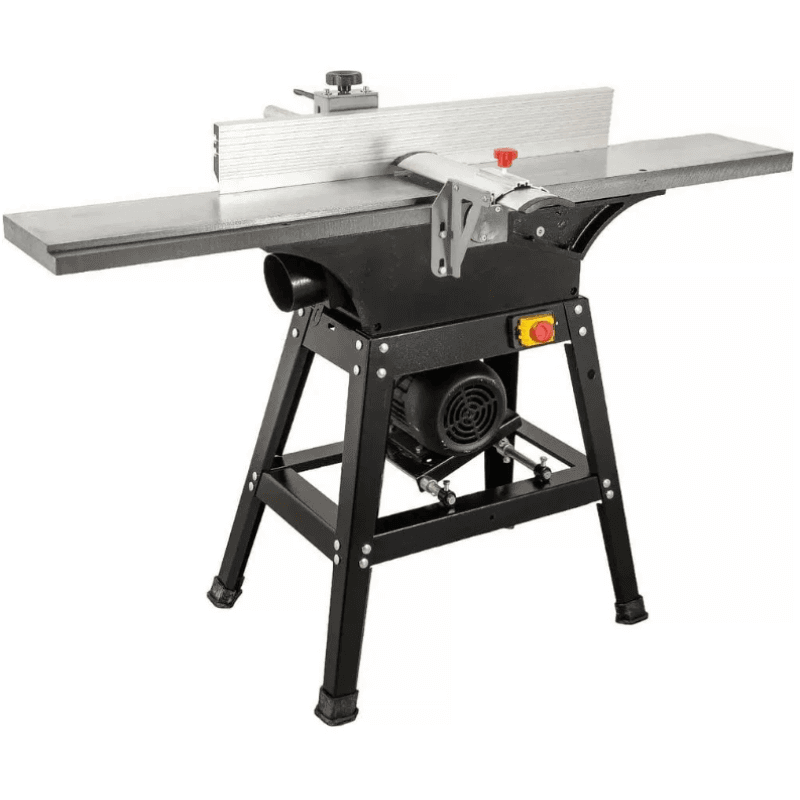
Model comparison
| Model | Weight (kg) | Voltage (V) | Overall dimensions (mm) | Power (kW) | Price incl. VAT |
|---|---|---|---|---|---|
| Jointer MB150 | 98 | 220 | 1400*450*990 | 1,1 | 29 900 ₴ |
| Jointer MB200 | 107 | 220 | 1400*500*990 | 1,5 | 39 500 ₴ |
| Jointer MB303 | 220 | 380 | 2000×500×850 | 2.2 | 83 000 ₴ |
| Jointer MB524F | 400 | 380 | 2500×580×900 | 3 | 153 000 ₴ |
Related articles
How to choose a jointer
Planing width
The cutterblock width limits the widest board you can face in one pass: 150 mm on the MB150, 200 mm on the MB200, 300 mm on the MB303 and 410 mm on the MB524F. For beams, battens and boards for furniture and doors 200 mm is usually enough. Panels, wide sill boards and production joinery need 300 mm or more, otherwise you face from both sides and get a step.
Table length and rigidity
A longer table joints long stock straighter, while a short table follows the bow of the board. Machine length is about 1400 mm on the MB150 and MB200, 2000 mm on the MB303 and 2500 mm on the MB524F. A heavy base damps vibration, so the 220-400 kg machines leave a cleaner surface. Tables should be ground flat; check them with a straightedge on delivery.
Power, knives and supply
The 220 V models with 1.1-1.5 kW motors suit a garage or small workshop. The MB303 (2.2 kW) and MB524F (3 kW) run on 380 V for continuous work, and the MB524F has power feed. Three or four knives on the cutterblock give a smooth cut without ripples. Always connect a dust collector, as a jointer produces a lot of chips. We can help match a model to your stock.
FAQ
What is the difference between a jointer and a thickness planer?
A jointer flattens the first face and squares an edge to it at 90 degrees: the board rests on the table and follows its flat surface, not its own bow. A thickness planer presses the board against its table with rollers and planes the opposite face parallel to the flat one, sizing the thickness. Without jointing first, the planer copies the bow and twist. That is why the two machines are normally used in pairs: jointer first, planer second.
How much should a jointer remove per pass?
Maximum cutting depth is 3 mm on the MB150 and MB200 and 4 mm on the MB303 and MB524F, but that is the limit for roughing softwood. For a clean surface take 0.5-1 mm per pass, less on oak, beech and ash, and feed steadily with the grain. A bowed board is first trimmed on the high spots with short passes and then flattened over its full length.
What determines the surface finish on a jointer?
Cuts per minute: cutterhead speed multiplied by the number of knives. The MB150 and MB200 run 4000 rpm with 4 knives, 16,000 cuts; the MB303 runs 4800 rpm with 3 knives (14,400); the MB524F runs 5000 rpm with 4 knives (20,000). More cuts and a slower feed give finer ripples. Sharp knives set at equal projection and planing with the grain matter just as much.
Can a 380 V jointer run on a 220 V supply?
Not directly: the MB303 (2.2 kW) and MB524F (3 kW) have three-phase motors. Options are a frequency inverter with single-phase input, if the motor can be connected in delta for 220 V, or run capacitors, which cost up to a third of the power and are a poor choice for a jointer. If there is no three-phase supply and none is planned, the 220 V MB150 or MB200 is simpler. Agree the wiring with an engineer before buying.
What is the shortest and thinnest workpiece a jointer can handle?
The workpiece must span the gap between the tables with margin: in practice no shorter than 300 mm and no thinner than 10-15 mm. Short parts get pulled into the cutterhead, so they are jointed as a long blank and cut to length afterwards. Thin and narrow parts need push blocks, and edge jointing needs a fence set to exactly 90 degrees with a square. A spare set of knives keeps the machine working while the other set is being sharpened.
Can you help me choose a jointer?
Yes. An engineer will match a jointer to the width and length of your stock, your workload and your 220 V or 380 V supply, and advise what to add: a thickness planer, a dust collector, knives. We issue a VAT invoice for companies and sole proprietors. Delivery across Ukraine, pickup in Dnipro is available.