Thickness planer vs jointer: the difference and which to buy
A jointer flattens the first face of a board and squares an edge to it; a thickness planer makes the opposite face parallel to the first and planes the board to an exact thickness. Rough or warped lumber needs both, because a thicknesser alone only reproduces the warp. For a home workshop the easiest start is a 220 V combination jointer-thicknesser (from ~19 800 UAH incl. VAT); a joinery shop is better served by separate 380 V machines.
What a jointer does and what a thicknesser does
Both machines cut wood with a rotating cutter head, but they use different references, so the results are different.
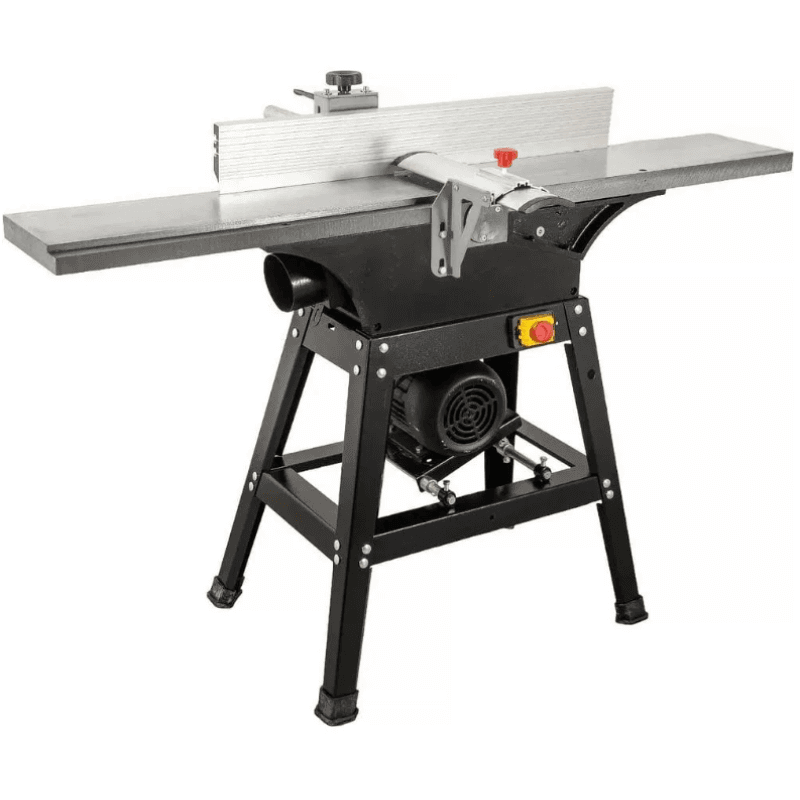
A jointer (surface planer) has two tables: the infeed table is lowered by the depth of cut, the outfeed table is level with the knives. You push the board by hand, the cutter head removes the high spots, and after a few passes the face is flat. Then the board is held against the fence and the edge is jointed square to that face.
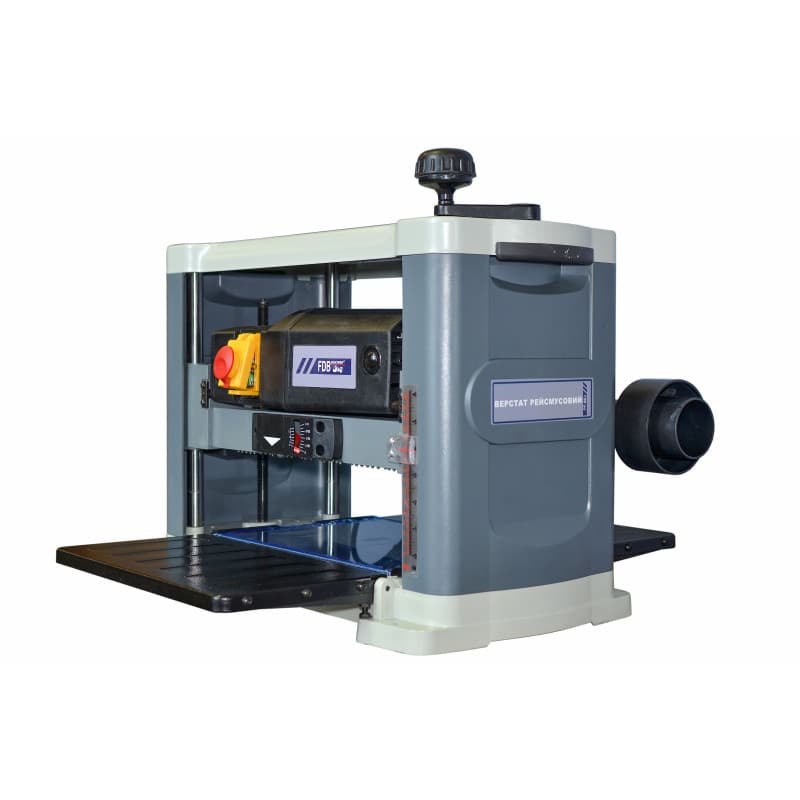
A thickness planer (thicknesser) works differently: the board lies flat face down, feed rollers pull it under the cutter head, and the table-to-knife distance sets the thickness. The top face comes out parallel to the bottom one, and every board in a batch has the same thickness.
- Jointer: creates the first flat reference face and a square edge. It does not control thickness.
- Thicknesser: copies the bottom face to the top and gives an exact thickness. It cannot make a flat face out of a warped board.
Why rough lumber needs both, and the milling order
Pre-dimensioned boards often need only a thicknesser. Rough or kiln-dried sawn boards almost always have some bow or twist, so every joinery shop uses the classic sequence:
- Crosscut the stock to length with 30-50 mm extra: a shorter board is easier to flatten, and the ends get trimmed later.
- Joint the first face on the jointer until it is completely flat.
- With that face against the fence, joint one edge square at 90 degrees.
- Run the board through the thicknesser flat face down and bring it to thickness, taking 1-2 mm per pass.
- Rip to width on a table saw from the jointed edge and, if needed, plane the second edge.
What a thicknesser cannot fix
Thicknesser feed rollers press the board onto the table. Under pressure it is planed flat, but once it leaves the machine it springs back to its original shape. So a thicknesser does not remove these defects:
- Cup: the board is curved across its width. After the thicknesser it is still cupped, just thinner.
- Twist (wind): the corners do not lie in one plane, and the board rocks diagonally on a flat table.
- Bow: the middle of the board is raised or lowered along its length. A long board flexes as it passes the rollers and comes out just as bowed.
- Out-of-square edge: a thicknesser does not touch the edge; that is the jointer's job.
Planer-thicknessers and 3-in-1 and 5-in-1 combination machines
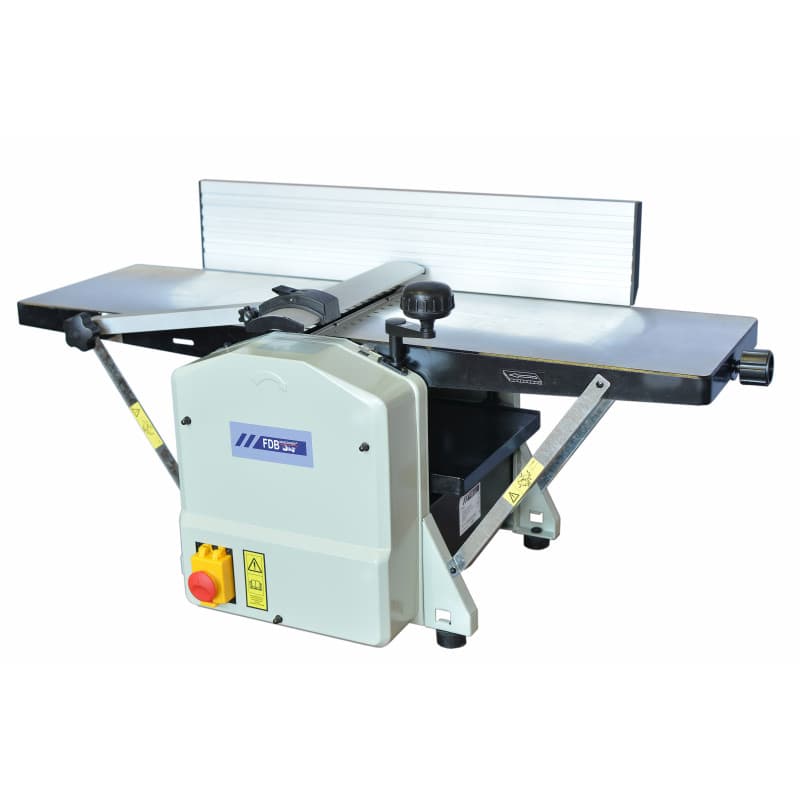
A planer-thicknesser is one machine with one cutter head: jointer tables on top, thicknessing table below. After jointing you flip up the tables or fit a guard and plane to thickness. The most affordable option in our catalog is the MLC10: 254 mm width, 913×257 mm jointer table, 1.5 kW, 220 V, about 19 800 UAH incl. VAT.
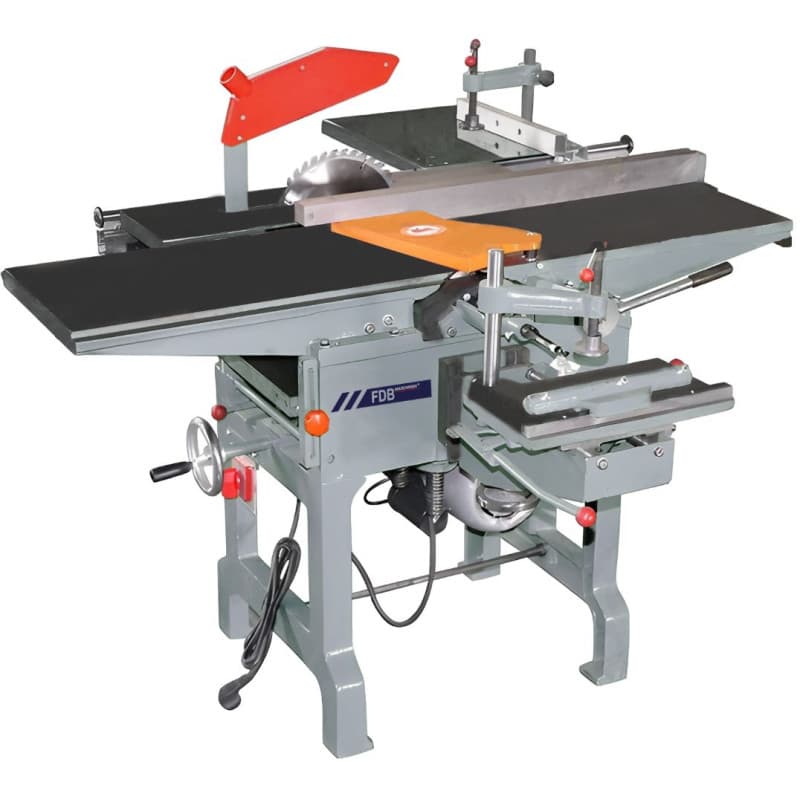
Larger combination woodworking machines add a circular saw, a mortising attachment and, per the manual, spindle moulding to jointing and thicknessing. The MLQ300TB, MLQ343M and MLQ345M plane 300-350 mm wide and 10-110 mm thick, while the MLQ400M with sliding carriage handles 400 mm and 6-200 mm. All of them run on 220 V. The lighter ML 210 B joints up to 210 mm and saws, but has no thicknesser.
Pros and cons of a combination machine:
- Pro: you can joint across the full thicknesser width (254-400 mm), while separate budget jointers are 150-200 mm wide.
- Pro: one machine instead of several saves floor space and money.
- Con: switching from jointing to thicknessing takes time, and two people cannot work on it at once.
- Con: the jointer table is shorter than on a standalone jointer: 913-1510 mm versus 1950-2500 mm on industrial models.
Key specs to compare
When comparing models, check these figures in the machine's manual:
- Planing width. The widest board you can plane in one pass. For furniture panels and worktops choose 300 mm or more; thicknessers in our catalog range from 330 to 630 mm.
- Jointer table length. The longer the table, the straighter a long board comes out. A short table follows the bow of a long workpiece.
- Knives and cutter head. 3-4 knives give a cleaner surface at the same feed than 2. Replacement knives must match the size in the manual exactly.
- Stock thickness. The maximum (110-200 mm) matters for beams, the minimum (3-10 mm) for thin strips.
- Feed speed. 6-8 m/min suits a workshop, 10-12 m/min and several speeds suit batch production.
- Motor and voltage. 1.5-3 kW models run on 220 V single phase, industrial 2.2-7.5 kW machines need 380 V. Check whether your premises have three-phase power.
Comparison table of models
Models from our thickness planers, jointers and combination machine sections. Prices rounded, incl. VAT.
| Model | Type | Width, mm | Thickness, mm | Table, knives, feed | Motor | Price incl. VAT |
|---|---|---|---|---|---|---|
| MB13 | Thicknesser | 330 | 6-152 | 2 knives, 6 m/min | 1.5 kW, 220 V | ~22 400 UAH |
| MB104 | Thicknesser | 400 | 10-120 | 4 knives, 8/12.5 m/min | 2.2 kW, 380 V | ~60 900 UAH |
| MB200 | Jointer | 200 | - | 1400 mm table, 4 knives | 1.5 kW, 220 V | ~39 500 UAH |
| MB303 | Jointer | 300 | - | 1950 mm table, 3 knives | 2.2 kW, 380 V | ~83 000 UAH |
| MLC10 | Planer-thicknesser | 254 | see manual | 913 mm table, 2 knives, 8 m/min | 1.5 kW, 220 V | ~19 800 UAH |
| MLQ343M | Combination | 300 | 10-110 | 1210 mm table, 3 knives, 10 m/min | 2.2 kW, 220 V | ~68 000 UAH |
| MLQ400M with carriage | Combination | 400 | 6-200 | 1510 mm table, 3 knives, 9.5 m/min | 3 kW, 220 V | ~93 500 UAH |
Which to buy first: home workshop vs joinery shop
For a home or garage workshop with only 220 V, the most sensible start is the MLC10 planer-thicknesser, or a pair made of the benchtop MB13 thicknesser (330 mm, about 22 400 UAH) and an MB150 or MB200 jointer. If you buy pre-dimensioned boards, get the thicknesser first; if you buy rough lumber, start with a jointer or a combination machine.
For a joinery shop or small production, choose separate 380 V machines so two operators never wait for each other: an MB303 or MB524F jointer with a long table plus an MB104, MB106B (600 mm) or MB106H (630 mm, 7.5 kW) thicknesser. The double-sided MV204A planes both faces in one pass. Short on space but also need a saw and mortiser? Take an MLQ combination machine.
MELITA (NTC Melita LLC) has been operating in Dnipro since 2015: 12-month warranty, VAT invoices for companies, delivery across Ukraine by Nova Poshta, Meest and freight carriers, free pickup in Dnipro. See the rest of the range in woodworking machines, and for help with selection describe your jobs in the quote form.
FAQ
What is the difference between a thickness planer and a jointer?
A jointer flattens the first face and squares an edge to it. A thickness planer planes the opposite face parallel to the first and to an exact thickness.
Can I use a thickness planer without a jointer?
Yes, if the boards are already dimensioned or flat. A thicknesser will not fix cup, twist or bow: the rollers press the board flat, and it springs back once it leaves the machine.
Is a planer-thicknesser better than two separate machines?
For a home workshop a combination is better: cheaper, smaller and it joints across the full width. For a shop, separate machines win because there is no changeover and two people can work at once.
Which 320 mm jointer-thicknesser should I choose?
The closest widths in our catalog are the 300 mm MLQ300TB, MLQ300 KV and MLQ343M combination machines, plus the separate 330 mm MB13 thicknesser. All of them run on 220 V.
How much should I take off per pass on a thicknesser?
The maximum depth is in the manual (2-5 mm on our models), but on wide or hard boards it is better to take 1-2 mm. That means less load on the motor and a cleaner surface.