Vibration isolation of equipment: machine tools, presses, compressors
Vibration isolation places a resilient element between a machine and the floor to reduce the transmission of vibration. Passive isolation protects a precision machine from shop-floor vibration; active isolation keeps vibration from a press, compressor or pump out of the floor. Rubber-metal OV-type mounts do both, provided the load on each mount is within its working range and the equipment manual allows installation without a foundation.
Why equipment needs vibration isolation
Almost every machine in a shop vibrates: a crank press strikes on every stroke, a reciprocating compressor rocks from its reciprocating masses, fans and pumps vibrate from residual imbalance. Through the concrete floor this vibration reaches neighbouring equipment and the building structure.
The consequences are not immediate, but they add up:
- Accuracy and surface finish: bed vibration turns into relative motion between tool and workpiece - waviness, lobing and size scatter appear on the part.
- Tool life: shocks and micro-vibration speed up chipping of cutting edges, especially carbide inserts and grinding wheels.
- Neighbouring machines: a grinding or jig-boring machine next to a press performs worse than the same machine in a separate room.
- Building and people: vibration travels through floor slabs to adjacent rooms, structure-borne noise rises, screeds and anchor fixings crack.
Passive vs active vibration isolation: the difference
The data sheets of OV mounts state that they are intended for passive and active vibration isolation. These terms describe the direction of protection, not the design of the mount.
Passive isolation protects the machine itself from external vibration. Example: a high-precision lathe or grinder stands in a shop with presses and an overhead crane, and the mounts keep that vibration away from the bed.
Active isolation protects the surroundings from a source machine. Example: a crank press or a compressor is set on mounts so that vibration does not go into the floor and to neighbouring machines. The same rubber-metal mount works in both modes because the resilient element reduces transmission in both directions.
An important note: some literature uses the word active for systems with sensors and actuators that cancel vibration in antiphase. Rubber-metal mounts are passive, unpowered elements; active in their data sheet only means isolating a vibration source.
How a vibration mount works: natural frequency and damping
A machine on rubber mounts is a mass on a spring. Such a system has a natural frequency: push the machine and it oscillates at that frequency. For OV, IV and hinged OV-30sh mounts the data sheet gives an average vertical natural frequency of 20 Hz, about 1200 oscillations per minute.
Isolation works when the disturbing frequency is clearly above the natural frequency of the system: by classical theory more than √2 times, i.e. roughly 1.4 times. The larger this margin, the less vibration reaches the floor. Near the natural frequency resonance occurs, and a resilient mount can even amplify vibration.
That is why the rubber in a mount is not only elastic but also damping: it absorbs part of the energy and limits the amplitude when the machine passes through resonance during start-up and run-down. OV mounts are equal-frequency mounts - designed so that the natural frequency changes little with load across the working range.
The practical conclusion: a mount reduces vibration at frequencies above its natural frequency well, while low-frequency, high-amplitude sources such as forging hammers need a vibration isolation design and a foundation per the manufacturer's documentation.
What equipment goes on anti-vibration mounts
According to the OV data sheet, they are used to install most metal-cutting machines without a foundation - lathes, milling, drilling and grinding machines - as well as crank presses, pumps, compressors and fans. The condition is a medium-size machine with a rigid bed that keeps its geometry on its own and does not rely on a foundation for stiffness.
The table below helps you orient. The load per mount is the machine mass divided by the number of support points, allowing for uneven distribution (heavy headstock, overhung motor).
Mounts are often ordered together with a machine: for new medium-size lathes and grinding machines, where passive isolation matters, and for presses, where the main task is active isolation and protection against creeping. For a press, a vibration mount fixator is added to each OV-31M. All mounts are in the machine tool components section.
| Equipment | What to check | Which mount |
|---|---|---|
| Medium-size lathes and milling machines | Mass, number of support points, installation requirements in the manual | OV-31M (250-4500 kg per mount), 12 mm height adjustment |
| Grinders and other high-precision machines | Passive isolation from neighbouring machines, levelling | OV-31M, OV M12 for light models |
| Crank presses | Shock load, horizontal forces, creeping over time | OV-31M with fixator |
| Compressors, pumps, fans | Active isolation, flexible pipe and cable connections | OV M12 or OV-31M by load |
| Light machines and units | Load per mount at least 40 kg | OV M12 (40-250 kg), 80 mm pad |
| Uneven floor, inclined base, skewed frame | The mount must swivel to follow the surface | Hinged IV M12 or OV-30sh (40-250 kg) |
How to choose vibration mounts for the load
The main rule: each mount must work within its range - not below the minimum and not above the maximum load. An overloaded mount bottoms out and loses its isolating properties; an underloaded one acts almost like a rigid block.
An example for orientation: a 2000 kg machine on four points gives about 500 kg per mount - the range of the OV-31M vibration mount. A 400 kg unit on four points gives about 100 kg per mount - the OV M12 vibration mount fits. Take the real mass distribution from the machine manual; a detailed calculation for uneven loads is in the article how many vibration mounts you need.
If the machine mass is unknown, estimate it from the main parts with the metal weight calculator or ask us via the quote form - we will match mounts by model or photo. The general selection procedure by mass, accuracy and floor condition is in how to choose vibration mounts for machine tools.
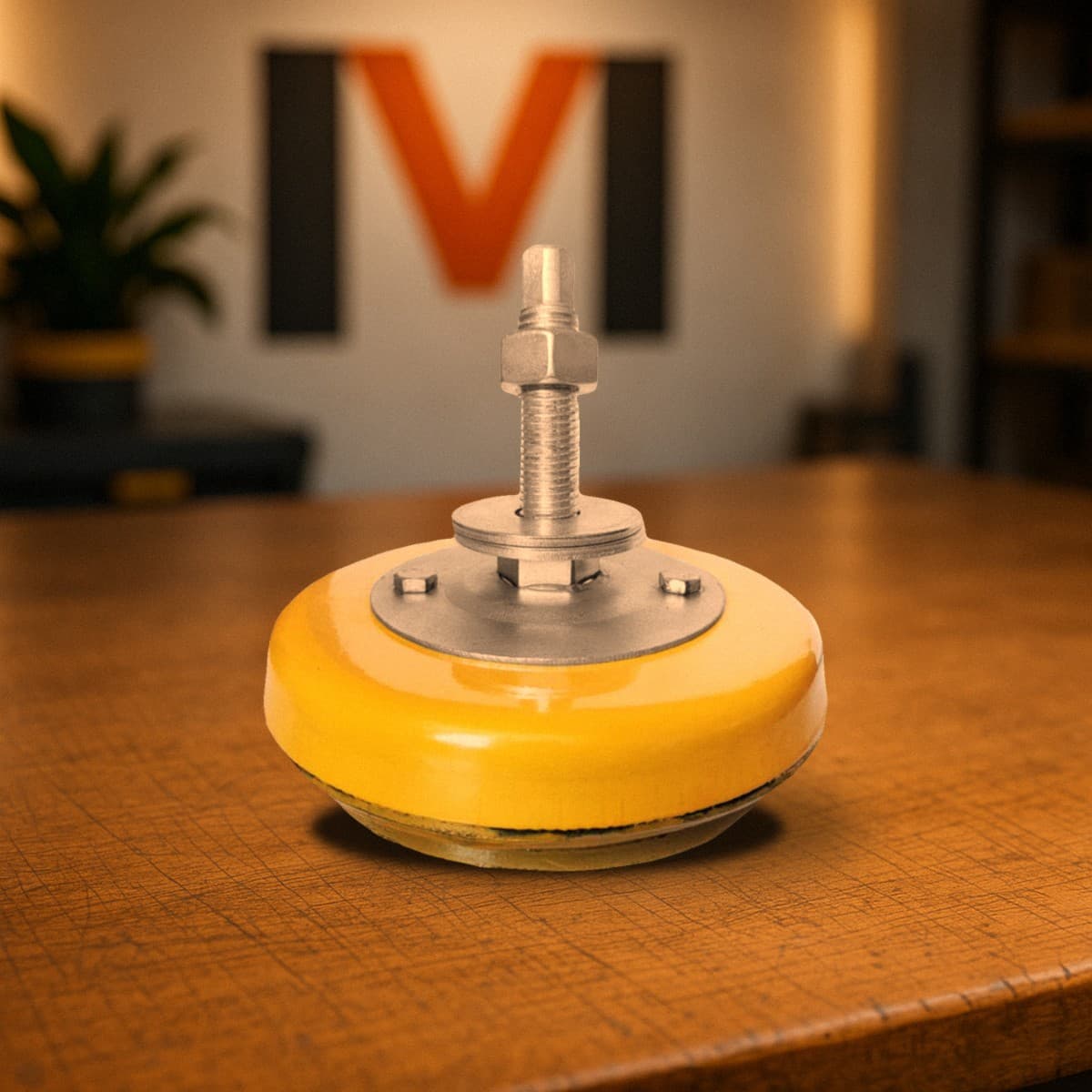
- OV-31M: 140 mm pad, M16 stud, 250-4500 kg, 12 mm height adjustment, from ~1,085 UAH excl. VAT.
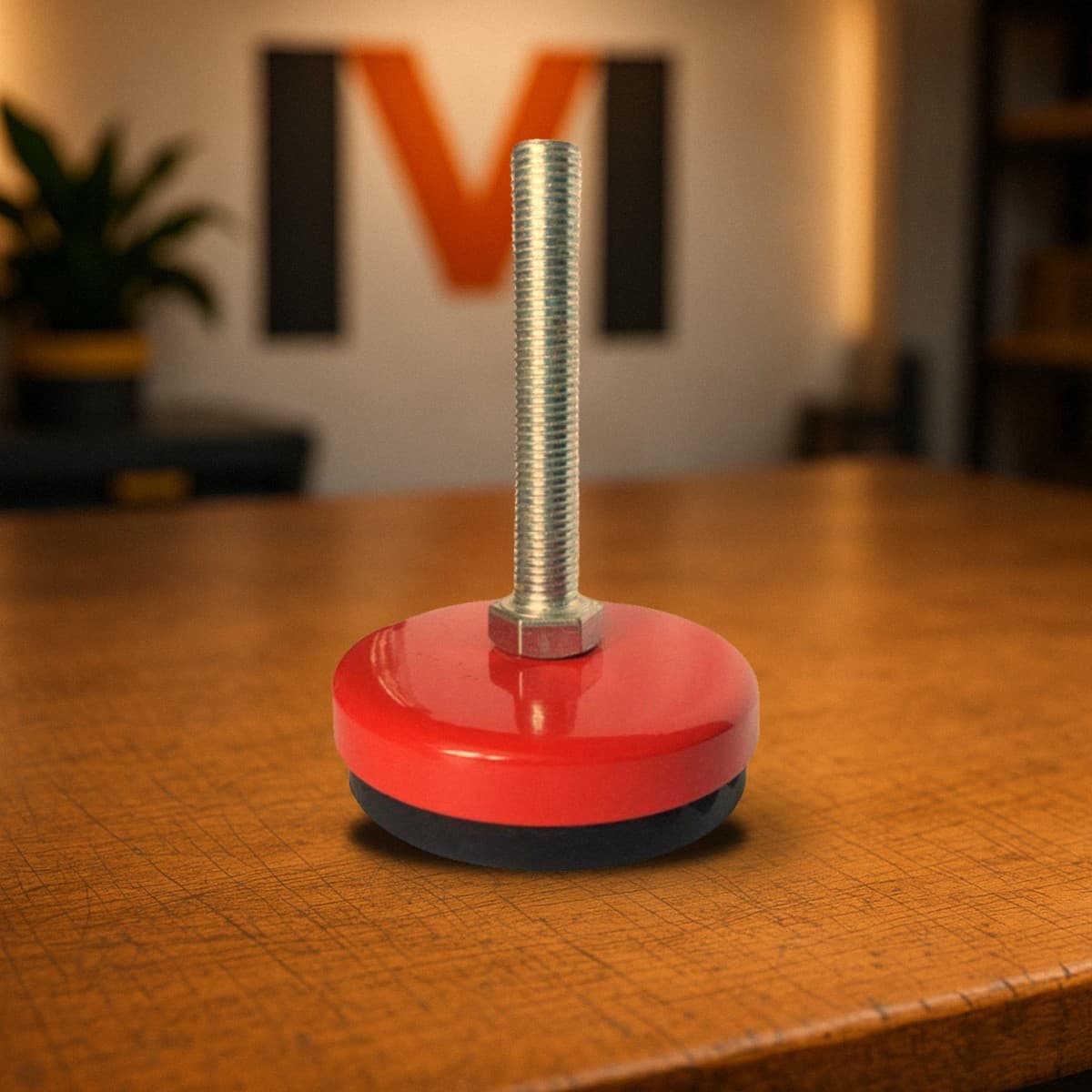
- OV M12: 80 mm pad, M12 stud, 40-250 kg, no height adjustment, from ~684 UAH excl. VAT.
- IV M12 and hinged OV-30sh: hinged M12 stud, 55 mm pad, 40-250 kg, from ~620 UAH excl. VAT.
- Fixator for OV-31M: keeps the mount from shifting in operation, from ~345 UAH excl. VAT.
When vibration mounts are not the answer
A mount does not replace a foundation in every case. Options are compared in vibration mounts or a foundation; below, briefly, the cases where mounts alone will not help.
- The equipment maker does not recommend installation on mounts or requires anchoring to a foundation - the machine manual rules.
- Heavy long machines whose bed gets its stiffness only together with the foundation: on separate mounts it may deform.
- Forging hammers and other equipment with powerful low-frequency impacts - they need a dedicated vibration isolation design.
- Cutting vibration (chatter) caused by tool overhang, wear or cutting data: a mount does not make the machine stiffer and does not remove it.
- A faulty source - spindle runout, unbalanced pulley, play, worn press units. Repair first: press spare parts and machine units, then isolation.
Common vibration isolation mistakes
Most problems with vibration mounts come not from the mounts but from installation and selection. Step by step - in how to install a machine on vibration mounts.
- Identical mounts under every point although the mass is uneven - some mounts are overloaded, others barely work.
- Different mount types under one machine: different stiffness causes tilt and rocking.
- Rigid pipes, ducts and cable trays to a compressor or pump on mounts - they carry vibration around the isolation and can crack.
- A press without fixators: repeated impacts make the mounts creep, and the levelling goes with them.
- No check after run-in: mounts settle, so the level must be checked and readjusted per the machine manual.
FAQ
What is the difference between passive and active vibration isolation?
Passive isolation protects the machine from external vibration; active isolation protects the floor and nearby equipment from the machine's own vibration. Rubber-metal OV mounts do both.
Can a press be installed on vibration mounts without a foundation?
The OV-31M data sheet covers foundation-free installation of crank presses unless the press maker forbids it. Fit fixators on presses so the mounts do not creep. More on crank presses in stamping on crank presses.
Does a compressor need vibration mounts?
A reciprocating compressor is a typical vibration source, and mounts reduce its transmission into the floor. Always use flexible pipe connections, otherwise vibration travels through the piping.
Will vibration mounts cure chatter during cutting?
No, chatter depends on the stiffness of the machine-fixture-tool-workpiece system and cutting data. A mount isolates the machine from the floor but adds no stiffness.
Which mount is right for an uneven floor?
For an uneven or inclined base, use hinged mounts - IV M12 or OV-30sh, whose pad swivels to follow the surface. More in hinged vibration mounts.