How Many Anti-Vibration Mounts per Machine: Load Calculation
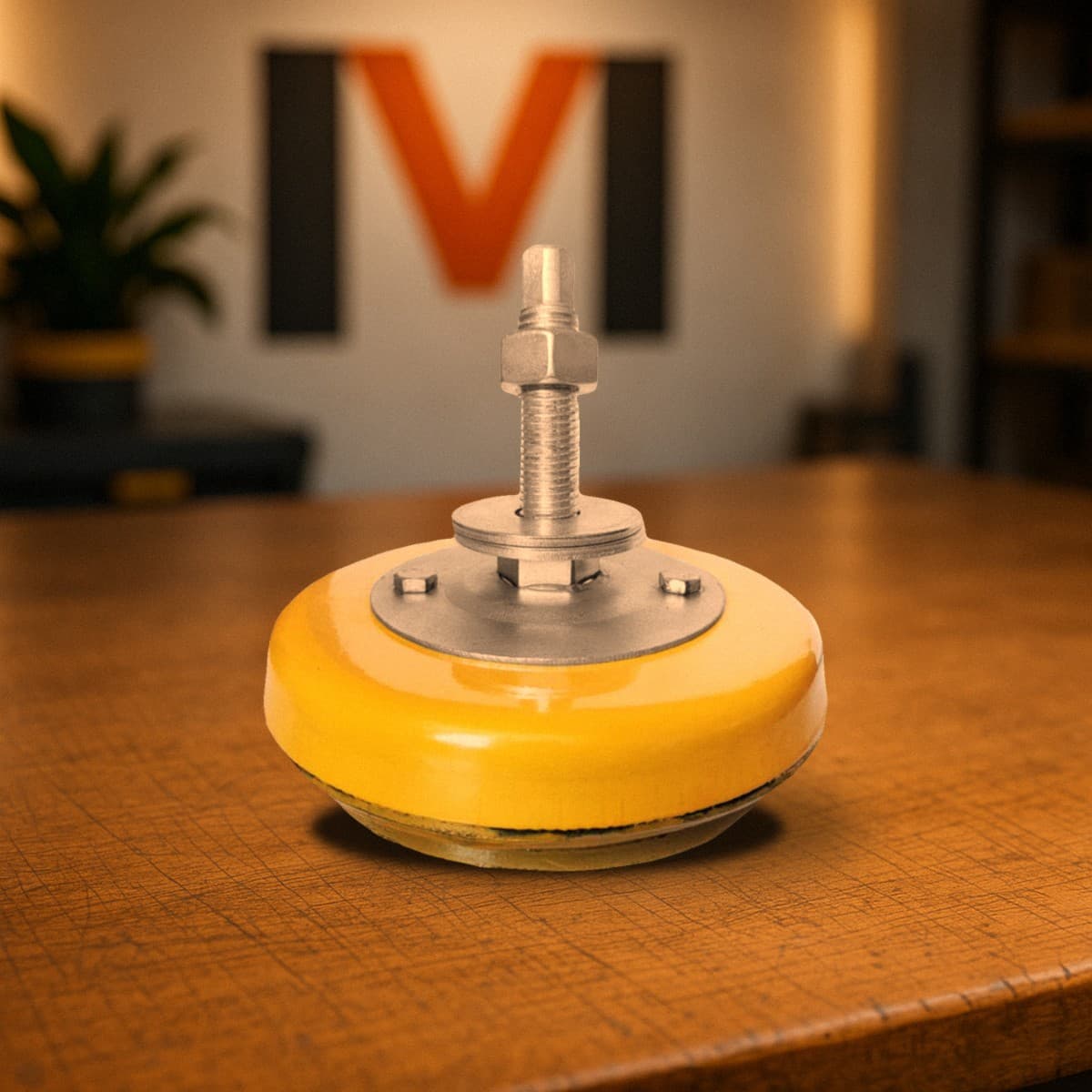
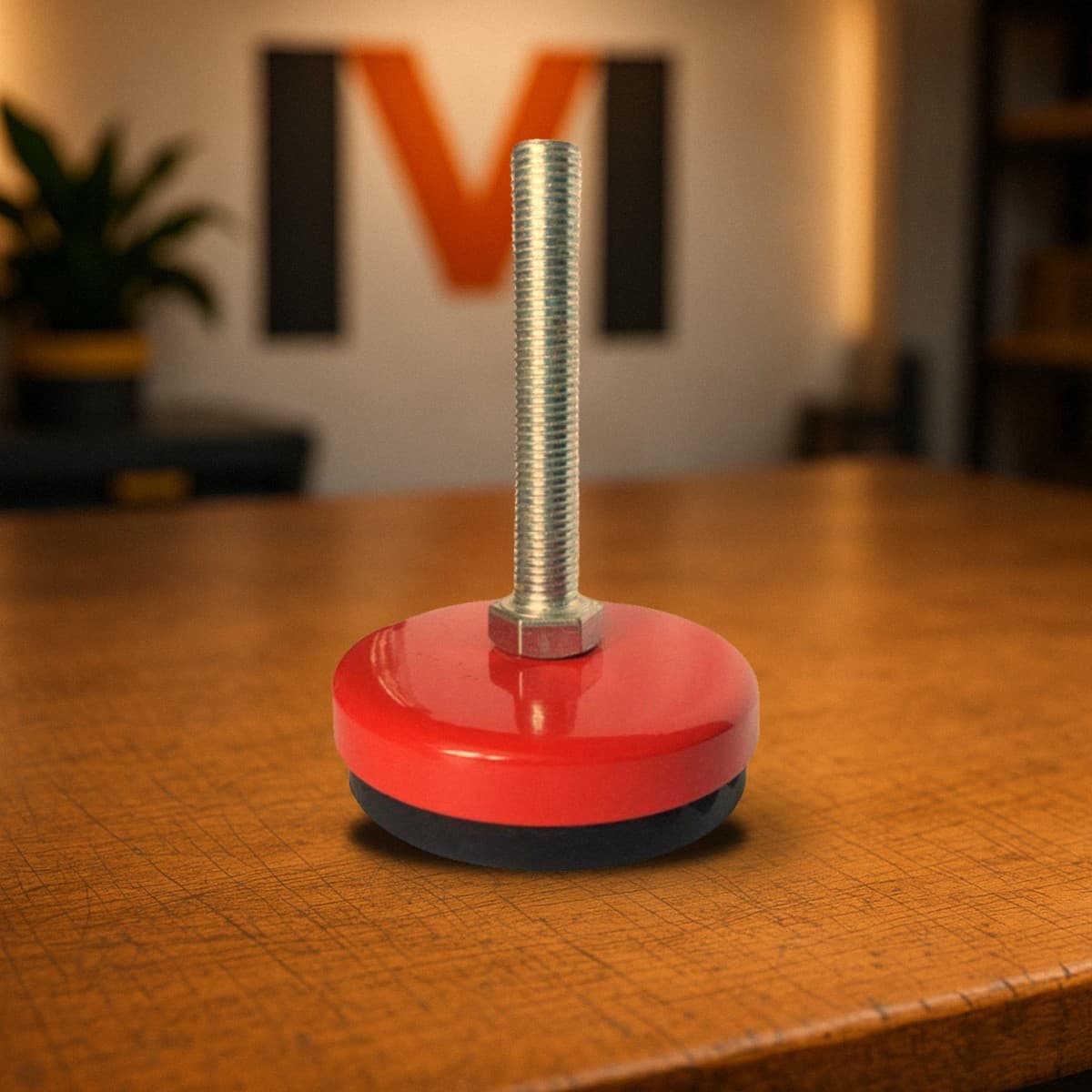
The machine bed sets the number of mounts: one goes under every fixing point on the installation drawing in the machine manual. Then the machine mass with tooling and the heaviest workpiece is split between these points, allowing for the offset centre of gravity, and every mount must end up inside its working range: OV-31M - 250 to 4500 kg, OV M12 and IV M12 - 40 to 250 kg. Overloading and underloading both make isolation worse.
How to calculate the load on one anti-vibration mount
The basic formula is simple: load per mount = machine mass / number of support points. But you do not choose the number of points freely - the bed design sets it. The machine manual has an installation drawing with holes for anchor bolts or levelling feet, and the mounts go exactly under those points.
Use the working mass, not the bare machine: everything that sits on it during operation. For a lathe that is the chuck, steady rest, tailstock and workpiece; for a milling machine - the vise, fixtures and workpiece on the table. If workpieces are heavy, estimate their mass from dimensions in the metal weight calculator.
The average is only the first step. The real load differs from point to point, so you check the most and the least loaded mount, not the average one.
- Step 1: machine mass from the manual plus tooling and the heaviest workpiece.
- Step 2: number and position of support points from the installation drawing.
- Step 3: split of the mass between points according to the centre of gravity.
- Step 4: check that the heaviest and the lightest point are inside the working range of the chosen model.
Uneven mass: heavy headstock and offset centre of gravity
Most machines carry their mass unevenly. On lathes the heaviest part is the headstock with gearbox and motor, on a pillar drill - the column and head, on a milling machine - the column. Mounts on that side carry more, mounts on the opposite side less.
The split follows the lever rule. If the distance between the front and rear lines of mounts is L and the centre of gravity is at distance a from the front line, the front pair carries M·(L−a)/L and the rear pair M·a/L. For a machine symmetric across its width, each share is divided by two. For example, with L = 2.0 m and a = 0.8 m the front pair carries 60% of the mass and the rear pair 40%.
The centre of gravity is sometimes shown on the installation drawing in the manual, sometimes together with mount loads. Without a manual, the load at each point can be measured with a dynamometer or load cell under a jack. Levelling also changes the load: three points always lie in one plane, but with four or more, a mount screwed higher takes more weight and its neighbour can unload almost to zero.
Working range of a mount: why both minimum and maximum matter
A rubber-metal mount isolates vibration when the rubber element is compressed by the machine weight into its working state. The stated characteristics, including a mean vertical natural frequency of about 20 Hz for our models, apply only within the working load range. That is why both numbers in the table below matter.
Overload is obvious: the rubber is over-compressed, the machine settles and loses level, the mount works outside its characteristics and fails sooner. Underload is less obvious but also harmful. The rubber hardly compresses, the system is too stiff for the light mass, the natural frequency rises and isolation gets worse. Isolation only works for vibration with a frequency more than √2 times the natural frequency of the system: for 20 Hz that is above ~28 Hz. The higher the natural frequency, the narrower the useful zone. An underloaded mount is also pressed less firmly to the floor and slides more easily.
So the rule is single: every mount, the heaviest and the lightest, must stay between minimum and maximum, with a margin per the machine manual. More on mount types in how to choose anti-vibration mounts for machines.
| Model | Load per mount, kg | Machine mass on 4 mounts, even split, kg | Stud | Price excl. VAT |
|---|---|---|---|---|
| OV-31M | 250-4500 | 1,000-18,000 | M16, 12 mm height adjustment | from ~1,085 UAH |
| OV M12 | 40-250 | 160-1,000 | M12 | from ~684 UAH excl. VAT |
| IV M12 (hinged) | 40-250 | 160-1,000 | M12, hinged | from ~620 UAH excl. VAT |
| Hinged rubber-metal (OV-30sh type) | 40-250 | 160-1,000 | M12, hinged | from ~620 UAH excl. VAT |
Worked examples: from a drill press to a heavy machine
The examples below illustrate the method; they are not data for specific models. Masses and the 60/40 split between the heavy and light side are assumed; for your machine take figures from the manual or measure them. The ranges are the rated ones for our mounts.
Note the 1,000 kg example: on four points no model fits all mounts at once, because the heavy side exceeds 250 kg and the light side stays below 250. The answer is more support points if the bed has them, or a consultation through our quote request form.
| Example (assumed) | Mass with tooling | Support points | Load per mount | Conclusion |
|---|---|---|---|---|
| Pillar drill press | 260 kg | 4 | 78 kg (column side) / 52 kg | OV M12 or IV M12: both points within 40-250 |
| Light lathe | 1,000 kg | 4 | 300 kg / 200 kg | No model fits on 4 points; on 6 points OV M12 averages ~167 kg |
| Medium lathe | 2,600 kg | 4 | 780 kg / 520 kg | OV-31M: both values within 250-4500 |
| Heavy machine | 12,000 kg | 8 | 1,500 kg on average | OV-31M: even twice the average, 3,000 kg, is below 4500 |
| Bench machine on OV-31M (mistake) | 200 kg | 4 | 50 kg on average | 5 times below the OV-31M minimum; OV M12 fits, but the light side (40 kg) is at the lower limit |
How many mounts to fit: selection order
Start with the manual: number of fixing points, mass, installation requirements. Some manufacturers prohibit or do not recommend anti-vibration mounts for their machines - then a foundation is needed, see anti-vibration mounts or a foundation. For presses and impact-loaded equipment, calculating from mass alone is not enough - follow the press manual.
After that the check takes a few steps and a few minutes with a calculator.
- Define the working mass: machine, tooling, heaviest workpiece.
- Calculate the share of mass on the heavy and light side by the lever rule, or take it from the manual.
- Divide each share by the number of mounts on that side.
- Heavy point up to 250 kg and light point from 40 kg - OV M12 mount or the hinged IV M12 for an uneven floor.
- Both points from 250 to 4500 kg - OV-31M mount; for machines with reciprocating motion add the OV-31M fixator from ~345 UAH excl. VAT.
- If points fall on different sides of the 250 kg boundary, do not guess - check whether extra points are possible or contact us.
Typical calculation mistakes
Most problems with mounts come not from the mount itself but from a wrongly calculated mass split. All our mounts and fixators are in the machine tool components section. The most common mistakes are:
- Splitting the mass equally and ignoring the heavy headstock or column.
- Taking the machine mass without chuck, fixtures and workpiece.
- Fitting more mounts than needed "to be safe" and underloading them below the minimum.
- Choosing OV-31M for a light machine "because it is stronger": at 50 kg per mount it does not work as an isolator.
- Not checking after levelling that every mount is loaded, leaving one "hanging".
- Ignoring the installation requirements of the machine manual; the procedure is in how to install a machine on anti-vibration mounts.
FAQ
How many anti-vibration mounts does a lathe need?
As many as the bed has fixing points on the installation drawing in the manual. Then check that the load at each point, allowing for the heavy headstock, falls within the range of the chosen model.
What load does the OV-31M mount take?
250 to 4500 kg per mount. M16 stud, 140 mm pad diameter, 12 mm height adjustment; details in OV-31M anti-vibration mount: specifications.
Can I fit more mounts to be safe?
Only if the bed has fixing points for them and the load per mount does not drop below the minimum. Extra underloaded mounts worsen isolation and complicate levelling.
What happens if a mount is underloaded?
The rubber hardly compresses, the natural frequency of the system rises above the stated value and the mount damps vibration worse. A lightly loaded mount also slides on the floor more easily.
Should the workpiece and tooling mass be included?
Yes, use the working mass: machine with chuck, fixtures and the heaviest workpiece. Workpiece mass can be estimated from dimensions in the metal weight calculator.