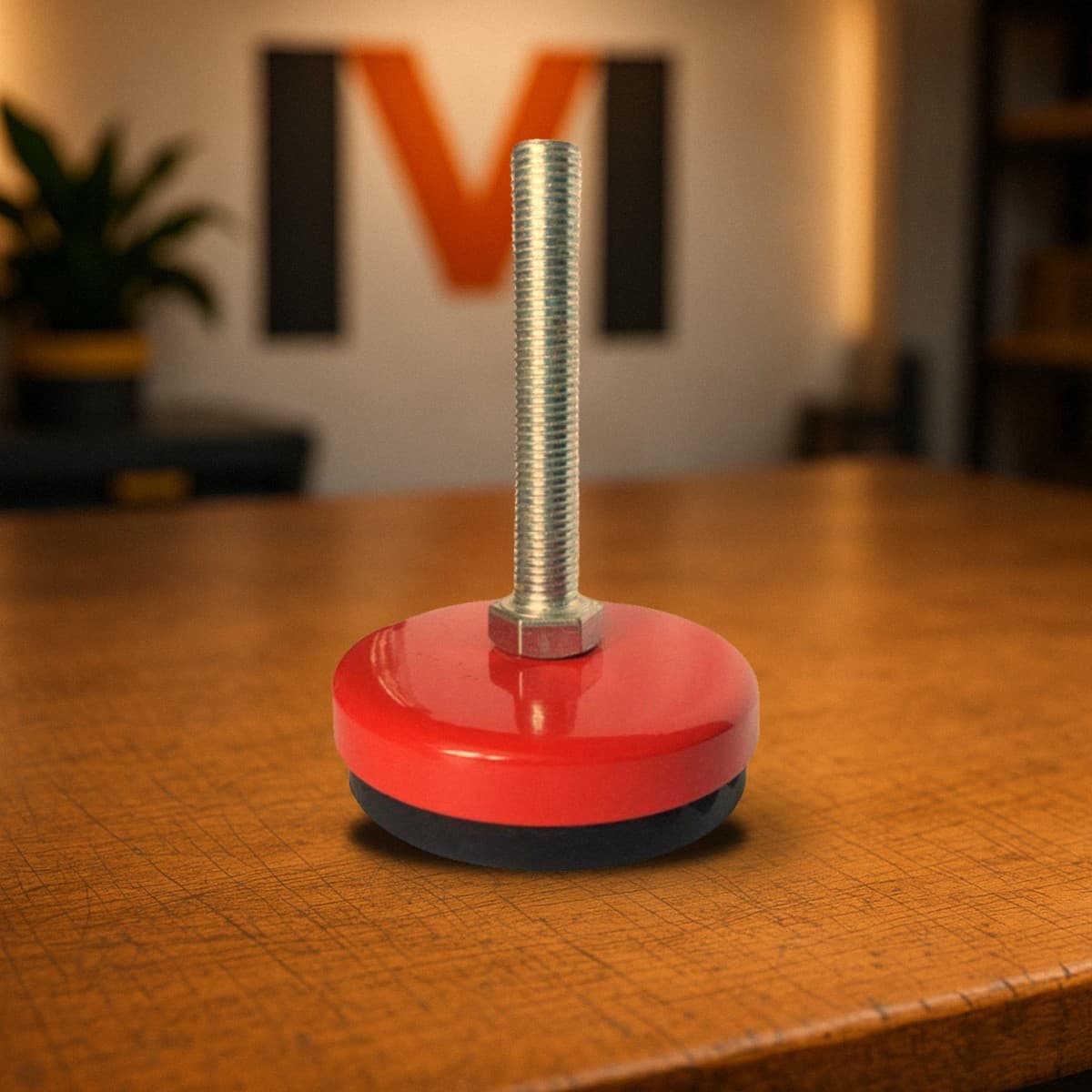
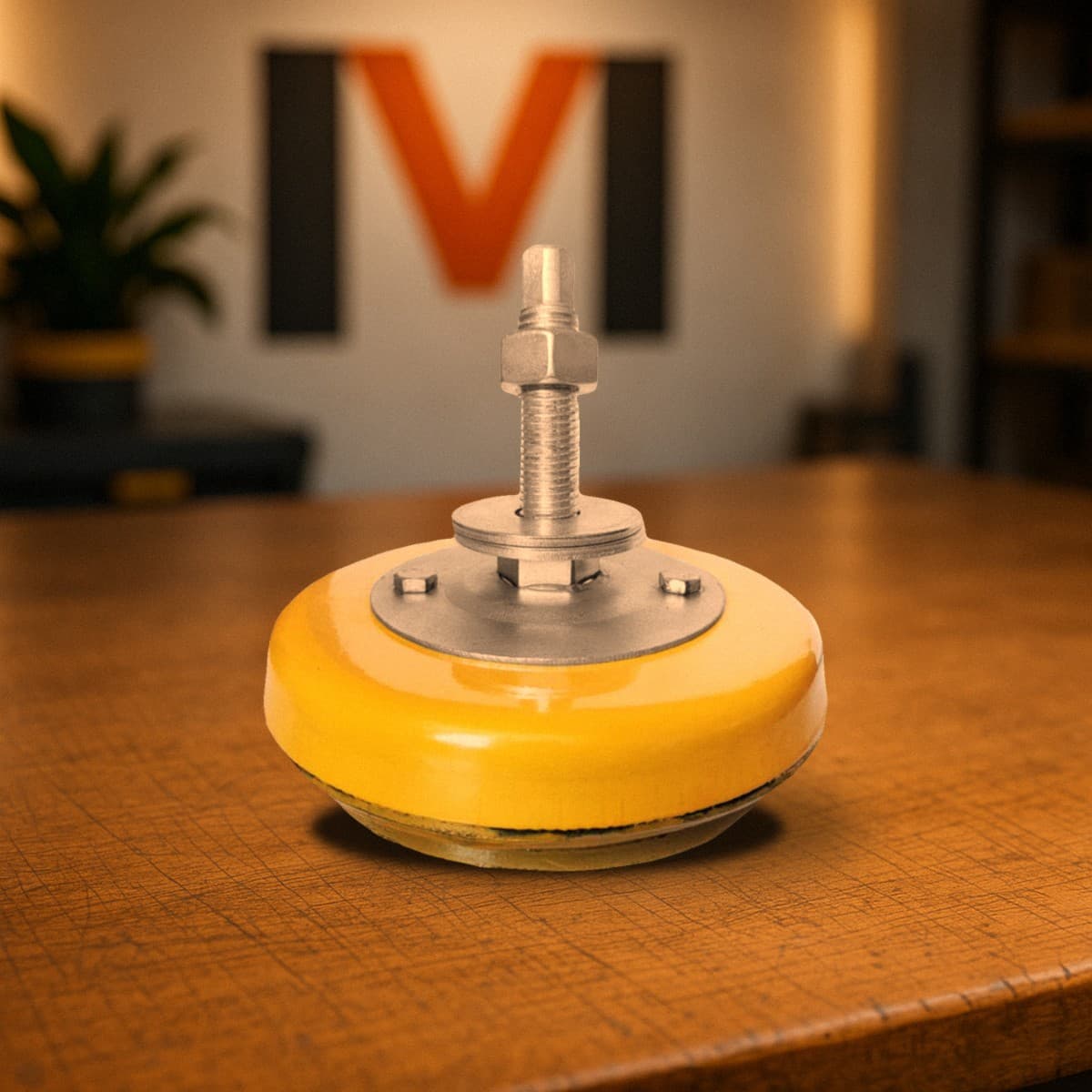
Hinged Vibration Mounts: When You Need Them and How to Choose
A hinged vibration mount is needed when the bearing surface of a machine foot is not parallel to the floor: a sloped floor, a welded or bent frame, cast feet without a machined face. The hinge between the stud and the body compensates a small angle, so the rubber pad sits on the floor with its full area. In our range the hinged IV M12 mounts and the OV-30sh type rubber-metal mounts are rated 40-250 kg per mount, i.e. for light and medium equipment; heavier machines need the rigid OV-31M (250-4500 kg).
What a hinged vibration mount is and how it differs from a rigid one
Every machine vibration mount is a rubber-metal unit: a steel body, a rubber pad that damps vibration, and a stud that goes through the hole in the machine foot; nuts on the stud are used to level the machine. General selection of type and size is covered in how to choose vibration mounts for machine tools; here we deal with one question only: rigid stud or hinged stud.
On a rigid mount (for example the OV M12 vibration mount or the OV-31M) the stud is fixed in the body and always stays perpendicular to the pad. If the machine foot sits at an angle to the floor, either the pad touches the floor with its edge, or the nut bears on the foot with one edge and bends the stud.
On a hinged mount the stud is connected to the body through a joint, so the angle between the stud and the pad can change. The pad lies flat on the floor and the stud follows the tilt of the foot. Isolation is the same: the rubber works in compression and the load is spread over the whole pad area.
Why it matters. A rubber pad performs as designed only when it presses on the floor with its full area. If it bears on its edge, the rubber is locally overloaded, the mount isolates worse, and the machine can gradually creep and lose its level.
When you need a hinged vibration mount
A hinged mount is not a just-in-case choice; it is chosen for a specific reason: the bearing face of the foot and the floor are not parallel. Typical cases:
An easy check: put a straightedge or level under the foot and measure the wedge gap with a feeler gauge. A 1 mm gap over 100 mm is an angle of about 0.6 degrees; a floor slope of 1 mm per metre is only about 0.06 degrees. In practice, the angle more often comes from the machine base than from the floor.
- Sloped floor: drains in the shop, old concrete that has settled, a joint between slabs.
- Welded frame or bent-sheet stand: after welding the support pads rarely lie in one plane parallel to the floor.
- Cast feet without a machined bearing face, with casting drafts.
- Light and medium equipment that is moved often: drill presses, grinders, small lathes, woodworking machines, pumps, compressors, fans.
- Equipment installed on mounts without anchor bolts, where you do not want to put wedges under every foot.
Comparison: hinged IV M12 and OV-30sh vs rigid OV M12 and OV-31M
Below are four mounts from our range with data from their technical descriptions. The two hinged ones - the IV M12 vibration mount and the hinged rubber-metal mounts of OV-30sh type to TU2-024-5997-87 - are rated for the same load range as the rigid OV M12.
The main difference between the three M12-class mounts is not the load but the stud mounting and the pad diameter. The heavy class is the rigid OV-31M only: we have no hinged mounts rated above 250 kg per mount.
| Parameter | IV M12 | Hinged OV-30sh | OV M12 | OV-31M |
|---|---|---|---|---|
| Stud mounting | hinged | hinged | rigid | rigid |
| Load per mount, kg | 40-250 | 40-250 | 40-250 | 250-4500 |
| Stud | M12 | M12 | M12 | M16 |
| Pad diameter, mm | 55 | 55 | 80 | 140 |
| Overall height, mm | 120 | 120 | 120 | 132 |
| Height adjustment | 12 mm | not stated, see passport | none | 12 mm |
| Mean vertical frequency | 20 Hz | 20 Hz | 20 Hz | 20 Hz |
| Price | from ~620 UAH excl. VAT | from ~620 UAH excl. VAT | from ~684 UAH excl. VAT | from ~1,085 UAH excl. VAT |
How to choose a hinged vibration mount: four steps
The procedure is the same as for any vibration mount, plus one angle check. How to calculate the load with uneven mass distribution is explained in how many vibration mounts a machine needs.
Example (illustrative): a 300 kg drill press on four feet gives about 75 kg per mount - inside the 40-250 kg range, so the IV M12 fits. A 1,400 kg milling machine on four feet gives about 350 kg per mount, above 250 kg, so it needs the rigid OV-31M vibration mount, and the foot angle is corrected with a packing plate or by machining the pad. A light 120 kg machine on four feet gives 30 kg per mount - below the 40 kg minimum: the rubber hardly compresses and isolation does not work as designed.
- Mass and number of support points. Take the mass from the machine passport, including tooling and the heaviest workpiece, divide by the number of mounts, and remember that a heavy headstock or motor loads its side more.
- Load range. The load on each mount must be inside the working range - not only below the maximum but also above the minimum. For IV M12 and OV-30sh it is 40-250 kg.
- Stud and foot hole. M12-class mounts have an M12 stud; check that the hole in the foot suits it and the foot thickness leaves room for the nuts.
- Angle between foot and floor. If the wedge gap is noticeable (see the check above), choose a hinged mount. The permissible hinge angle is not stated in the descriptions of our mounts, so with a large misalignment fix the cause first, and for unusual cases send photos of the feet via the quote request form.
Which vibration mount to choose for the job
The table below is a short summary. All four mounts are in the machine tool components section; always check the load per mount by calculation for your machine.
| Situation | What to choose | Why |
|---|---|---|
| Light machine, level floor, machined feet | OV M12 | no angle to compensate, 80 mm pad |
| Light or medium machine, feet not parallel to floor | IV M12 or OV-30sh | the hinge compensates a small angle |
| Welded frame: pump, compressor, fan | IV M12 or OV-30sh | frame pads rarely lie in one plane |
| Levelling needed on a hinged mount | IV M12 | 12 mm height adjustment stated in the description |
| Load per mount above 250 kg | OV-31M | 250-4500 kg range, M16 stud |
| Machine shifts during operation | OV-31M with fixator | the fixator holds the mount against shifting |
Typical mistakes when choosing hinged vibration mounts
Most problems with hinged mounts come not from the mount itself but from expecting it to do what it does not do. If you are unsure whether mounts are enough at all, read when vibration mounts are enough and when a foundation is needed.
- Confusing angle with height. The hinge compensates tilt, not the height difference between the corners of the machine. Height differences are taken up by stud adjustment (where available) or by levelling the floor.
- Going outside the load range. M12 hinged mounts are rated 40-250 kg; both overload and underload degrade performance.
- Mixing mount types under one machine. Different models have different pads and stiffness, so they settle differently and the level drifts.
- Using furniture or conveyor levelling feet with a swivel instead of vibration mounts. A plastic swivel foot levels but does not isolate: it has no rubber pad rated for the working load.
- Installing hinged mounts on a loose or broken floor surface. A mount does not replace a load-bearing floor.
- Not re-checking the level after run-in. The rubber settles slightly in the first days of operation, so the level and nut tightness are checked again.
Installation and checks after installation
Hinged mounts are installed the same way as rigid ones: place them under the feet, lower the machine, level it with the nuts on the studs and lock the nuts. The only difference: before tightening, make sure the pad lies on the floor with its full area and the hinge has followed the tilt of the foot rather than bearing on its edge. For the step-by-step procedure see how to install a machine on vibration mounts.
Take the specific installation and alignment requirements from the operating manual of your equipment: some manufacturers do not recommend installing their machines on vibration mounts. MELITA ships mounts with a VAT invoice, delivery across Ukraine or pickup in Dnipro. For heavy equipment on OV-31M that shifts during operation there is the OV-31M mount fixator. We also help choose the type and quantity by machine model or photo.
FAQ
What is the difference between a hinged and a standard vibration mount?
On a standard (rigid) mount the stud is always perpendicular to the pad. On a hinged mount the stud is joined to the body through a hinge and can tilt, so the pad lies flat on the floor even under a tilted foot.
Can a hinged mount level a machine on an uneven floor?
The hinge compensates a small tilt angle, not a height difference. Height is set by stud adjustment (up to 12 mm on the IV M12 per its description) or by levelling the floor.
What load does the IV M12 vibration mount take?
The working range is 40 to 250 kg per mount. The load must be inside the range: above the minimum and below the maximum.
How do the IV M12 and OV-30sh hinged mounts differ?
According to their descriptions both have an M12 stud, a 55 mm pad, 120 mm height and a 40-250 kg range. The IV M12 has 12 mm height adjustment stated; for the OV-30sh it is not stated.
Are hinged vibration mounts suitable for a heavy machine or a press?
Our hinged mounts are rated up to 250 kg per mount, i.e. for light and medium equipment. For heavier machines there is the rigid OV-31M rated 250-4500 kg; check in the equipment passport whether installation on vibration mounts is allowed.
Can hinged and rigid mounts be used under one machine?
Better not: different models have different pads and stiffness and settle unequally. Use mounts of one model under one machine.