Metal Milling Cutters: Types, HSS vs Carbide, Shanks and Machines
Milling cutters for metal are grouped by shape: end mills (slots, shoulders, contours), keyway cutters (keyseats with plunging like a drill), face mills (wide flat surfaces), side and slitting cutters (deep slots and cut-off on a horizontal arbor) and T-slot cutters (T-slots in tables and plates). On benchtop drill-mills with spindle speeds up to 2000-2500 rpm, high-speed steel (HSS, M2) cutters are usually the rational choice; carbide pays off on rigid, high-speed machines. Hold the cutter in a collet chuck or arbor on the spindle taper, never in a drill chuck.
Main types of milling cutters for metal
People searching for a metal milling cutter may mean either a metal milling machine or the cutter itself - a multi-tooth cutting tool. This article is about cutters. The cutter type decides which surface it produces and which spindle it runs on.
- End mill - teeth on the end and on the side. Used for slots, shoulders, pockets, contours and small flat areas. Comes with 2, 3, 4 or more flutes, as a ball-nose version for radii and 3D surfaces, and as a roughing end mill with chip-breaking serrations, nicknamed a corn-cob cutter.
- Keyway (slot drill) cutter - a two-flute end mill whose end edges reach the centre. It can plunge straight down like a drill and then feed sideways, which is how closed keyways in shafts are made. Its diameter is held to a close tolerance so the slot fits the key.
- Face mill - large diameter, cuts with its face. Either a solid shell mill or an indexable body with carbide inserts. Levels wide surfaces in one or two passes.
- Side and slitting cutter - a disc with teeth around the rim (slotting, side-and-face, slitting saw). Mounted on the arbor of a horizontal spindle; cuts deep slots, splines and parts off.
- T-slot cutter - a shank-type cutter whose head is wider than its neck. First an end mill cuts a straight slot, then the T-slot cutter forms the wide bottom. Dovetail cutters with a 45 or 60 degree angle belong to the same group - they cut slideways and the slots for them.
HSS or carbide cutter: which to choose
High-speed steel cutters (HSS, R6M5 in GOST terms, equivalent to AISI M2) are inexpensive, tough and forgive the vibration and backlash of a light machine. They can be resharpened. Cobalt versions (HSS-Co, such as M35) hold heat better and suit stainless and alloy steels. How to read these designations is explained in our article on steel grades and their designations.
Carbide cutters (solid or indexable) run at several times the cutting speed and machine hardened steel. But they are brittle: on a machine with play or chatter the edge chips. TiN, TiAlN and AlTiN coatings extend tool life. For aluminium, use 2-3 flute cutters with polished flutes, either uncoated or with a coating aluminium does not stick to.
The main practical limit is spindle speed. Speed is n = 1000 × Vc / (π × D). A 10 mm HSS end mill in structural steel runs at a cutting speed of about 20-30 m/min, which is roughly 650-950 rpm. Carbide in the same steel wants 80-150 m/min, or 2500-4800 rpm. Benchtop BF-series machines with 50-2250 rpm make full use of HSS, but small carbide cutters run short of speed there. Work out the numbers for your cutter with our speed and feed calculators.
Shanks, collet chucks and tool holding
A cutter only works as well as it is held: any runout in the holder costs accuracy and tool life. The most versatile option for straight-shank cutters is a collet chuck; collet types and sizing are covered in our article on ER collets and collet chucks. The main holding options:
- Straight shank - for end mills, keyway and T-slot cutters. Held in a collet chuck (the most common collets are ER25 for 1-16 mm and ER32 for 2-20 mm) or in a Weldon holder that clamps on a flat on the shank.
- Morse taper shank (MT2, MT3, MT4) - fits straight into the spindle or via a reducing sleeve, and must be pulled in with a drawbar, otherwise side load will knock the taper loose.
- Shell-type cutters (face mills, side and slitting cutters) have a bore and sit on an arbor: face mills on a short arbor in the spindle, disc cutters on the long arbor of a horizontal spindle.
- ISO40 (SK40) taper with an M16 drawbar is the standard on universal milling machines, with ready-made collet chucks and arbors available.
- A drill chuck is not for milling: it is not designed for side loads, the cutter runs out in it, and a chuck on a taper without a drawbar can drop out mid-cut.
Which cutter for which job and on which machine
The cutter sizes a machine can handle are listed in its manual as the maximum end-milling and face-milling diameters. Here is how it looks on models from our catalogue. Choose collet chucks, arbors and other machine accessories to match the spindle taper.
| Cutter | What it does | Holding | Machine |
|---|---|---|---|
| HSS end mill, 2-4 flutes | Slots, shoulders, pockets, contours | ER collet or Weldon | Any vertical; BF 20B up to 16 mm, BF 30B up to 20 mm |
| Keyway cutter, 2 flutes | Closed and open keyways | ER collet or Weldon | Vertical mill or drill-mill |
| Shell or indexable face mill | Wide flat surfaces | Arbor in the spindle taper | BF 20B up to 63 mm, BF 30B up to 76 mm, TMM110W up to 100 mm |
| Side and slitting cutter | Deep slots, splines, cut-off | Horizontal spindle arbor | Only a machine with a horizontal spindle, e.g. TMM110W |
| T-slot and dovetail cutter | T-slots, slideways | ER collet or Weldon | Vertical, after a straight pilot slot |
| Ball-nose end mill | Radii, fillets, 3D surfaces | ER collet | Vertical; CNC for true 3D work |
Milling cutters for a drill: what works and what does not
For drills and die grinders there are rotary burrs - small cutters with a 3-8 mm shank and teeth over the whole head. They deburr, open up and fit holes, and remove weld beads in awkward places. They are hand-held, so precision is out of the question, and they work better at die-grinder speeds than in a drill.
Clamping an end mill in a drill or a pillar drill and pushing the part around in a vice is a bad idea. Drill and pillar-drill spindle bearings are designed for axial load; side force wrecks them, a chuck on a taper can fall out, and the cutter snaps from runout. If you mill regularly, it is cheaper to buy a drill-mill straight away: it has a cross table with dials and a spindle built for side load.
Choosing cutters for your machine
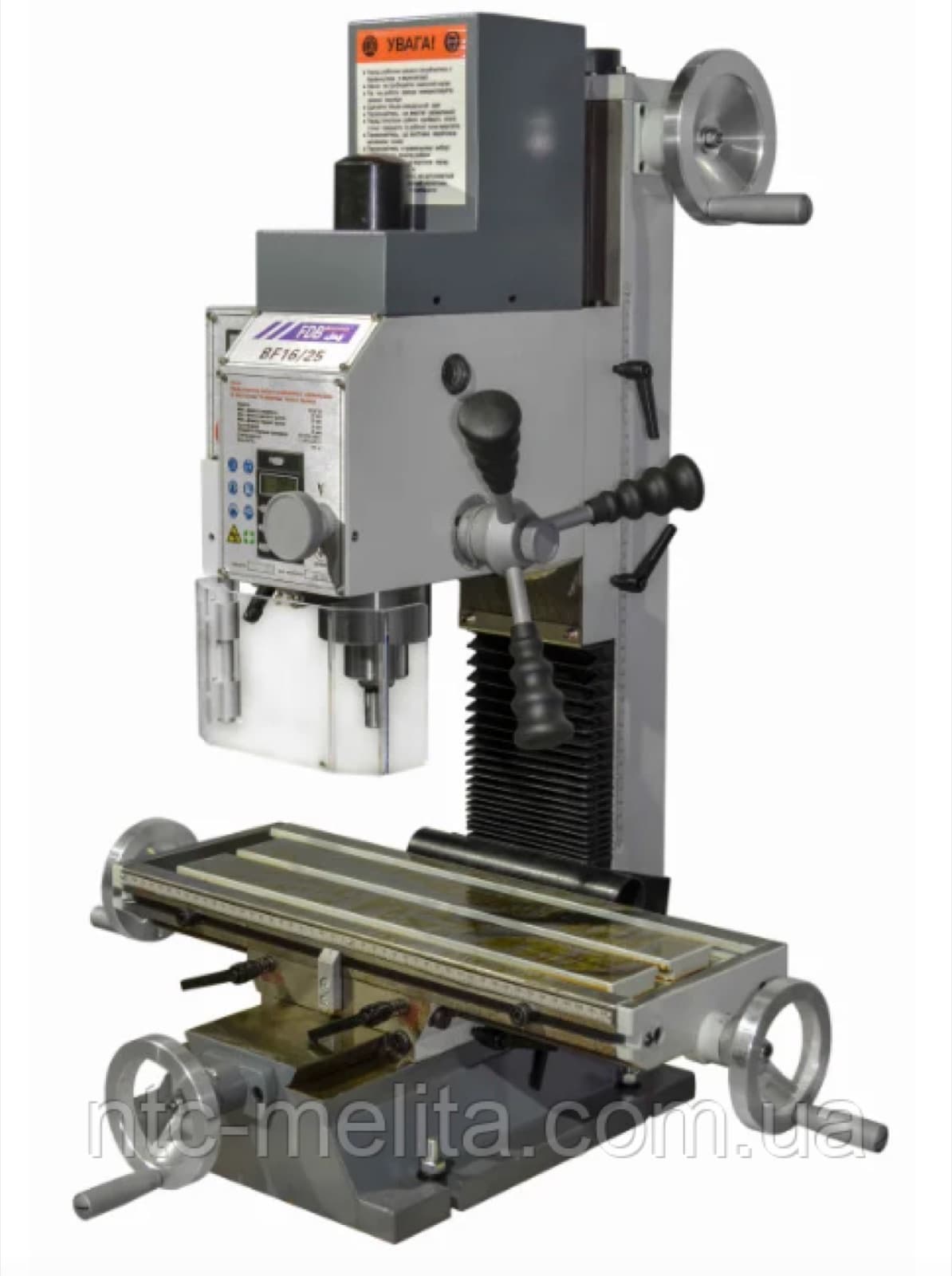
BF-series drill-mills have a vertical spindle with a Morse taper and an M12 drawbar. For the BF 20B (MT3, 1.1 kW, from ~83,000 UAH incl. VAT) and the BF 30B (MT3, 1.5 kW, from ~112,000 UAH incl. VAT), get an ER collet chuck on an MT3 shank and a set of 4-16 mm HSS end mills and keyway cutters - that covers most repair work. Disc cutters do not fit these machines: there is no horizontal spindle.
If you plan to run carbide, you need speed and rigidity. The BF45VH has a 2.2 kW brushless motor with two ranges, 70-700 and 300-4500 rpm, plus X-axis power feed - in the upper range a 10 mm carbide end mill in steel reaches its proper cutting speed.
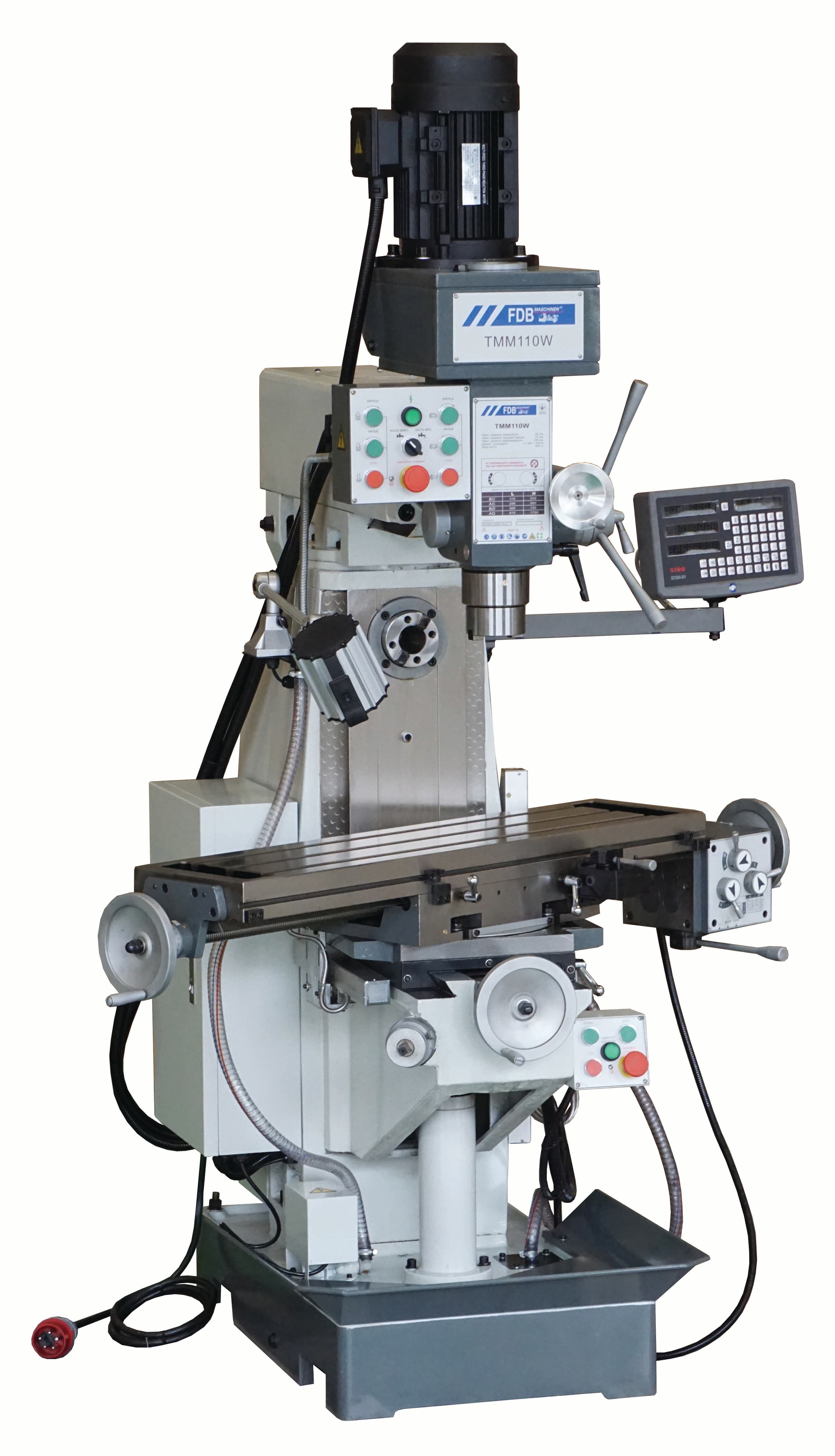
Disc cutters, splines and gears call for a universal machine with a horizontal spindle, such as the TMM110W (ISO40 taper, face milling up to 100 mm). For circular indexing it is paired with a UDG D-200 dividing head.
Workholding matters just as much. For milling, use machine vices with an accurate slideway, such as the 125 mm precision swivel vice (from ~7,100 UAH incl. VAT). Allow for the vice height in the spindle-to-table distance: on the BF 20B it is 330 mm, and with a vice and a long cutter the margin runs out quickly.
How not to break a cutter: typical mistakes
Most cutters broken on manual machines fail because of settings and holding, not defects. Cooling matters too: which fluid to use and how to apply it is in our article on cutting fluids for machine tools. Check yourself against this list:
- On a manual machine with leadscrew backlash, mill conventionally (feed against the cutter rotation). Climb milling can pull the table through the backlash and snap the cutter.
- Keep cutter stick-out to a minimum: rigidity drops very quickly as overhang grows.
- Take deep slots in several passes rather than full depth at once, especially on light machines.
- Use 2-3 flutes for slotting so the chips have room to escape; 4 or more flutes for side and finish milling.
- Lock the quill and any axes that are not moving - this kills chatter.
- Use coolant on steel; aluminium sticks to the teeth without lubrication, and a cutter with packed flutes breaks.
FAQ
What is the difference between an end mill and a keyway cutter?
A keyway cutter has two flutes with end edges reaching the centre, so it plunges vertically like a drill. An end mill with three or more flutes is usually not meant for straight plunging and works best on its side.
Which cutters suit a benchtop drill-mill?
HSS end mills and keyway cutters of 4-16 mm in an ER collet chuck, plus a small face mill within the manual's limit (up to 63 mm on the BF 20B). At up to 2250 rpm HSS is fully used, while small carbide cutters run short of speed.
Can I hold an end mill in a drill chuck or a hand drill?
No. A drill chuck and drill bearings do not resist side loads: the cutter runs out, and a chuck on a taper without a drawbar can drop out. Drills take rotary burrs for deburring; real milling needs a collet chuck on a milling machine.
Which is better: HSS or carbide?
On light, low-speed machines, HSS: it is tough, cheaper and can be resharpened. Carbide is for hardened steels and productive cutting on a rigid, high-speed machine.
Which end mill is right for aluminium?
A 2-3 flute cutter with large polished flutes and a sharp edge, uncoated or with a coating aluminium does not stick to. Run higher speeds than for steel, always with lubricant or coolant.
How do I mill T-slots?
First cut a straight slot to the neck width with an end mill, then form the wide bottom with a T-slot cutter. Both operations can be done on a vertical mill or a drill-mill.