Metalworking coolant (cutting fluid) for machine tools
Metalworking coolant (cutting fluid; in Ukrainian MOR or ZOR, in Russian SOZh) is fed into the cutting zone to cool the tool and workpiece, reduce friction, flush away chips and protect the metal from rust. For most work on lathes, milling machines and band saws a water-based emulsion or semi-synthetic fluid at roughly 3-10% concentration is used, with the exact value taken from the concentrate's data sheet. Tapping and heavy cutting are better served by a straight (neat) cutting oil, while cast iron and brass are often machined dry.
What a cutting fluid does
Almost all cutting work turns into heat. Without cooling the edge overheats and dulls, the part grows off size and chips weld onto the tool. A coolant does several jobs at once; which one matters most on an operation decides the fluid.
- Cooling: the fluid carries heat away from the cut, the tool lasts longer and the part holds its size better.
- Lubrication: a film between the chip and the tool face reduces friction and built-up edge, giving a cleaner finish.
- Chip removal: the stream flushes chips out of the hole, slot or saw kerf so they are not recut.
- Corrosion protection: additives protect the part, the table and the machine ways from rust between operations.
Coolant types: soluble oil, semi-synthetic, synthetic, straight oil
Metalworking fluids are either water-miscible (concentrate diluted with water) or neat (oil used as supplied). Water-based fluids cool better, oils lubricate better. Check each concentrate's data sheet for its intended use.
- Emulsion (soluble oil, mineral concentrate): mineral oil with emulsifiers that turns milky white in water. Versatile, lubricates well, suits turning, milling, drilling and sawing.
- Semi-synthetic: less oil, more synthetic components, a translucent fluid. More stable, lasts longer in the sump, cools better and works well on both steel and aluminium.
- Synthetic: almost oil-free, a clear solution. The best at cooling and cleaning, which is why it is often used for grinding; lubricity is lower.
- Straight cutting oil (neat oil): for tapping, reaming, broaching, gear cutting and heavy cutting of tough steels, where lubrication is what counts. It cools less and smokes more when overheated.
Which fluid for which operation and material
The table shows general practice. Check a concentrate for compatibility with your materials (especially aluminium and non-ferrous metals) and the machine's paint and seals. Work out cutting data in the spindle speed and feed calculator: with coolant the speed can usually be higher than dry.
Dry machining is fine when fluid does more harm than good: cast iron produces dust and fine chips, and its graphite lubricates the cut; brass and plastics cut well without coolant; when milling with carbide inserts in an interrupted cut, uneven cooling causes thermal cracking, so either run dry with an air blast or use a heavy, continuous flood.
| Operation / material | Usual choice | Note |
|---|---|---|
| Turning and milling structural steel | Emulsion or semi-synthetic | Flood at the cutting zone |
| Stainless steel, tough alloys | Richer emulsion or semi-synthetic with EP (extreme pressure) additives | Lubrication matters, less built-up edge |
| Aluminium, copper | Semi-synthetic or emulsion safe for non-ferrous metals; mist lubrication | Prevents material sticking to the edge |
| Cast iron, brass | Often dry with dust extraction; or synthetic | Emulsion plus cast iron dust makes sludge |
| Grinding | Synthetic or semi-synthetic | Cooling and a clean wheel |
| Band sawing | Emulsion or semi-synthetic | Longer blade life |
| Tapping, reaming | Cutting oil or paste, applied by brush | Thread finish and tap life |
| Carbide milling with interrupted cut | Dry with air blast, or heavy flood | Risk of insert thermal cracks |
Emulsion concentration and how to mix the concentrate
Typical working concentration of water-based coolants is 3-10%: lower for grinding and light machining, higher for heavy cutting, stainless steel and threading. Follow the exact range in the concentrate's data sheet: too lean a mix protects poorly against rust and goes off faster, too rich a mix foams, irritates skin and leaves a sticky film.
- Pour the concentrate into the water while stirring, not water into the concentrate, otherwise the emulsion may split.
- Use clean water; very hard water reduces emulsion stability, very soft water tends to foam.
- Check concentration with a refractometer: multiply the reading by the concentrate maker's factor.
- Water evaporates from the sump, so concentration creeps up over time; top up with a ready mix of lower concentration, not plain water or neat concentrate.
How to apply coolant: flood, mist, brush
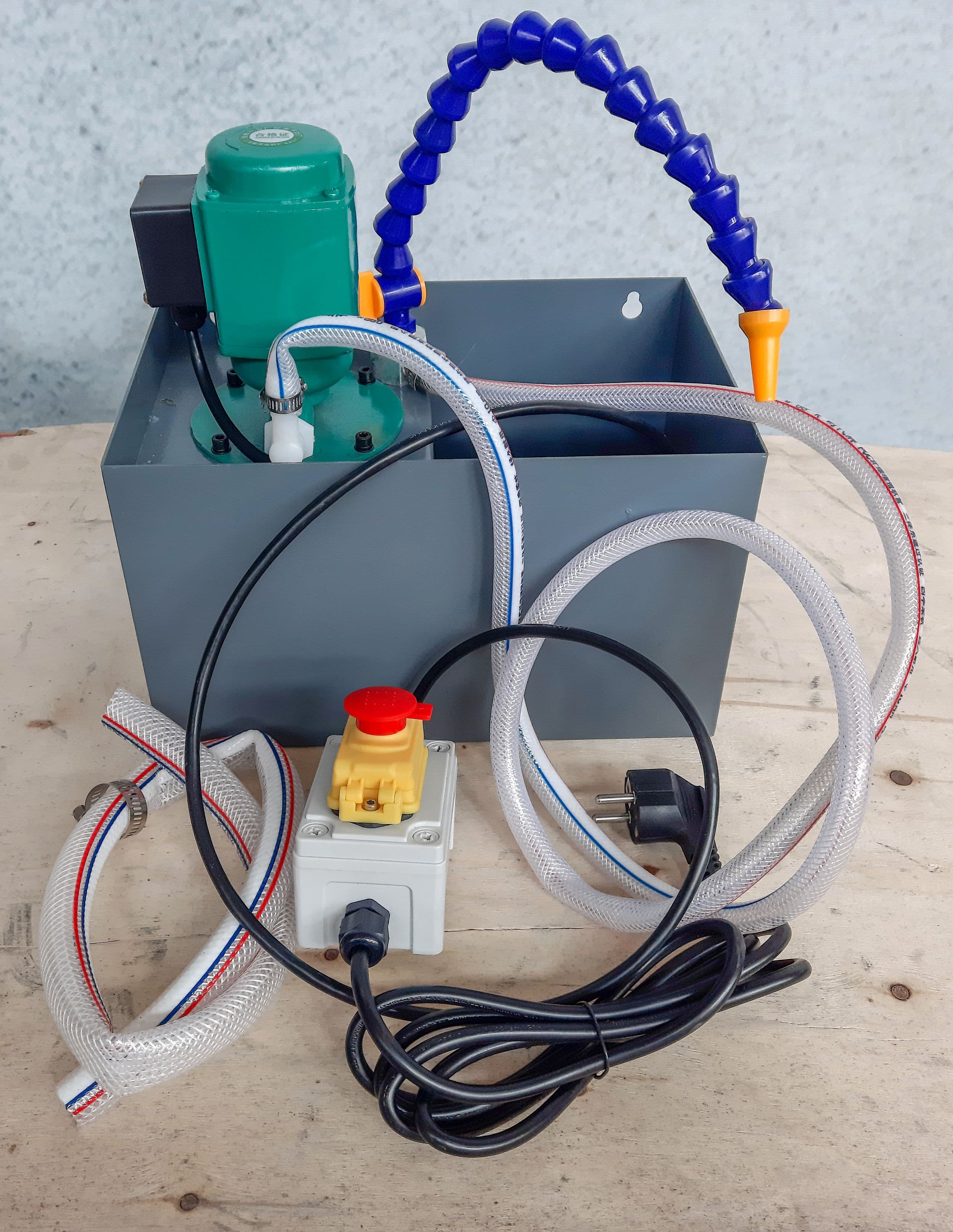
The most common method is flood coolant: a pump in the tank feeds a hose and nozzle, and the fluid drains into the chip tray and back to the tank through a screen, as on lathes, milling machines and band saws. Mist lubrication (air with a small amount of fluid) is handy on milling machines and for aluminium where there is no tray, but it needs extraction. A brush or oil can is for tapping and one-off parts.
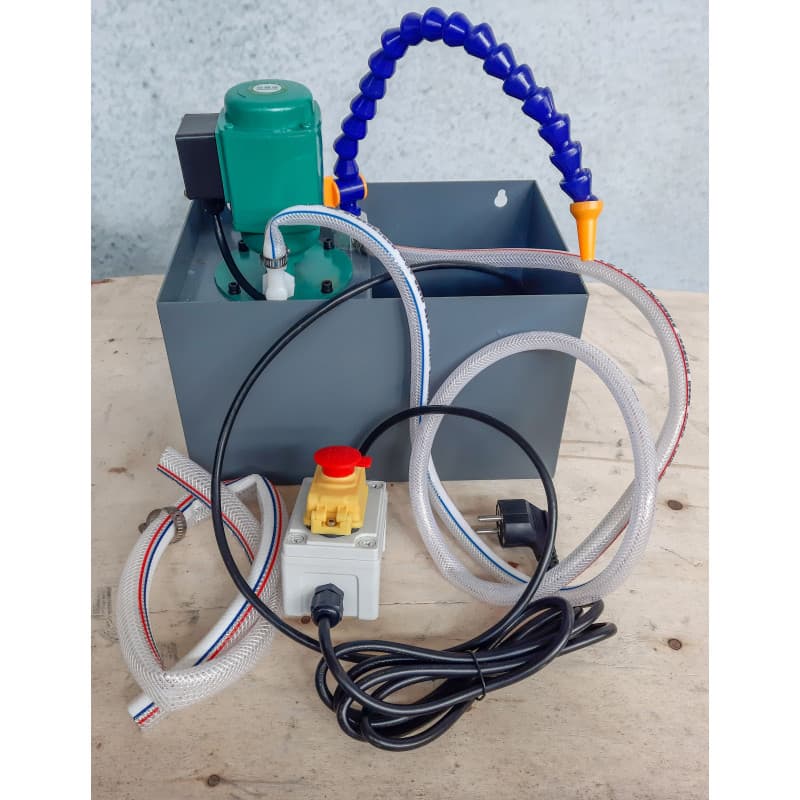
If a machine has no built-in coolant or it has failed, fit a ready coolant system: tank, pump and hose with nozzle. All systems below are in machine parts and accessories, with a 12-month warranty; prices are rounded and include VAT.
For a bench lathe or milling machine on a 220 V supply, the Optimum KME 1 fits: 11 l tank, 8 l/min pump, 2.5 m delivery head, 3/8" hose on a magnetic base. The FDB Maschinen CB13L/230V is made for band saws, lathes, milling and drilling machines; for a shop with three-phase power there are the CB13L/380V and CB13L/400V. Ask our manager for the CB13L flow rate and tank volume. For a large machine with its own sump there is a coolant pump with up to 15 m head, a replacement for the P-125M and P-200M.
| Model | Power supply | Known specs | Price incl. VAT |
|---|---|---|---|
| Optimum KME 1 | 230 V | 11 l tank, 8 l/min, up to 2.5 m head | ~8 900 UAH |
| FDB CB13L/230V | 230 V | Band saws, lathes, milling, drilling machines | ~9 900 UAH |
| FDB CB13L/380V | 380 V | Same, three-phase | ~11 900 UAH |
| FDB CB13L/400V | 400 V | Same, three-phase | ~9 900 UAH |
| Coolant pump, up to 15 m | - | Centrifugal, 100 l/min, cast iron body, viscosity up to 100 mm²/s | ~18 900 UAH |
Coolant maintenance, replacement and safety
Chips, oil from the ways and hydraulics, dust and bacteria all get into the sump. Regular care extends fluid life and costs less than frequent changes. Flood coolant comes as standard on lathes, metal milling machines and band saws.
- Once a shift or several times a week, check concentration with a refractometer and, if needed, pH with test strips as per the concentrate data sheet.
- Skim tramp oil off the sump surface: it cuts off air and feeds bacteria.
- A rotten-egg smell, especially after a weekend, means bacteria are multiplying; during downtime it helps to run the circulation now and then.
- Replace the fluid if smell and foam persist, the emulsion has split or parts start to rust; before refilling, clean sludge out of the tank, tray and hoses.
- Safety: wear gloves or barrier cream, wash hands with soap and water, not solvent; flood and mist need ventilation and a guard, and spent coolant goes to a waste disposal service, not down the drain.
FAQ
What are MOR, ZOR and SOZh?
They are all names for metalworking coolant. MOR and ZOR are the Ukrainian abbreviations, SOZh is the Russian one, still common in search.
What emulsion concentration does a lathe need?
Usually 3-10%: toward the lower end for light machining, toward the upper end for heavy cutting and stainless steel. Check the exact range in your concentrate's data sheet and verify it with a refractometer.
Can I use water or motor oil instead of coolant?
No. Plain water rusts the part and the machine, and used motor oil smokes, cools poorly and is not meant for skin contact.
Why does the emulsion in the sump smell, and what should I do?
Bacteria, usually fed by tramp oil, low concentration and standing without circulation. Skim the oil and restore concentration; if the smell stays, clean the system and refill.
How do I add coolant to a machine that has none?
Fit a separate coolant system: a tank with pump, a hose with nozzle and a tray to return the fluid. The model is chosen by supply voltage and machine size; send your machine model through the quote request form and MELITA will suggest an option with a VAT invoice and delivery across Ukraine.