Taps and dies: how to cut threads by hand and on a machine
A tap cuts an internal thread in a hole, a die cuts an external thread on a rod. By hand: drill the tap hole (6.8 mm for M8, 8.5 mm for M10), set the tap square to the hole and turn it with a tap wrench and lubricant, half a turn forward and a quarter back; a die is run onto a rod 0.1-0.2 mm below the nominal size. For batches of holes use a drill press with spindle reverse, a tapping head or a tapping machine.
Taps and dies: what each one cuts
A tap is a hardened screw with lengthwise flutes and a tapered cutting lead. It cuts the internal thread in a hole for a bolt or stud. A die is a ring with an internal thread and chip holes; it cuts the external thread on a rod, pipe or stud.
Both are marked the same way: M8x1.25 means a metric thread 8 mm in diameter with a 1.25 mm pitch. If no pitch is given (just M8), coarse pitch is meant. Fine pitch is always written out (M8x1) and needs a different drill, so before buying check the pitch against the drawing or the metric thread chart.
Types of taps: hand tap sets, machine taps, forming taps
Hand taps are sold in sets of two or three. The first (roughing) tap has the longest lead and removes most of the metal, the last (finishing) one forms the full profile. The number is marked by rings on the shank: one ring for the first, two for the second. Hand taps are turned with a tap wrench that grips the square shank.
Machine taps cut the thread in a single pass and are held in a chuck, tapping head or collet. Choose them by hole type: spiral point (gun) taps for through holes push the chips ahead, spiral flute taps for blind holes lift the chips out. Straight flutes are the general choice for cast iron and short-chipping materials.
A forming tap (roll tap) does not cut but displaces the metal, so there are no chips at all. The thread is stronger, but it needs a larger hole than a cutting tap and only works in ductile materials: aluminium, copper, brass, low-carbon and stainless steel. It is not suitable for cast iron or hardened steel.
| Tap type | How to recognise | Holes | Where it works |
|---|---|---|---|
| Hand tap set (2-3 pcs) | Rings on the shank, square for a wrench | Through and blind, single holes | By hand, repair, assembly |
| Machine tap, straight flutes | Straight flutes, short lead | Through, cast iron, brass | Machine, tapping head |
| Machine tap, spiral point | Angled grind at the start of the flutes | Through, steel | Machine, batches |
| Machine tap, spiral flute | Helical flutes like a drill | Blind, gummy materials | Machine, batches |
| Forming tap (roll tap) | Lobed profile, no flutes | Through and blind | Machine, ductile metals |
Tap drill size and rod diameter for a die: chart M3-M16
For a standard cutting tap with coarse pitch the drill size is roughly nominal diameter minus pitch: M6 - 5 mm, M8 - 6.8 mm, M10 - 8.5 mm. A forming tap needs a larger drill, roughly nominal minus half the pitch; the exact value is in the maker's catalogue. For fine pitch and non-standard sizes use the tap drill calculator.
The rod for a die is turned 0.1-0.2 mm below nominal: at full diameter the die runs tight, tears the thread crests and can crack. Chamfer the rod end so the die starts square. The die outside diameter in the chart is typical and sets the size of the die stock.
| Thread | Pitch, mm | Tap drill, mm | Forming tap drill, mm | Rod for die, mm | Die OD, mm |
|---|---|---|---|---|---|
| M3 | 0.5 | 2.5 | 2.8 | 2.90-2.95 | 20 |
| M4 | 0.7 | 3.3 | 3.7 | 3.85-3.90 | 20 |
| M5 | 0.8 | 4.2 | 4.6 | 4.85-4.90 | 20 |
| M6 | 1.0 | 5.0 | 5.5 | 5.80-5.90 | 20 |
| M8 | 1.25 | 6.8 | 7.4 | 7.80-7.90 | 25 |
| M10 | 1.5 | 8.5 | 9.3 | 9.80-9.85 | 30 |
| M12 | 1.75 | 10.2 | 11.2 | 11.75-11.85 | 38 |
| M16 | 2.0 | 14.0 | 15.0 | 15.75-15.85 | 45 |
How to tap a thread by hand: step by step
Clamp the part firmly, preferably in a bench or machine vise, hole facing up. The key requirement in hand tapping is alignment: a tap tilted by 2-3 degrees gives a crooked thread and is the most common way to break one.
In a blind hole drill about 3-5 pitches deeper than the thread, because the tap lead does not cut a full profile. Clear chips from a blind hole several times during the job.
- Drill with the size from the chart and countersink a 90-degree chamfer to the major thread diameter - the tap starts more easily and the first thread does not burr.
- Lubricate tap No. 1 and set it in the hole, pressing lightly along the axis with the wrench.
- After 2-3 turns check with a square from two sides that the tap is perpendicular. Misalignment can be corrected now, not later.
- Turn half a turn forward and a quarter back to break the chip. Apply even force with both hands and no side load.
- If the tap gets tight, do not force it: back it out one turn, clear the flutes and add lubricant.
- Run tap No. 2 through, then No. 3 if the set has one. Start each next tap by hand in the threads already cut.
- Blow out the hole and check the thread with a bolt or a plug gauge.
How to cut a thread with a die: die stock and sets
The die goes into a die stock (die holder) and is locked with screws. The die stock is chosen by die outside diameter, not by thread: M3-M6 dies are usually 20 mm, M8 - 25 mm, M10 - 30 mm, M12 - 38 mm. One face of the die has a longer lead chamfer; that side goes onto the rod first.
Clamp the rod vertically with the chamfered end up. Hold the die strictly square and turn it like a tap: half a turn forward, a quarter back, with lubricant.
A tap and die set pays off for a maintenance crew that needs many sizes in small amounts. For production work it is more practical to buy good taps of the common sizes (M6, M8, M10, M12) separately: they wear first and have to be replaced in a set anyway.
- What a set should contain: coarse-pitch taps and dies M3-M12, a tap wrench, die stocks for 20, 25 and 30 mm dies.
- Material: HSS for structural steel, HSS-Co (cobalt) for stainless and gummy steels. Carbon tool steel is only good for soft metals and occasional threads.
- A die stock should have three screws: the centre one spreads a split die and allows slight adjustment of the thread size.
- Check a cheap set before use: cutting edges should be sharp and free of chips, the die thread free of burrs.
Machine tapping: drill press, tapping head or tapping machine
With dozens of holes, hand tapping becomes the bottleneck. The simplest route is a drill press with spindle reverse: the tap enters at low speed and at the required depth the operator reverses the spindle to back it out. The OPTIdrill D 33Pro drill press has such a reverse (from ~62 000 UAH incl. VAT).
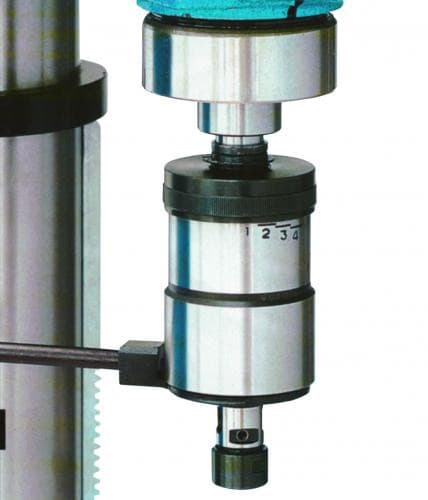
Without a reverse, fit a tapping head such as the PROMA ZH-5M12 into the spindle (from ~19 100 UAH incl. VAT): threads M5-M12, mounting via a B16 taper and a Morse taper 4 arbor. Heads like this are usually designed for machines without spindle reverse, but confirm that in the head's passport. Its safety clutch slips when the tap bottoms out and saves it from breaking.
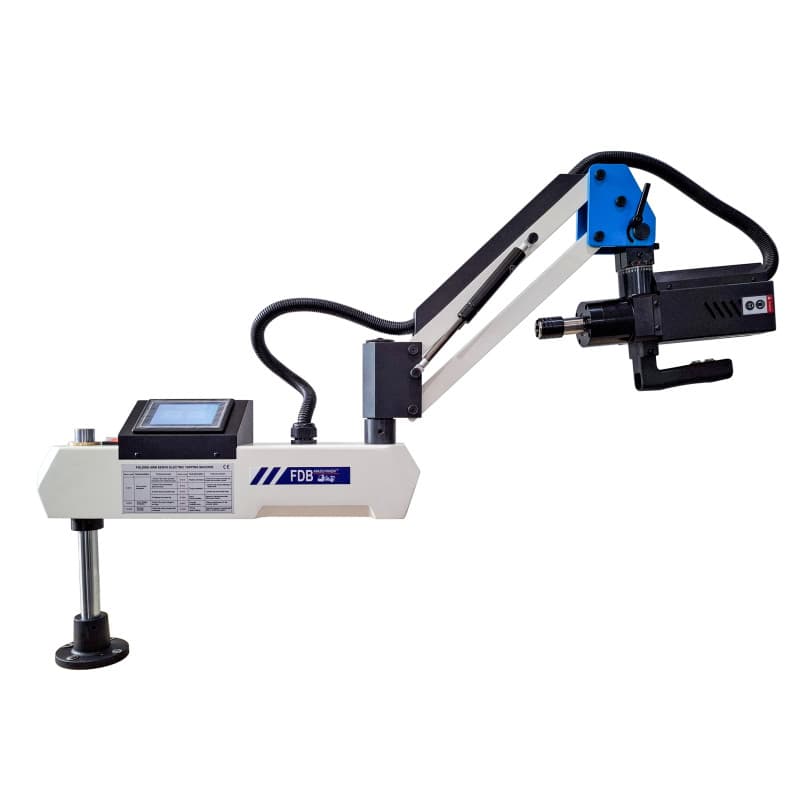
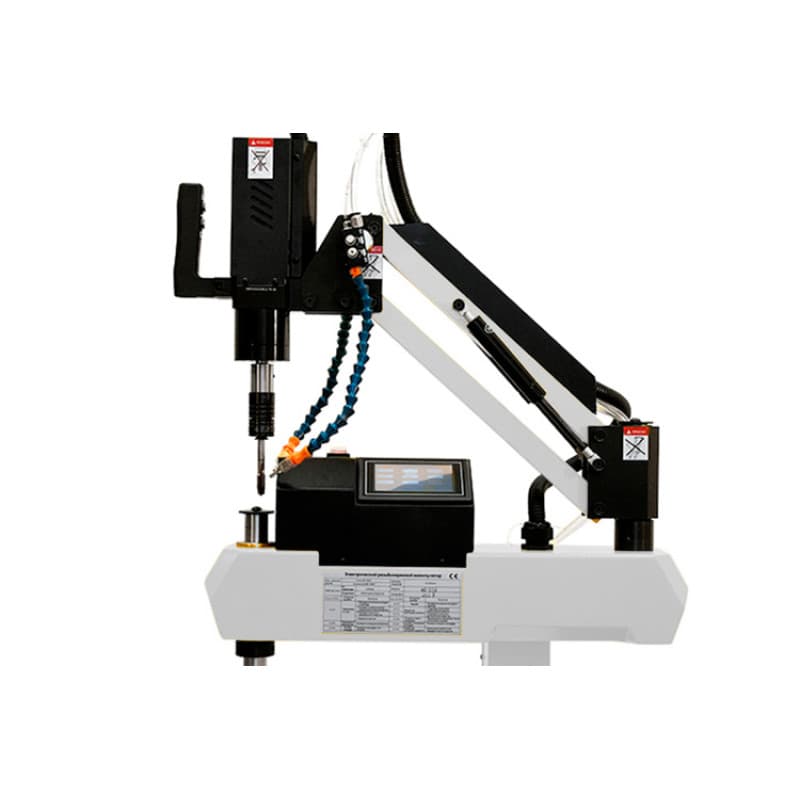
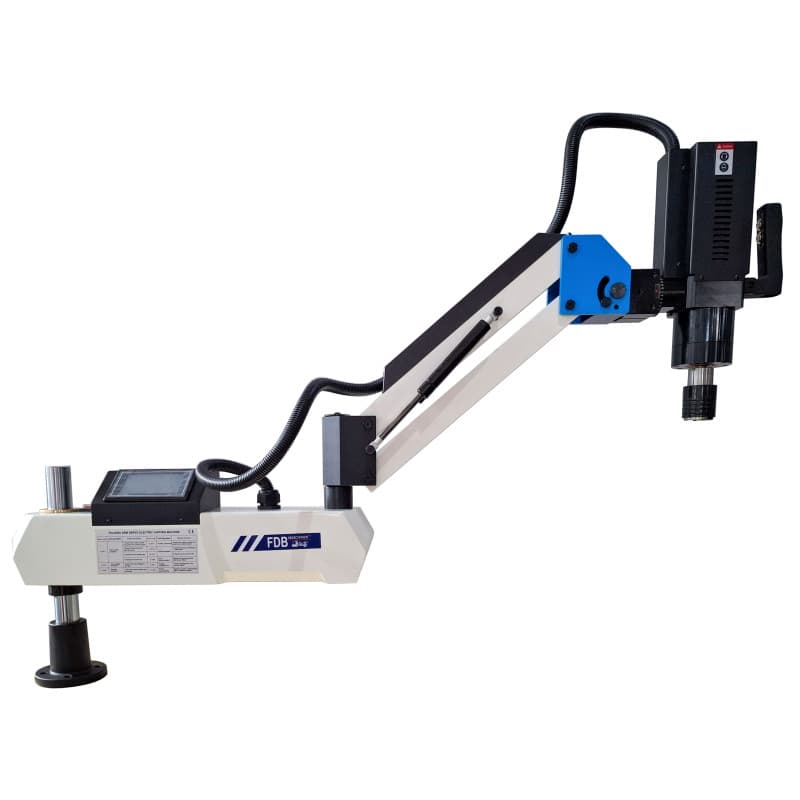
For batches and large housings there is a separate class - tapping machines with an articulated arm and servo drive: the operator guides the head to the hole, depth and reverse are controlled electronically. The FDB Maschinen DS16 taps M3-M16 with an 1100 mm arm reach, the DS24 goes up to M24 and has lubricant spray with air blow (needs a compressor).
All models are in the tapping machines section, and how to choose between them by thread size, reach and material is covered in how to choose a tapping machine.
| Job | What to use | Thread range | Price |
|---|---|---|---|
| Single threads, repair | Hand tap sets, tap wrench | Any | Hand tools |
| Small batches on a drill press | Drill press with spindle reverse | Depends on the model, see the manual | From ~62 000 UAH incl. VAT (D 33Pro) |
| Batches, machine without reverse | Tapping head ZH-5M12 | M5-M12 | From ~19 000 UAH incl. VAT |
| Batches, housings, large parts | DS16 / DS16L (arm 1100 / 1500 mm) | M3-M16 | From ~51 000 / ~58 000 UAH incl. VAT |
| Large threads, heavy parts | DS24 / DS36 | M6-M24 / M6-M36 | From ~73 000 / ~77 000 UAH incl. VAT |
Thread cutting lubricant and typical mistakes
Lubricant cuts friction and heat and stops metal from welding onto the tap. For steel use dedicated tapping pastes or oils, for stainless - pastes with extreme-pressure additives, for aluminium - kerosene or light oil; cast iron and brass are often tapped dry. On a machine coolant works too - see coolant for machine tools for types and delivery.
Most broken taps and stripped threads come down to one of six causes, and all of them can be removed before you start.
- Drill too small: the tap is overloaded, the thread is tight, the tap breaks. Check the drill against the chart, especially for fine pitch.
- Tap or die not square: crooked thread, torn crests, breakage. Check with a square after the first turns.
- Chips not broken or cleared: the tap jams, especially in a blind hole. Reverse regularly and clean the hole.
- Tap bottoming in a blind hole: drill 3-5 pitches deeper and set a depth stop on the machine.
- Tapping steel dry: built-up metal, galling, fast wear. Always lubricate, except cast iron and brass.
- Worn or cheap soft-steel tap: it crushes the threads instead of cutting. Replace taps of common sizes as soon as the torque goes up.
Broken tap in the hole: what to do
An HSS tap is hardened, so an ordinary drill will not cut it - do not try to drill it out, you will only ruin the hole. First see whether the broken piece sticks out, and soak it with penetrating oil.
The method depends on where the piece sits and what the part is made of.
- Piece sticks out: carefully turn it back with pliers or a tap extractor, whose fingers go into the flutes. Rock it back and forth in small steps.
- Piece flush with the surface in a through hole: HSS is brittle, it can be shattered with a punch and picked out in pieces.
- Valuable part: EDM (spark erosion) removes the piece without damaging the thread around it. Repair and tool shops offer this.
- Aluminium part: etching in a hot potassium alum solution is sometimes used - the steel dissolves, aluminium barely does. It takes hours.
- Thread damaged: drill out for the next size up or fit a wire thread insert of the same nominal size.
FAQ
What drill size for an M6, M8, M10, M12 tap?
For coarse pitch: M6 - 5.0 mm, M8 - 6.8 mm, M10 - 8.5 mm, M12 - 10.2 mm. Fine pitch and forming taps need different sizes - see the chart above or the tap drill calculator.
What is the difference between taps No. 1, No. 2 and No. 3?
The first is a roughing tap with a long lead that removes most of the metal; the last is the finishing tap that forms the full profile. The number is marked by rings on the shank, and the taps are run in order.
What rod diameter do I need for an M8 die?
7.8-7.9 mm, i.e. 0.1-0.2 mm below nominal, with a chamfer on the end. At a full 8 mm the die runs tight and tears the thread.
What die stock do I need for an M10 die?
Die stocks are sized by die outside diameter: usually 30 mm for M10, 25 mm for M8 and 20 mm for M3-M6. It is best to measure the die itself.
Can I tap threads on a drill press?
Yes, if the drill press has spindle reverse or is fitted with a tapping head with a safety clutch. Use low speed and machine taps.
What should I do if a tap breaks?
Do not drill it with an ordinary drill. A protruding piece is backed out with a tap extractor, a flush piece is shattered with a punch, and in valuable parts it is removed by EDM.