Metal Drill Bits: How to Choose HSS, Cobalt or Carbide
For structural steel, cast iron and aluminium a ground HSS drill (M2, marked HSS-G) with a 118-135° point angle is enough. For stainless and alloy steel use cobalt HSS-Co drills (5-8% cobalt) with a 135° point and lower speeds. Carbide pays off only on a rigid machine with coolant, and drills above 13-16 mm usually have a Morse taper shank that fits straight into the drill press spindle.
Types of metal drill bits and where they are used
A metal drill usually means a twist drill: two flutes, two cutting lips and a chisel edge at the tip. Other shapes suit other jobs, and mixing them up spoils holes.
A step drill only works in thin material: the sheet must not be thicker than one step (check the maximum thickness for your particular drill), otherwise the hole gets a shoulder. For large holes in thick plate and beams annular cutters are better - they cut only a ring instead of the whole volume of metal.
The most practical workshop drill set is 19 pieces from 1 to 10 mm in 0.5 mm steps, or 25 pieces up to 13 mm. Tap drill sizes (6.8 mm for M8, 8.5 for M10, 10.2 for M12) wear out first, so keep spares, and get the exact size for any thread from the tap drill calculator.
- Stub length twist drill (DIN 1897) - the stiffest, wanders least, good for hand drilling and hard materials.
- Jobber length twist drill (DIN 338) - the main working type for holes up to 3-5 diameters deep.
- Long series (DIN 340) - for deep holes; bends more easily, so needs lower feed and frequent chip clearing.
- Step drill - for thin sheet, box section and enclosures: one bit makes holes of several diameters.
- Centre drill - for an accurate hole start on a machine so the twist drill does not wander.
- Annular cutter - for holes from 12 mm in plate and beams, mostly on magnetic drills.
Drill material: HSS, cobalt HSS-Co or carbide
The material decides how many holes a drill will make and in which metal. Almost all metal drills are high-speed steel, HSS (M2, Р6М5 in post-Soviet standards). It stays hard up to about 600 °C, so in ordinary steel at moderate speed it works even without flood coolant.
Cobalt drills (HSS-Co, HSS-E, M35/M42) contain 5-8% cobalt. Cobalt raises heat resistance: the edge holds where plain HSS turns blue and dulls. Carbide (tungsten carbide) is harder still and allows several times higher cutting speed, but it is brittle: spindle runout or a shifting workpiece chips the edge.
"HSS" on the shank with no grade and no standard most often means a cheap roll-forged drill. For machine work buy fully ground drills marked with a standard (DIN 338) and grade. Relative prices below are approximate, base = ground HSS of the same size.
| Type | Marking | Colour (usually) | Use | Relative price |
|---|---|---|---|---|
| Roll-forged HSS | HSS-R | black | mild steel, occasional holes with a hand drill | below base |
| Ground HSS | HSS-G, M2, Р6М5 | bright or gold (TiN) | structural steel, cast iron, aluminium, brass | base, ×1 |
| Cobalt 5% | HSS-Co5, HSS-E, M35, Р6М5К5 | amber, bronze | stainless, alloy and hardened-and-tempered steel | ×1.5-2 |
| Cobalt 8% | HSS-Co8, M42 | amber | heat-resistant steels, production drilling of stainless | ×2-3 |
| Solid carbide | VHM, HM, Carbide | matte grey, often TiAlN coated | production on a rigid machine with coolant, hardened steel | ×5-10 and more |
Coating and colour: black, gold and bronze drill bits
Colour shows how the drill was finished, not its quality:
So, black or gold? In structural steel a ground TiN-coated drill lasts longer than a black roll-forged one, while in stainless both lose to cobalt. A gold colour without an HSS-G marking or a standard may be just a decorative layer.
- Black (black oxide, steam tempering) - a thin film against corrosion and chip welding. Typical of roll-forged HSS-R. The film does not add hardness.
- Bright - ground HSS without coating. Accurate edges, easy to resharpen.
- Gold TiN (titanium nitride) - a hard coating that reduces friction and wear. Sharpening removes it from the flanks, so part of the benefit is lost.
- Amber or bronze - usually the temper colour of cobalt steel, not a coating. Do not confuse it with TiN: check the shank marking.
- Violet-grey TiAlN (AlTiN) - a coating for carbide and high-speed work, stands higher temperatures than TiN.
Point angle 118 or 135 degrees and point geometry
The point angle is the angle between the two main cutting lips. The standard 118° is a universal grind for structural steel, cast iron and non-ferrous metals. It bites easily into soft metal, but without a centre punch mark it walks on the surface.
135° is used on drills for harder materials - stainless and alloy steel. The lips are shorter and stronger, and with a split point (form C per DIN 1412) the drill centres itself and needs noticeably less thrust. For hand drilling sheet metal, 135° split point is the most convenient choice.
For brass and bronze, grind the rake on the lips down to zero, otherwise the drill grabs on breakthrough. How to set the angles by hand or on a machine is covered in how to sharpen a drill bit.
If a shop dulls a dozen drills per shift, resharpening beats buying new ones. That is what drill bit sharpening machines are for; the simplest Opti GQ-D13 costs from ~2,900 UAH incl. VAT. It sharpens 3-13 mm drills at a fixed 118° point only; a 135° point has to be ground another way.
Shank: straight or Morse taper, and which machine
Drills up to 13-16 mm usually have a straight shank and go into a chuck. A chuck holds by friction, so a large drill under load spins and damages the shank. Most hand drills have a 13 mm chuck, bench drill presses 13 or 16 mm.
Larger drills have a Morse taper shank (DIN 345). The taper goes into the spindle directly or via a sleeve: more torque, no chuck runout. Taper and sleeve sizes are in the Morse taper table.
Before buying a 20 mm drill, check two figures in the machine manual: maximum drilling diameter in steel and spindle taper. A 20 mm hole in steel is beyond a hand drill or a 16 mm bench drill: you need a machine rated for 20 mm or more in steel, for example the floor-standing FDB Maschinen Drilling 25/380V (25 mm in steel, MT3 spindle, 380 V) from ~21,500 UAH incl. VAT. A 20 mm drill has an MT2 shank, so it fits an MT3 spindle through an adapter sleeve.
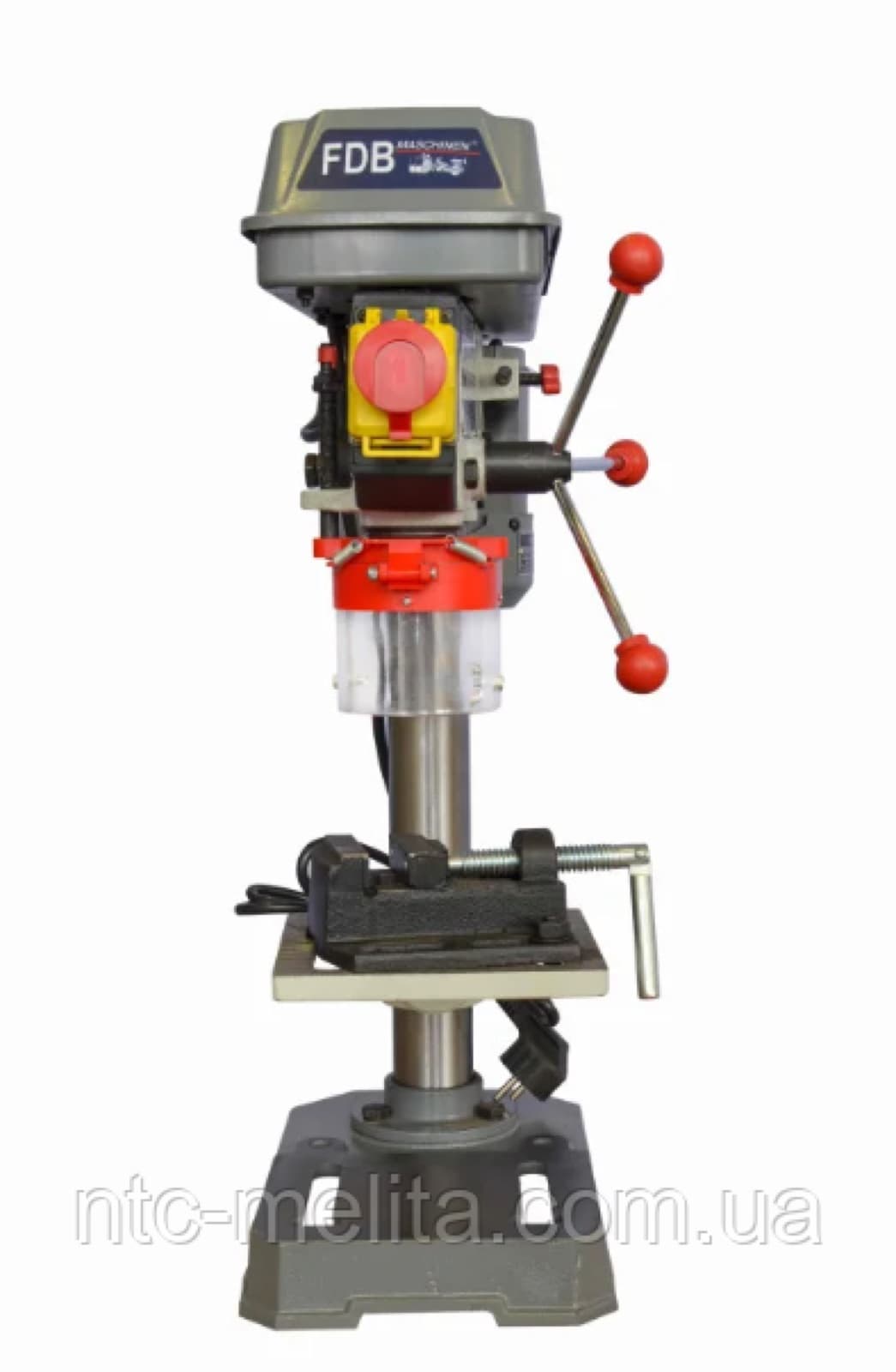
For small holes in a workshop a machine from bench drill presses is enough: from ~5,800 UAH incl. VAT for the FDB Maschinen Drilling 13/50 to ~29,900 UAH for the OPTIdrill DQ 20 V.
For drilling on structures - beams, trusses, columns - there are magnetic drilling machines, for example the FDB Maschinen MBD23 from ~18,500 UAH incl. VAT: annular cutters 12-23 mm (19.05 mm Weldon shank) and twist drills up to 13 mm.
| Taper on the drill | Drill diameters per DIN 345, mm | Fits spindle |
|---|---|---|
| MT1 | 3-14 | MT1, or MT2-MT4 with a sleeve |
| MT2 | 14.25-23 | MT2, or MT3-MT4 with a sleeve |
| MT3 | 23.25-31.75 | MT3, or MT4 with a sleeve |
| MT4 | 32-50.5 | MT4, or MT5 with a sleeve |
Which drill for which material: table and spindle speed
The table gives starting parameters for 5-20 mm drills on a drill press. Cutting speed v is in metres per minute for HSS; spindle speed is n = 1000 × v / (π × D), where D is the drill diameter in mm.
Example: a 10 mm drill in C45 steel at v = 25 m/min gives n = 1000 × 25 / (3.14 × 10) ≈ 800 rpm. The same drill in stainless at 10 m/min - about 320 rpm, and a 20 mm drill in structural steel - about 400 rpm. Feed for HSS is roughly 0.01-0.02 of the diameter per revolution, i.e. 0.1-0.2 mm/rev for 10 mm. Calculate it for your machine with the speed and feed calculator.
If the exact speed is missing, take the nearest lower step. Carbide drills run several times faster, but only with a rigidly clamped part and minimal spindle runout. Stainless has its own traps - work hardening, chip welding, overheating; they are covered in how to drill stainless and hardened steel.
| Material | Drill | Point angle | v, m/min (HSS) | Cooling |
|---|---|---|---|---|
| Structural steel (S235, C20, C45) | HSS-G, HSS-G TiN | 118-135° | 20-30 | emulsion |
| Alloy and hardened-and-tempered steel (41Cr4, 30CrMnSi) | HSS-Co5 | 135° | 10-18 | emulsion or oil |
| Stainless (AISI 304, AISI 321) | HSS-Co5, HSS-Co8 | 135° | 8-12 | oil or rich emulsion |
| Grey cast iron | HSS-G, carbide | 118° | 15-25 | dry, air blast |
| Aluminium and its alloys | HSS-G with polished flutes | 118-130° | 40-80 | emulsion |
| Brass, bronze | HSS-G with zero rake | 118° | 30-50 | dry or emulsion |
| Hardened steel above 45 HRC | carbide only | 130-140° | per drill maker's catalogue | mandatory |
How to check drill quality and common mistakes
Before buying a batch, check a few drills with a micrometer:
Drills die mostly from wrong parameters, not bad steel. A blue edge means overheating: speed too high or no coolant. Resharpen back to sound metal, or it dulls within a few holes.
The second mistake is going to full size at once. The chisel edge of a 16-20 mm drill does not cut but squeezes the metal, so first drill a pilot slightly larger than the chisel edge width (usually 4-6 mm), then open the hole up. Reduce feed at breakthrough: that is where a drill grabs and breaks, especially in thin sheet and brass.
The third is holding the part by hand. Clamp it in a machine vice or with clamps: when the drill jams, an unclamped part spins with it.
Finally, a drill does not give a precise hole for a shaft or pin (H7). Drill 0.1-0.3 mm undersize and finish with a reamer.
- Shank marking: diameter, steel grade (HSS-G, HSS-Co5, M35) and preferably a standard. Laser or stamped marking is more reliable than paint.
- Diameter measured near the tip: a quality drill is h8, i.e. 9.978 to 10.000 mm for 10 mm.
- Symmetry: both cutting lips equal in length, point on centre. An asymmetric drill cuts oversize.
- Ground flutes and margins without burrs or chips.
- Straight body: rolled on flat glass, the drill must not hop.
FAQ
Which drill bits are best for metal?
For most jobs - ground HSS-G with a 135° split point, TiN optional. For stainless and alloy steel - cobalt HSS-Co5. The steel grade and standard on the shank matter more than the colour.
What is the difference between a cobalt and a regular HSS drill?
It contains 5-8% cobalt, so the edge withstands more heat and holds in stainless and alloy steel. In mild steel the difference is small and not worth the extra cost.
What drill makes a 20 mm hole in metal?
A 20 mm twist drill with a Morse taper 2 shank on a drill press rated for that diameter, after a 4-6 mm pilot hole. In thin sheet a step drill or annular cutter is more convenient.
118 or 135 degree point - which to choose?
118° is universal for mild steel, cast iron and non-ferrous metals. 135° is for harder steels and stainless; with a split point it centres without a punch mark.
Can cobalt and carbide drills be resharpened?
Cobalt drills are sharpened like regular HSS, on an aluminium oxide or CBN wheel. Carbide needs a diamond wheel, so it is sharpened on a dedicated machine or sent to a service.
Which metal drill set should I buy?
For a workshop - 19 drills 1-10 mm in 0.5 mm steps or 25 drills up to 13 mm, ground HSS-G in a metal case. Buy common tap drill sizes (6.8, 8.5, 10.2 mm) individually.