How to Sharpen a Drill Bit: Point Angles, Grinders and Sharpeners
A twist drill for metal is ground to a 118° point angle for ordinary steel and 130-140° for stainless and hard steel, with 8-12° lip relief and, above all, two cutting lips of equal length. By hand this is done on a bench grinder with a fine-grit wheel, but repeatability depends on the operator. If you sharpen many drills, a drill sharpening machine with a collet chuck is faster and more accurate: the fixture sets the angle, and after the chuck is turned 180° the second lip comes out the same as the first.
Drill point angles: what you need to get
A twist drill has two main cutting lips with the chisel edge (web) between them. Sharpening a drill means restoring three things: the point angle, the relief angle behind the lip, and symmetry. If one lip is longer or ground at a different angle, the drill cuts on one side, makes the hole oversize and dulls quickly.
Lip relief gives clearance behind the cutting edge so the drill cuts instead of rubbing its heel on the metal. It is easy to check: looking at the point end-on, the chisel edge should sit at roughly 50-55° to the cutting lips. The values in the table are approximate; for exact angles of a specific tool, see the drill manufacturer's catalogue.
| Material | Point angle | Lip relief |
|---|---|---|
| Structural and carbon steel | 118° | 8-12° |
| Stainless, alloy, hardened steel | 130-140° | 6-9° |
| Cast iron | 90-118° | 8-12° |
| Aluminium, copper, brass | 118-135° | 12-15° |
| Plastics | 60-90° | 12-15° |
How to tell a drill needs sharpening
A dull drill does not just cut slowly: it overheats itself and the part, and on a drill press it puts extra load on the spindle and feed. Sharpen at the first signs of wear - the less metal you have to remove, the faster the job and the longer the drill lasts.
- You need more feed pressure, the drill squeals and chatters.
- Instead of spiral chips you get fine crumbs or dust, chips turn blue, smoke appears.
- The hole comes out larger than the drill diameter or oval, with a heavy burr at the exit.
- The cutting lips show rounded or chipped corners and shiny wear lands.
How to sharpen a drill by hand on a bench grinder
For hand sharpening an ordinary double-wheel bench grinder with a fine-grit aluminium oxide wheel and a properly set tool rest will do. For example, the Proma BKL-2000 - 200 mm wheel, 2850 rpm, 230 V, about 10 800 UAH incl. VAT. The sequence is:
- Hold the drill so the cutting lip is horizontal and touches the wheel, with the drill axis at half the point angle to the wheel face (59° for a 118° point).
- Press the lip lightly and, without lifting it, swing the shank down with a slight twist - this creates the lip relief.
- Take light passes without heavy pressure and let the drill cool: a blue edge is a sign of overheating. Never plunge a red-hot drill into water - sudden cooling causes microcracks at the edge.
- Rotate the drill 180° and repeat the same motion on the second lip, counting the passes.
- Check the angle and lip length with a drill point gauge; on large drills thin the web with the corner of the wheel.
Drill sharpening machine: how it works and why
A drill sharpening machine (drill sharpener) replaces the hand with a fixture. The drill is clamped in a collet chuck, its stick-out is set against a stop, then the chuck goes into a port set at the required angle and is rotated from stop to stop. The chuck is then indexed 180° and the second lip is ground - it comes out exactly like the first. Many models have a separate port for web thinning.
These machines use diamond or CBN wheels, which hold their shape for a long time and heat the tool less. CBN suits high-speed steel best, including cobalt grades, while diamond is for carbide; check the passport of the specific model for its wheel. Thanks to the fixture, sharpening takes a minute or two, and the result does not depend on operator skill. For a shop where 3-13 mm drills get dull every day, such a machine pays back quickly: a correctly sharpened drill works like new and does not need to be bought again.
There is one limitation: the diameter range is set by the collets. Most bench models take drills of 2-13 or 3-13 mm; larger drills need a model with an additional collet set, or hand sharpening on a bench grinder.
Which drill sharpening machine to choose
All models below are in the drill sharpening machines section, run on 220-230 V and carry a 12-month warranty. Prices are rounded, incl. VAT.
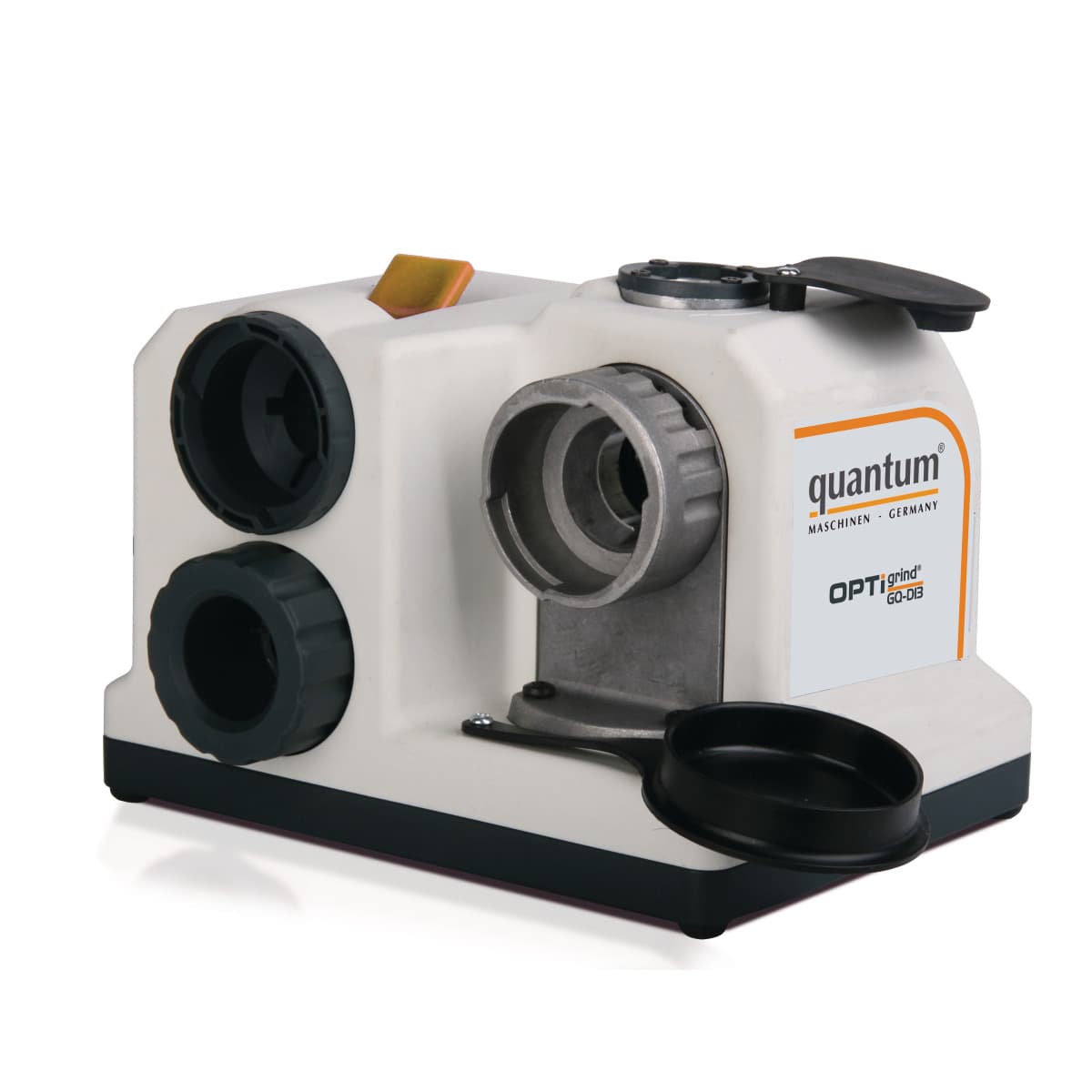
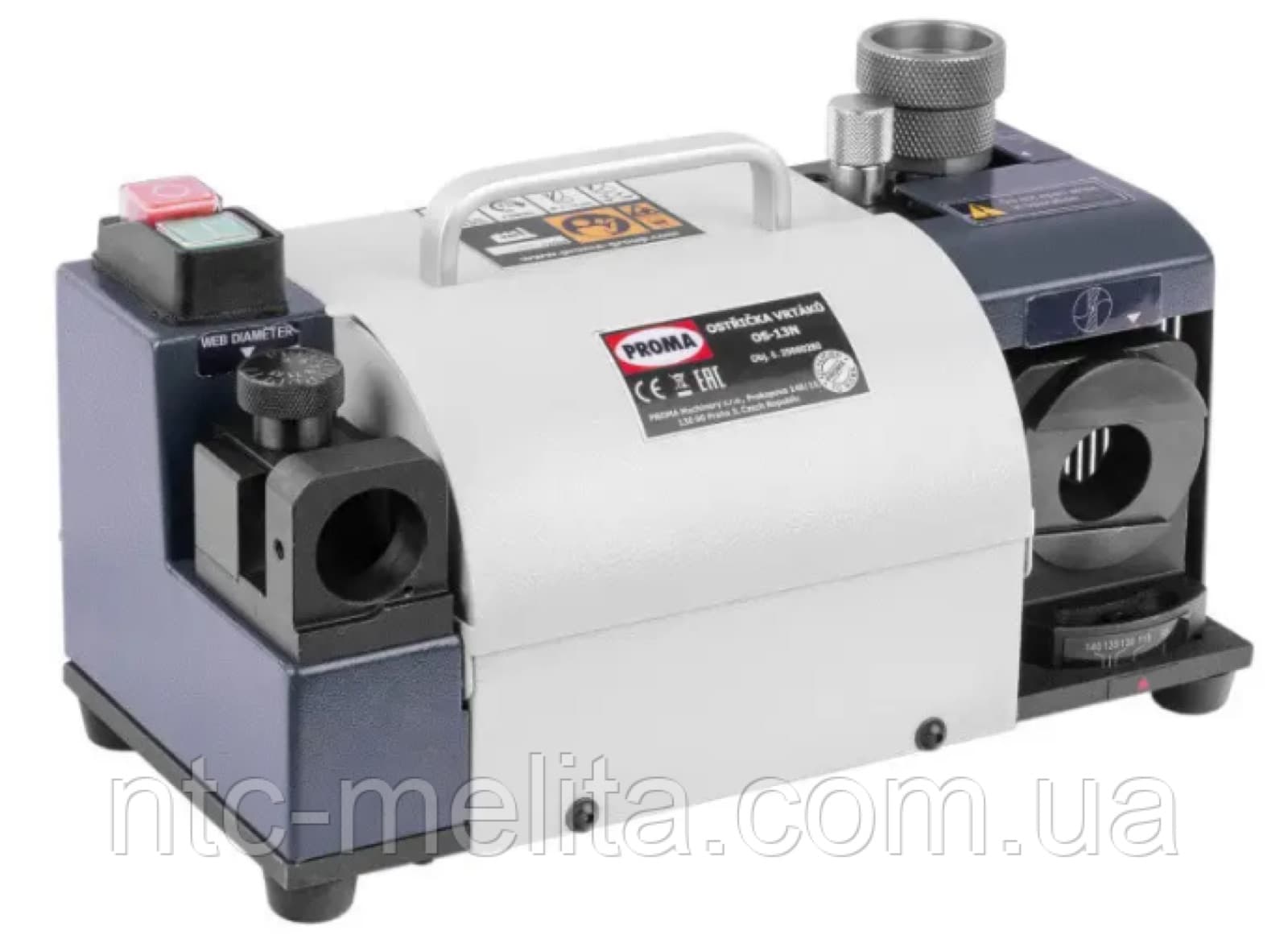
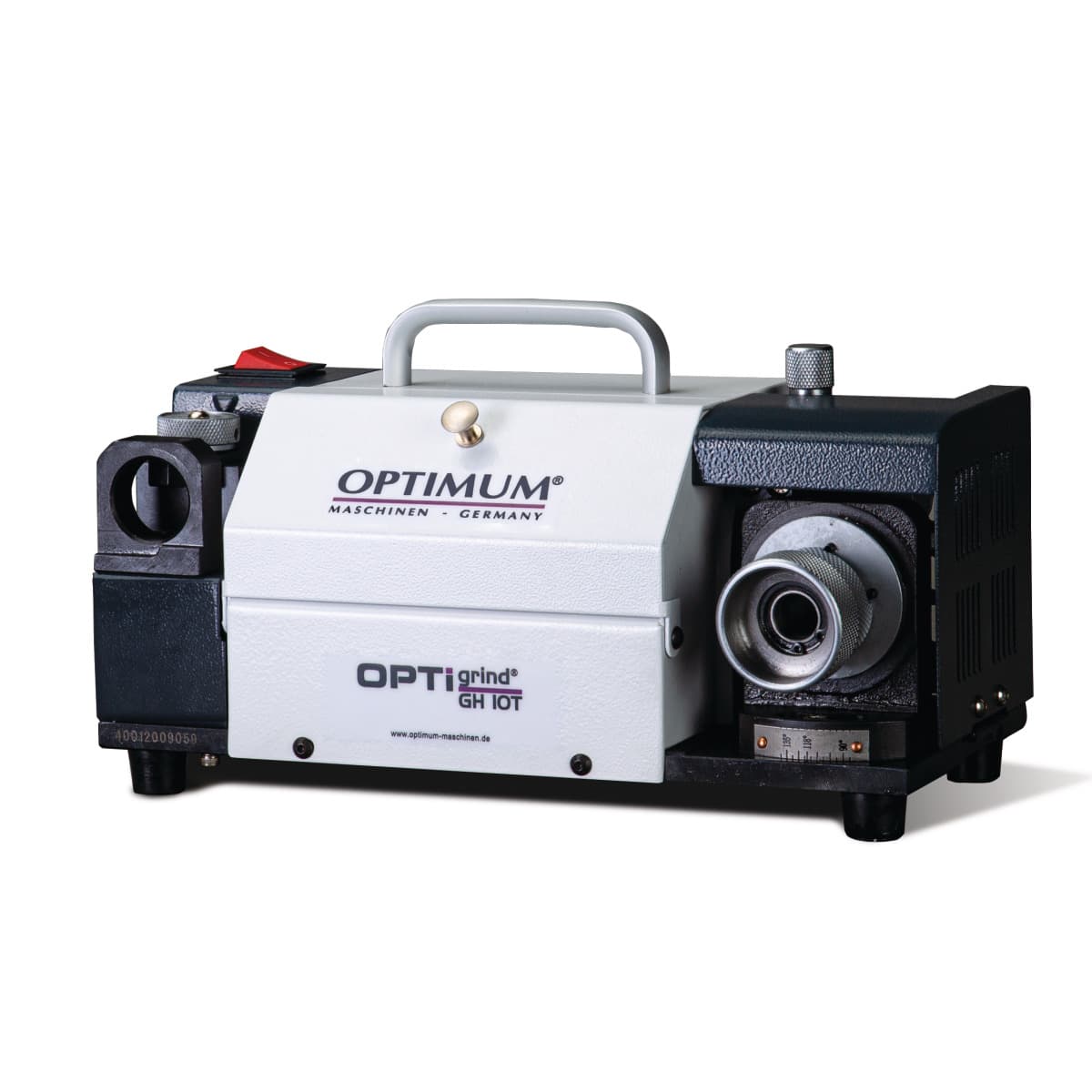
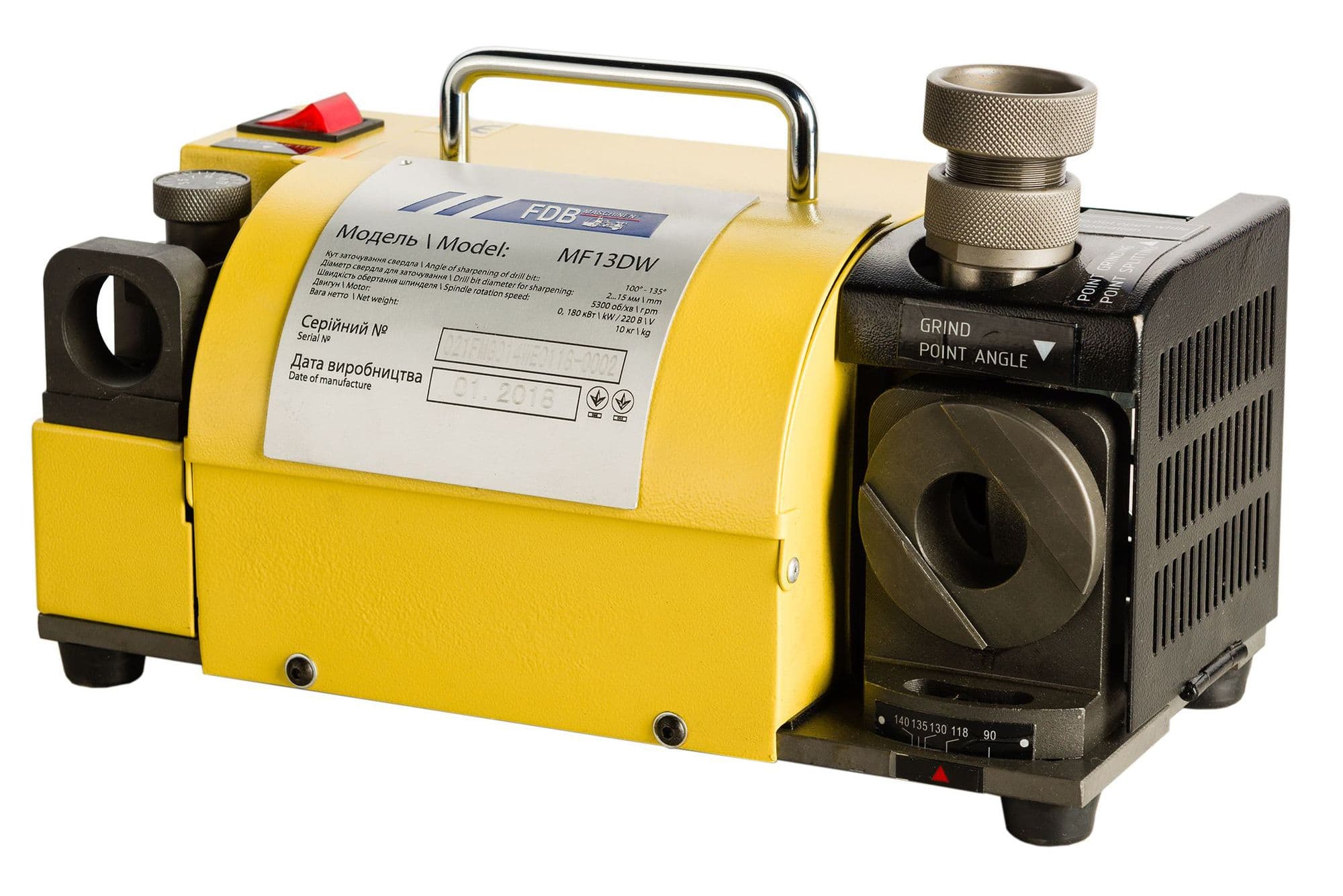
For home and occasional use the Opti GQ-D13 is enough: 3-13 mm drills, 118° only, weighs 2.5 kg. For workshops and production where different angles are needed - the OS-13N, OPTIgrind GH 10T or FDB MF13DW - the latter grinds a two-facet relief. If you use drills over 13 mm, look at the OPTIgrind GH 15T with collets up to 30 mm.
| Model | Drill diameters | Point angle | Price incl. VAT |
|---|---|---|---|
| Opti GQ-D13 | 3-13 mm | 118° (fixed) | ~2 900 UAH |
| OS-13N | 2-13 mm | 90-140° | ~20 000 UAH |
| OPTIgrind GH 10T | 3-13 mm | 90-135° | ~27 400 UAH |
| FDB MF13DW | 2-13 mm | 90-135° | ~31 100 UAH |
| OPTIgrind GH 15T | collets 2-30 mm | 90-145° | ~66 700 UAH, to order |
After sharpening: check and drilling parameters
Drill a test hole in the same material. A correctly sharpened drill produces two identical spiral chips, and the hole comes out to size without a noticeable burr. If chips come off one side only, the lips are asymmetric - sharpen again.
Even a sharp drill dulls fast if it runs too fast. Work out spindle speed and feed for your diameter and material in the spindle speed and feed calculator. If your machine cannot reach the right speed or vibrates, see our drilling machines with a wider speed range.
Not sure which model fits your set of drills? Send the diameters and materials through the quote request form - MELITA will pick a machine and issue a VAT invoice, with delivery across Ukraine or free pickup in Dnipro.
FAQ
What angle should a metal drill bit be sharpened at?
118° point angle for ordinary steel, 130-140° for stainless and hardened steel. Lip relief is roughly 8-12°, slightly less for hard materials.
Can I sharpen a drill on an ordinary bench grinder?
Yes, on a grinder with a fine-grit wheel and a tool rest. What matters is equal length and angle of both lips, so check the result with a gauge and a test hole.
What wheel do I need for carbide or carbide-tipped drills?
Aluminium oxide wheels barely cut carbide; it needs a diamond wheel. High-speed steel is ground on aluminium oxide or CBN wheels.
Which drill sharpener is good for home use?
For occasional work with 3-13 mm drills a simple model with a fixed 118° angle is enough, for example the Opti GQ-D13 at ~2 900 UAH incl. VAT.
Can a machine sharpen a drill larger than 13 mm?
Most bench models cannot: their range is limited by 2-13 mm collets. For drills up to 30 mm you need a model like the OPTIgrind GH 15T, or hand sharpening on a bench grinder.