DIY pipe bender: what you can build and when to buy one
Three types of pipe bender are realistic to build yourself: a lever bender with a former for thin-wall tubing, a shoe bender on a hydraulic bottle jack for water and gas pipe, and a three-roll bender for arcs in square and rectangular tube. The hardest part is the shoe or roller with a groove that matches the pipe's outside diameter exactly: without it the pipe flattens, and every diameter needs its own. A factory hydraulic bender with six formers from 1/2 to 2 inches costs from ~13,000 UAH incl. VAT - compare that with your DIY estimate using the checklist below.
DIY pipe bender: which designs actually work
Home-made pipe benders copy the same layouts as factory ones, just from parts at hand. The difference is not the principle but the accuracy of the grooves, the stiffness of the frame and how repeatable the angle is. Below are the four designs people build most often and what each is good for. How factory models work and differ is covered in detail in how to choose a pipe bender.
- Former (lever) bender. A grooved disc or sector is bolted to the bench, the pipe end is held by a stop, and a lever wraps the pipe around the former. The bend radius equals the former radius measured on the pipe centreline. Suits copper and thin-wall steel tubing of small diameter.
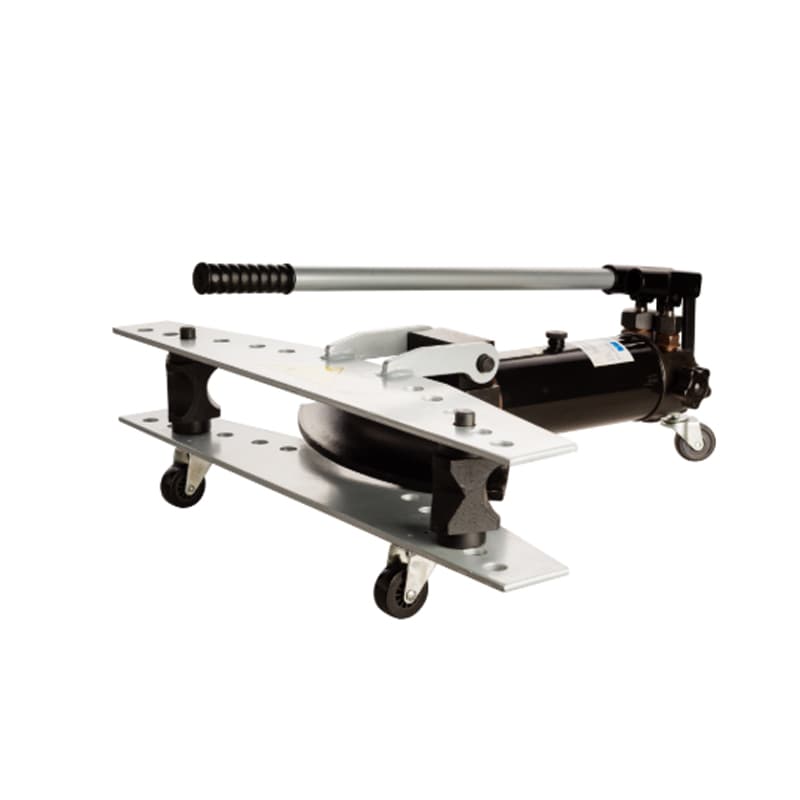
- Shoe bender on a jack. A hydraulic bottle jack in a steel frame pushes a shoe into a pipe resting on two supports. This is the layout of a manual hydraulic pipe bender, designed for heavy-wall water and gas pipe.
- Roll bender. Three rolls, the middle one tightened by a screw; the pipe is rolled back and forth over several passes. It gives a large-radius arc in square, rectangular or round tube - arches, canopies, greenhouses.
- No bender at all. The pipe is packed with dry sand, plugged and bent around a template while held in a vise, steel sometimes with heat. Fine for one-off parts where the bend shape is not critical.
Which pipe a DIY bender can handle
Before cutting steel for a frame, decide on the pipe. A home-made bender works well for one or two sizes and poorly as a universal tool. The table shows what is realistic and where you cannot do without a factory tool.
| Pipe | DIY layout | What usually goes wrong | Factory alternative |
|---|---|---|---|
| Copper and thin-wall steel tubing up to 7/8″ | Grooved former and lever | Kinking with a former that has no groove or the wrong size | Manual lever bender, up to 180° |
| Water and gas pipe 1/2-2″, wall 2.75-4.5 mm | Shoe on a jack, two supports | Ovality and dents if the shoe groove does not match the diameter | Hydraulic bender 10-16 t with formers |
| Square or rectangular tube, large-radius arc | Three rolls with a screw | Rippled wall, the tube twists into a spiral | Profile roll bender |
| Square or rectangular tube, sharp angle | Notch and weld, or heat | Wrinkle on the inside, dented wall | Lever bender with square formers, bending machine |
| Galvanised pipe | Any cold layout | Heat destroys the zinc and gives off harmful fumes | Cold bending on a former matched to the diameter |
| Thin-wall stainless tube | Not recommended | Wrinkles, flattening, marks from carbon steel | Mandrel bending machine, selected for the tube |
Radius, flattening and wall: what to check before you build
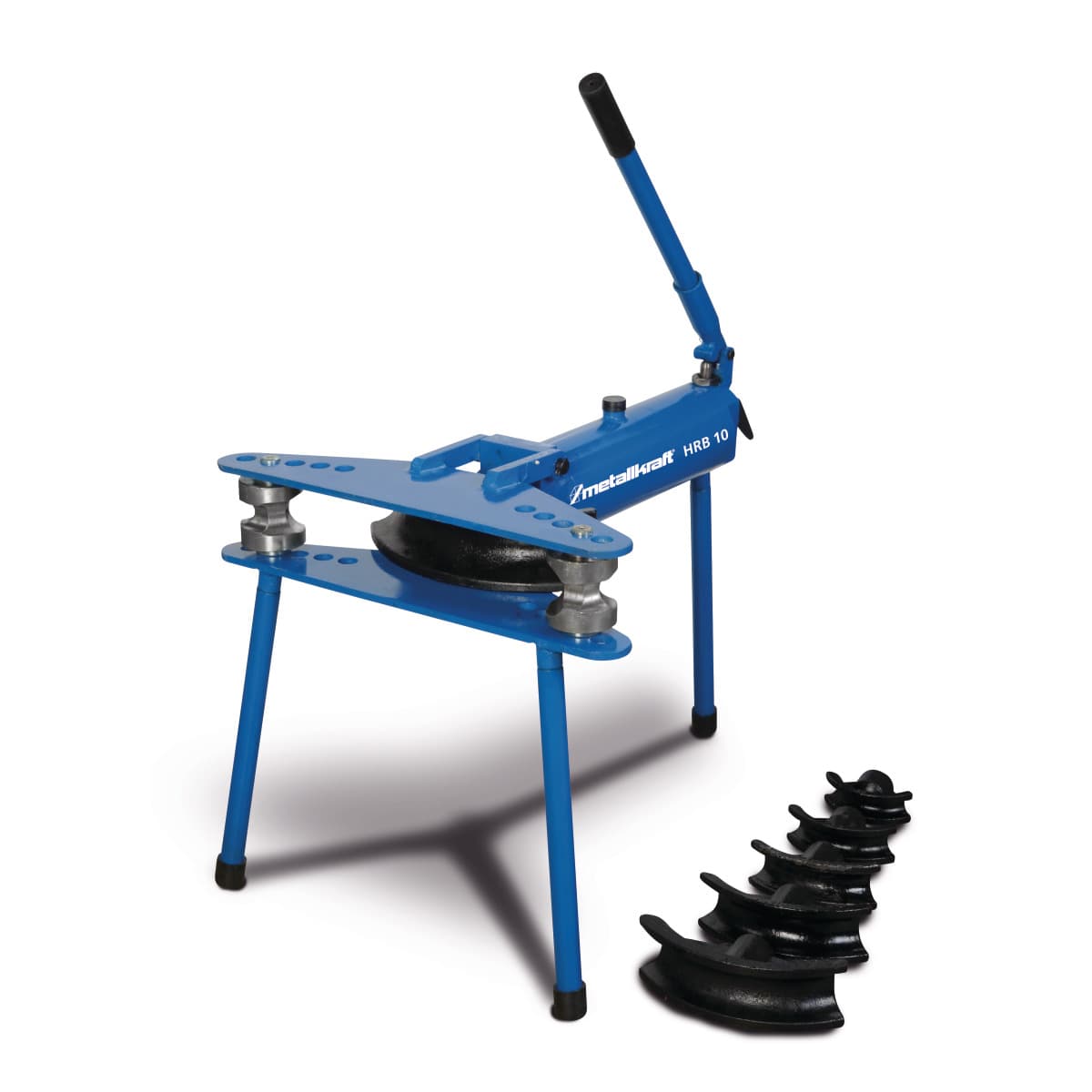
Bend radius is measured on the pipe centreline, not on the inside of the bend. Factory formers set it at roughly three outside diameters: the Metallkraft HRB 10 passport gives a minimum radius of 62 mm for 1/2 inch pipe and 187 mm for 2 inch. If a home-made shoe or former is smaller, the inner wall wrinkles and the outer wall thins.
What separates a working DIY bender from scrap is the groove. It must wrap the pipe at its outside diameter: for 1/2 inch pipe that is 21.3 mm, not 12.7 mm. A flat shoe or an oversized groove gives an oval. The groove is turned on a lathe, so price the turning work up front, separately for every diameter.
Blank length is calculated on the centreline: arc length equals π × R × angle / 180. For a 100 mm radius and 90° that is about 157 mm. After unloading the pipe springs back slightly, so you overbend, and the correction is found with a test bend. General rules for radius and springback are in metal bending.
- Measure the outside diameter and wall with a caliper instead of taking them from the pipe's name.
- Check the former or shoe radius against the radius required by the drawing.
- Check that the groove wraps the pipe without a gap at its outside diameter.
- Make a test bend on an offcut and measure the diameter in the bend in two directions - the difference shows ovality.
- Place the weld seam of a welded pipe at the side, in the neutral zone, not on the outside or inside of the bend.
DIY pipe bender from a bottle jack: layout and weak points
The layout is simple: two side plates of steel sheet or channel, two support rollers or stops on pins between them, and a bottle jack in the middle with a shoe on its ram. The jack pushes the shoe out and the pipe bends between the supports. The full jack force goes into the frame, so welds and pins must carry it with a margin.
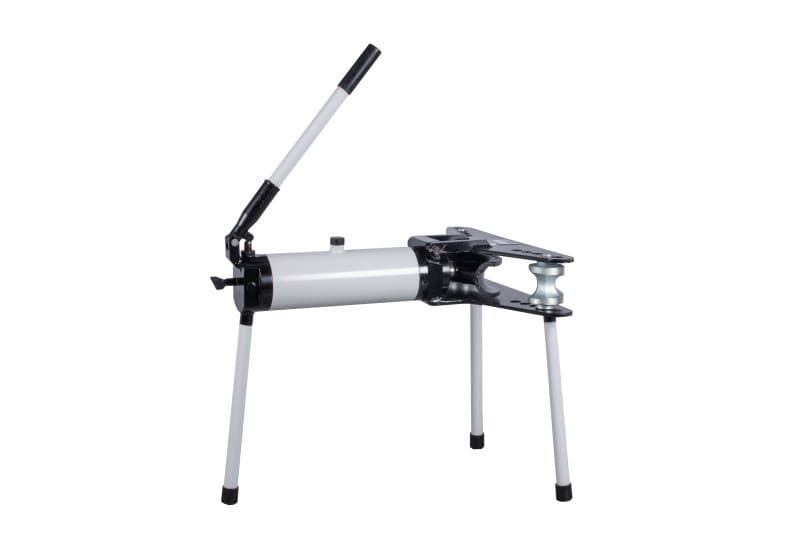
For reference, the factory FDB HBM-240/16-R delivers 16 t, has a 240 mm ram stroke and bends 1/2-2 inch pipe with a 2.75-4.5 mm wall to 90°. These figures show what load the frame should be designed for. If the workshop already has a hydraulic press, it can be easier to make a shoe-and-supports attachment for it than a separate frame - choosing such a press is covered in hydraulic press for a workshop.
- Shoe. Without a turned groove matching the diameter the pipe flattens, and the shoe is the part most often remade.
- Frame. Thin side plates spread under load, the supports skew and the angle varies.
- Jack. Not every bottle jack works lying on its side - check its manual, otherwise it will not push or will draw in air.
- Support spacing. It affects the bend shape, so make the supports adjustable with several holes.
- Angle. There is no stop, the angle is checked with a protractor after each stroke, and a batch of identical parts is hard to get.
DIY bender for square and rectangular tube
For arcs in square tube people build a roll bender: two lower support rolls, an upper pressure roll on a screw, and a hand crank driving through a shaft or chain. The rolls must be steel and flanged to the tube width, otherwise the wall ripples and the tube twists into a spiral. Choosing rolls and drive is covered in profile bender: how to bend square tube.
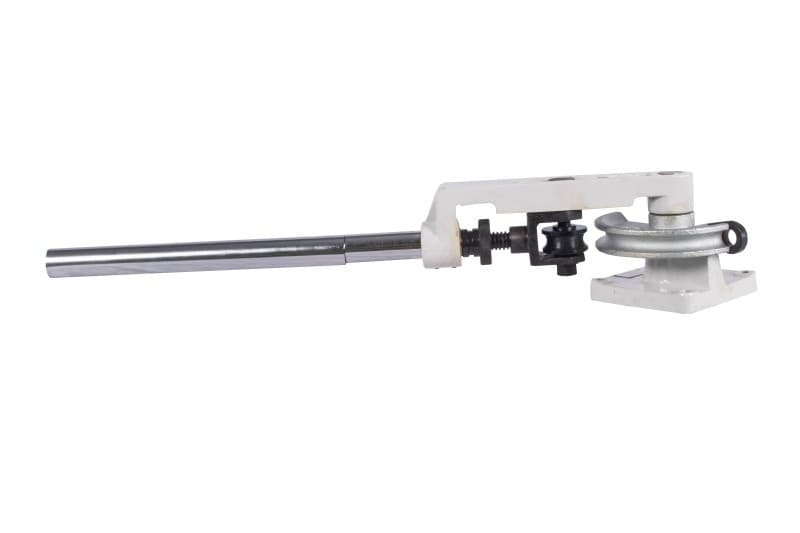
A sharp angle on small square tube is hard to get with a home-made former: the wall caves in. The factory lever Proma ROT-180K has formers for 3/4 and 1 inch square tube with a 0.8-1.2 mm wall, and the Proma UO-120 universal bending machine bends 16x16 mm square tube cold and 30x30 mm with heat, up to 120°.
How much a DIY pipe bender costs: work out your own figures
Prices for steel, turning work and jacks change, so we do not quote a ready figure. Fill in your own numbers from the list below and add them up. Remember that you need a separate shoe or former for every diameter.
Compare the total with a factory tool: hydraulic pipe benders with a set of formers in our catalogue cost from ~13,000 to ~30,000 UAH incl. VAT, the manual lever ROT-180K about 17,900 UAH. Factory machines carry a 12-month warranty, and companies receive a VAT invoice.
- Steel for the frame: plate, channel or angle - ___ UAH.
- Pins, axles, bolts, roller bearings - ___ UAH.
- Jack or screw clamp with a force margin - ___ UAH.
- Turning work: shoe, rolls or formers, number of diameters × price per part - ___ UAH.
- Welding rods, cutting and grinding discs, paint - ___ UAH.
- Your time: hours for drawing, cutting, welding and tuning × your hourly rate - ___ UAH.
- Pipe scrapped on test bends - ___ UAH.
DIY or factory: which to choose for the job
A home-made bender makes sense when there is one pipe size, a few parts and the shape is not critical. When there are several diameters, the angle must be accurate or the pipe goes into a pressurised system, a factory tool is the rational choice. Models from our catalogue, prices rounded, incl. VAT:
Plate rolls and bending machines for flat bar are in the sheet benders, rolls and shears section, and how to choose a sheet bender and plate rolls explains the difference. If your pipe is non-standard, send the sizes through the quote form and we will suggest a tool.
| Job | DIY | Factory option | Price incl. VAT |
|---|---|---|---|
| A few greenhouse arcs from square tube | Yes, roll bender | Profile roll bender | depends on model |
| One-off elbow in 1/2-1″ pipe, no pressure | Yes, shoe on a jack or sand | FDB HBM-240/16-R, 16 t, 90° | ~13,000 UAH |
| Heating, water, gas 1/2-2″, angles up to 120° | No, needs a former for each diameter | Metallkraft HRB 10, 6 formers, radius 62-187 mm | ~18,600 UAH |
| Pipe 20-60 mm, angle up to 110° | No | Proma HOT-150, 10 t, 150 mm stroke | ~29,900 UAH |
| Copper tubing 3/8-7/8″, angle up to 180° | Possible, grooved former | Proma ROT-180K | ~17,900 UAH |
| Flat bar, rod, square up to 16x16 mm | Possible, mandrel in a vise | Proma UO-120, up to 120° | ~17,000 UAH |
Common mistakes when building a pipe bender
Most failed home-made benders break down not because of the idea but because of details that look unimportant on the drawing:
- Wooden or plastic rolls: they deform under load and the radius drifts.
- One shoe for all pipes - smaller pipes flatten, larger ones do not sit in the groove.
- Former radius smaller than needed - a wrinkle on the inside of the bend.
- Heating galvanised pipe - burnt zinc, harmful fumes and corrosion at the bend.
- Damp or loosely packed sand - steam when heated and a dent where a void remained.
- Bending the finished part straight away without a test bend - the springback-corrected angle is unknown.
FAQ
How do I make a pipe bender from a bottle jack?
You need a stiff frame with two supports, a bottle jack that works in the required position, and a shoe with a turned groove matching the pipe's outside diameter. Without a matching groove the pipe will flatten.
How do I bend a pipe without a pipe bender?
Steel pipe is packed tightly with dry sand, plugged at both ends and bent around a template, sometimes with heat. It works for one-off parts, but ovality and wall thinning are unpredictable.
How do I bend square tube myself?
A large-radius arc is rolled on a roll bender over several passes. A sharp angle in square tube is made by notching and welding or on a lever bender with square formers.
What is the minimum bend radius of a pipe?
It depends on the pipe and wall. Factory formers of hydraulic benders set the radius at roughly three outside diameters: on the Metallkraft HRB 10 it is 62 mm for 1/2 inch and 187 mm for 2 inch.
Is it worth building a pipe bender yourself?
It depends on your costs for steel, turning work and time. Add them up with the checklist and compare with a factory hydraulic bender from ~13,000 UAH incl. VAT.
Can galvanised pipe be bent with heat?
Better not: heat destroys the zinc coating, gives off harmful fumes, and the bend rusts afterwards. Galvanised pipe is bent cold on a former matched to its diameter.