Sheet metal brake and slip rolls: how to choose
A sheet metal brake makes a straight angled bend along a line - for flashings, boxes, angles. Slip rolls roll sheet into a cylinder, cone or arc - for ventilation ducts, shells, tanks. Choose by maximum thickness and sheet width: in our catalog the ESF1260B box-and-pan brake bends up to 1.5 mm over 1250 mm, and rolls range from 305 mm / 0.8 mm bench models to 1050 mm / 3 mm motorised ones.
Brake or rolls: what each one is for
Both machines bend sheet metal, but the result is fundamentally different. A brake makes an edge - an angle from a few degrees to 135° and more along a straight line. Rolls make a smooth curve: the blank passes between three rolls and comes out as a cylinder or arc of the required radius. Both are often searched for simply as a sheet bending machine, but they are different machines.
Workshops often mix up the names. For example, the Optimum BM 3 is sold under a name that translates as sheet bender, but it is a three-roll manual slip roll. So look at the design, not the name:
- Manual brake: the sheet is clamped by a clamping beam and the edge is folded by a swinging beam. Angles, edges, flanges.
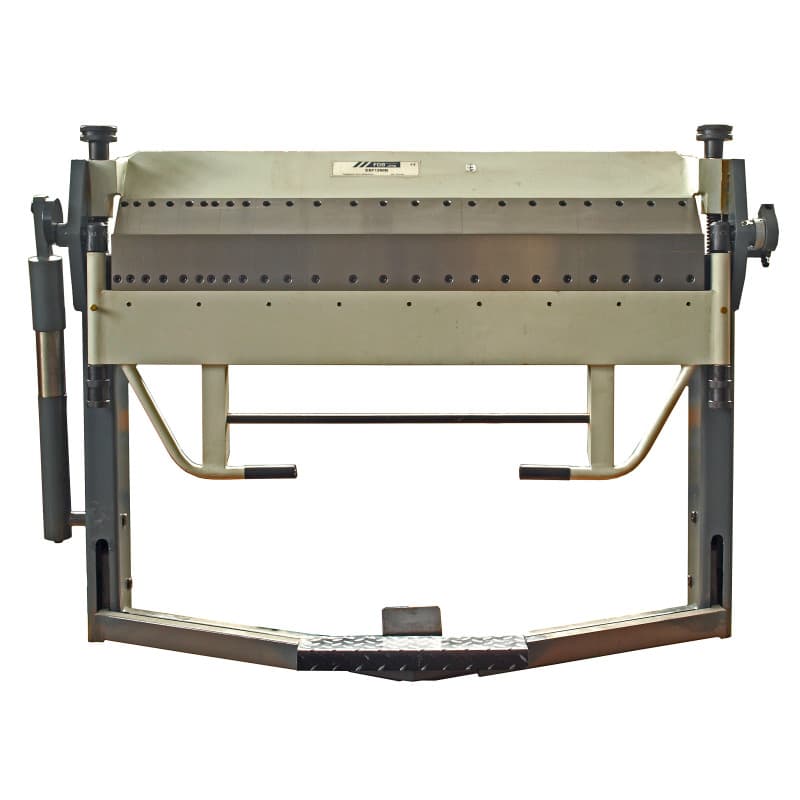
- Box-and-pan (segment) brake: the clamping beam is made of segments of different widths. You can fold a box or tray with all four sides.
- Manual slip rolls: three rolls turned by a handle through gears. Cylinders, cones and arcs in thin sheet.
- Powered rolls: an electric motor drives the rolls, feed is controlled by a foot pedal. For thicker sheet and batches.
Manual and box-and-pan brakes: how to choose
A plain manual brake suits simple parts with one or two bends: flashings, strips, angles, covers. When you need a closed box, a solid beam hits the sides already bent. A box-and-pan brake solves this: you assemble the beam from segments to the exact box width and fold the fourth side without interference.
The FDB Maschinen ESF1260B box-and-pan brake bends sheet up to 1250 mm long and 1.5 mm thick to 135°. It weighs 340 kg - a stationary machine for the shop floor, ventilation and roofing work and enclosure fabrication. Price about 110,000 UAH incl. VAT.
If you need to bend sheet thicker than a manual brake is rated for, or run large batches of identical parts, look at a hydraulic press brake - such machines are in hydraulic and crank presses. You can estimate the bending force for your part with the bending and punching force calculator.
Slip rolls for sheet metal: how three-roll machines work
In three-roll machines two rolls feed the sheet and the third sets the radius. The more you tighten it, the smaller the diameter. A large radius takes one or two passes, a small one is reached gradually over several.
Blank length for a shell or cone is easy to get from the sheet metal flat pattern calculator, and general rules on radii and springback are in metal bending basics.
What to look for in the design:
- Asymmetric roll layout. It lets you pre-bend the sheet edge so no flat section is left at the cylinder seam. The RBM 305 and RBM 1000-20 Eco are built this way.
- Swing-out top roll. Without it you cannot remove a finished cylinder without opening it up.
- Inclined rear roll. Needed for cones - reducers, funnels.
- Grooves in the rolls. They let you bend wire and rod into rings.
- Top roll diameter. It sets the minimum part diameter: a thinner roll allows a smaller diameter: from 35-40 mm on bench models to 135 mm on the motorised rolls.
| Model | Sheet width | Thickness (steel) | Min. diameter | Price incl. VAT |
|---|---|---|---|---|
| Optimum BM 3, clamps in a vise | 310 mm | 1 mm (aluminium 2 mm) | 35 mm | ~9,000 UAH |
| Metallkraft RBM 305, bench | 305 mm | 0.8 mm | 40 mm | ~7,800 UAH |
| Metallkraft RBM 1000-20 Eco, 60 mm roll | 1000 mm | 2 mm | 100 mm | ~80,400 UAH |
| Metallkraft RBM 1050-22 Eco, 75 mm roll | 1050 mm | 2 mm | 115 mm | ~144,000 UAH |
| Metallkraft RBM 1050-30E, 1.1 kW drive | 1050 mm | 3 mm | 135 mm | ~360,000 UAH |
Sheet thickness and width: how to read the spec sheet
The key figures of any brake or rolls are maximum thickness and working width. Behind them are conditions worth knowing:
- Rated thickness refers to ordinary structural steel. For the RBM 1050-30E the manufacturer gives 3 mm for steel with 400 N/mm² tensile strength, 2.25 mm for stainless and 3.6 mm for aluminium.
- A cone is harder to roll than a cylinder: on the same machine the cone maximum is 1.5 mm in steel, half as much.
- Choose a machine with margin. Working at the rated limit speeds up wear and gives worse geometry.
- Minimum diameter and maximum thickness are separate limits. On the thickest sheet the smallest rated diameter may be out of reach, so check this before buying.
- Blank length for a cylinder is calculated on the mean diameter: L = π × (D inner + s). For a shell with a 300 mm inner diameter from 1 mm sheet that is π × 301 ≈ 946 mm.
- Roll galvanised and pre-painted sheet on clean rolls and without excessive pressure so the coating is not damaged.
Selection table: what to buy for which job
Typical jobs and machines from our catalog. Prices rounded, incl. VAT.
| Job | Machine type | Model | Price incl. VAT |
|---|---|---|---|
| Small cylinders, wire rings, jewellery and model work | Manual rolls in a vise | Optimum BM 3 | ~9,000 UAH |
| Small tubes and cones from thin sheet up to 0.8 mm | Bench manual rolls | Metallkraft RBM 305 | ~7,800 UAH |
| Ventilation ducts, downpipes, shells up to 2 mm | 1 m manual rolls | Metallkraft RBM 1000-20 Eco or RBM 1050-22 Eco | ~80,400-144,000 UAH |
| Batch shells and tanks up to 3 mm | Powered rolls | Metallkraft RBM 1050-30E | ~360,000 UAH |
| Boxes, trays, enclosures, flashings up to 1.5 mm | Box-and-pan brake | FDB Maschinen ESF1260B | ~110,000 UAH |
Home-made brake or factory machine: typical mistakes
A home-made brake from two channels and hinges is a popular idea, and it copes with a few flashings in 0.5 mm galvanised sheet. Problems start beyond one metre and with thicker sheet: the beam deflects in the middle, the angle varies along the bend, and repeating a part in a batch is impossible. If the brake is for work rather than one roof, a factory machine gives a consistent angle and repeatable parts.
Do not cut blanks with an angle grinder before bending: heat and burrs on the edge can crack at the bend. What to cut with at each thickness is covered in how to cut sheet metal. Typical mistakes in choosing and using:
- Buying a machine right at the rated thickness. You need margin, especially if stainless comes up now and then.
- Rolls instead of a brake for angled parts, or the other way round. Angle - brake, radius - rolls.
- Manual rolls for a batch of shells in 2 mm sheet. That is hard physical work; batches need a powered drive.
- No pre-bending of edges on the rolls - flat sections remain at the cylinder seam.
- Pre-painted sheet on dirty rolls or with excessive clamping - scratches and peeling coating.
Buy a sheet metal brake or rolls from MELITA
MELITA (NTC Melita LLC) has supplied metalworking equipment from Dnipro since 2015. All models are in sheet benders, rolls and shears, together with shears for cutting sheet before bending. The BM 3 manual rolls clamp in a vise; how to choose one is covered in how to choose a vise.
Machines carry a 12-month warranty, and companies receive an invoice with VAT. We deliver across Ukraine by Nova Poshta and freight carriers; pickup in Dnipro is free. Heavy rolls and brakes ship by freight.
Not sure which machine you need? Send a drawing or photo of the part, the material and sheet thickness via the request form and we will pick a brake or rolls and send a quote.
FAQ
What is the difference between a sheet metal brake and slip rolls?
A brake makes a straight angled bend along a line, while rolls form sheet into a cylinder, cone or arc. Boxes and flashings need a brake, tubes and shells need rolls.
What is a box-and-pan brake?
It is a brake whose clamping beam is made of segments of different widths. This lets you fold a box with four sides: the beam is assembled to its exact width.
What sheet thickness can manual slip rolls handle?
It depends on width and model: 305 mm bench rolls take up to 0.8 mm steel, 1000-1050 mm manual rolls up to 2 mm. For 3 mm over 1050 mm you need powered rolls.
What is the smallest tube diameter I can roll?
It depends on the top roll diameter: in our models from 35-40 mm on bench rolls to 100-135 mm on 1 m machines. The exact value is in the spec sheet.
Can I roll stainless steel on ordinary rolls?
Yes, but the allowed thickness is lower than for mild steel: 2.25 mm instead of 3 mm on the RBM 1050-30E. Hardened rolls for stainless can be ordered for this model.
Can I make a sheet metal brake myself?
Yes, for one-off parts in thin galvanised sheet up to about a metre long. On longer and thicker sheet a home-made beam deflects and the angle varies along the bend.