Bending and punching force
Enter thickness, bend length and material - the calculator gives the V-die opening, bending force in tonnes, minimum flange, and the punching force for a given hole diameter.
21.7 t
- Die opening V
- 24 mm
- Minimum flange
- 17 mm
- Inner radius
- ≈ 4.0 mm
- With 20% margin
- 26.1 t
Not sure about the numbers? An engineer will check the calculation and pick equipment from stock or to order.
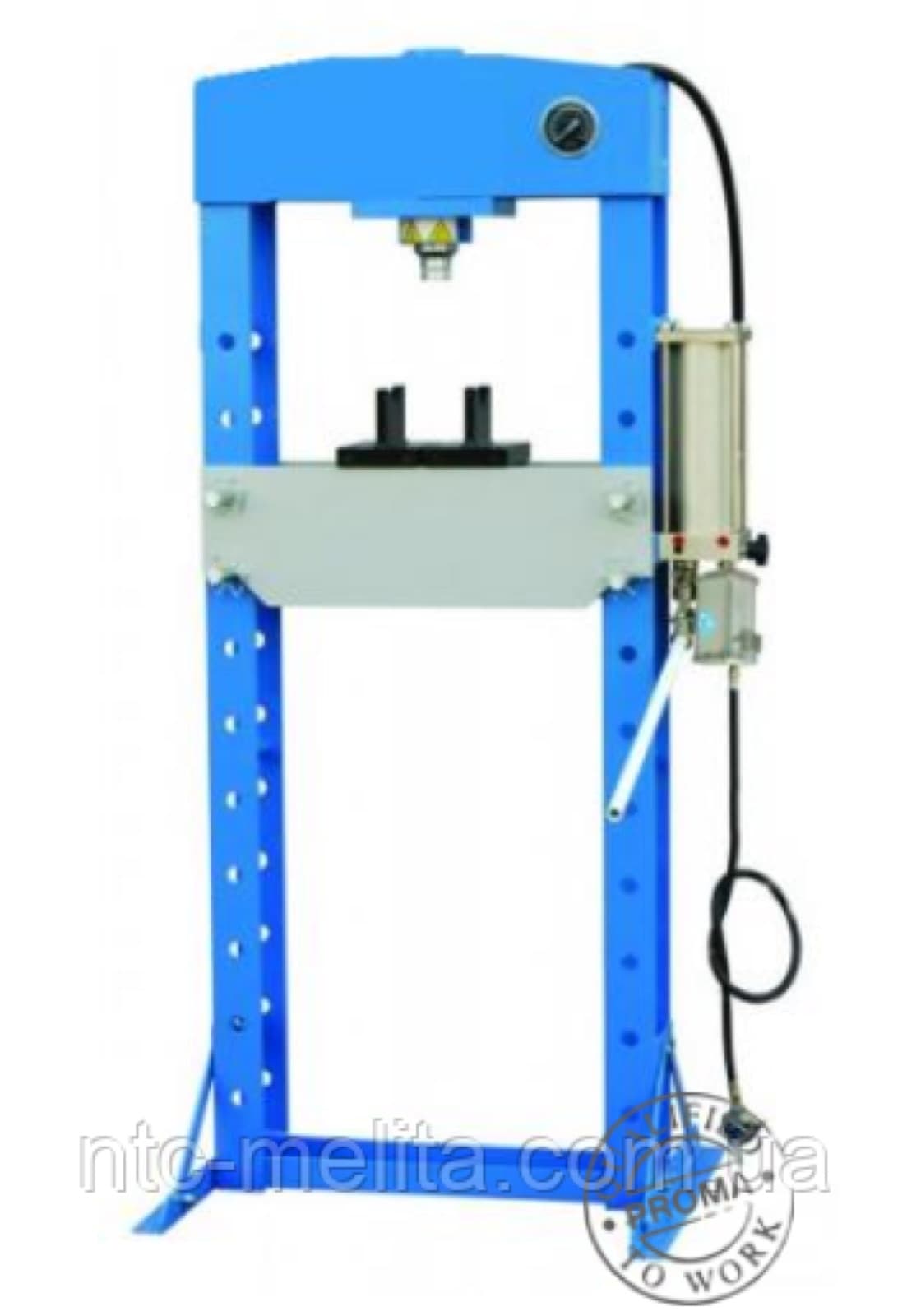
Matching products
Presses and benders →
How it is calculated
Air bending in a V-die: F [kN/m] = 1.42 × Rm × s² / V, where Rm is tensile strength in MPa, s is thickness in mm and V is the die opening in mm. The die opening is V = 8s for sheet up to 3 mm, 10s up to 10 mm and 12s above. Tonnes = kN / 9.81, multiplied by the bend length in metres.
Minimum flange is about 0.7V; the inside radius comes out at roughly V/6.
Punching: F = π × d × s × 0.8 × Rm (shear along the hole perimeter). A 20 mm hole in 3 mm St3: 3.14 × 20 × 3 × 0.8 × 400 ≈ 60 kN, i.e. about 6.2 t.
Tensile strength Rm: St3 mild steel - 400 MPa, steel 45 (C45) - 600, stainless - 650, aluminium - 200. Example: a 1 m bend in 3 mm St3, V = 24 mm - 21.7 t.
Bending force for St3 per metre
| Thickness, mm | Die V, mm | kN/m | t/m |
|---|---|---|---|
| 1 | 8 | 71 | 7.2 |
| 2 | 16 | 142 | 14.5 |
| 3 | 24 | 213 | 21.7 |
| 4 | 40 | 227 | 23.2 |
| 5 | 50 | 284 | 29.0 |
| 6 | 60 | 341 | 34.7 |
| 8 | 80 | 454 | 46.3 |
| 10 | 100 | 568 | 57.9 |
Practical tips
- Keep a 20% margin to the rated press force - for scatter in material strength, tool wear and setup errors.
- In the same die, force grows with the square of thickness: twice the thickness needs four times the tonnage.
- A narrower die gives a smaller radius, but force rises in inverse proportion to V. Do not go below 6s.
- Stainless springs back more - overbend by a few degrees.
- A short bend in the middle of the press is safer than at the end of the bed: off-centre load tilts the ram.
- Worn friction inserts in the clutch-brake reduce actual force and stopping accuracy - see press spare parts.
When to involve an engineer
The result is an estimate for air bending. Coining, bottoming, high-strength steels and long parts near the limit of a press brake should be checked against the machine passport and the tool maker's charts.