
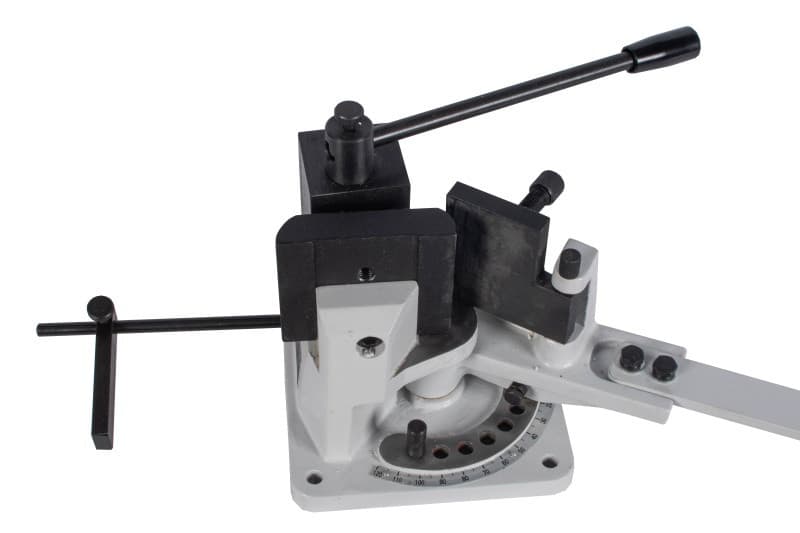
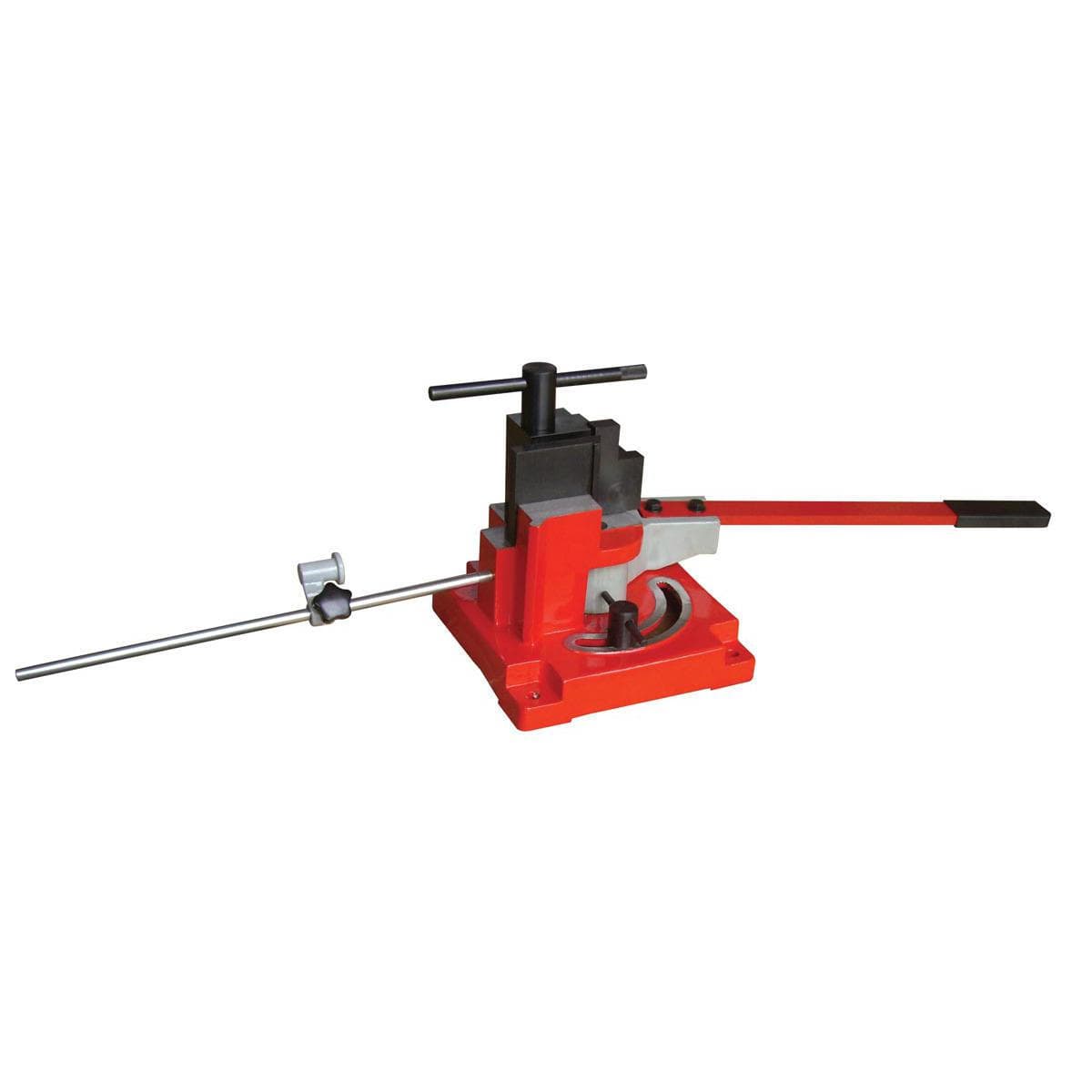
● In stockThree-roll bender Optimum BM 3/manual slip roll
weight10 kg
8 964 ₴incl. VAT · 7 470 ₴ excl. VAT
Enter the outside flange dimensions, thickness, inside radius and bend angle - the calculator returns the blank length before bending and the bend allowance.

When sheet is bent, the outer fibres stretch, the inner fibres compress, and somewhere in between lies a layer whose length does not change - the neutral axis. The flat pattern is calculated along it. Its position is set by the K-factor: the fraction of thickness measured from the inside surface.
For one bend: L = (A - R - s) + (B - R - s) + BA, where A and B are outside flange dimensions, R is the inside radius and s the thickness. Bend allowance BA = π × (R + K × s) × angle / 180.
Example: A = 50 mm, B = 80 mm, s = 2 mm, R = 2 mm, 90°. R/s = 1, so K = 0.4. Straight sections: 46 + 76 = 122 mm, BA = 3.14 × (2 + 0.8) × 90 / 180 ≈ 4.4 mm. Flat length - 126.4 mm.
| R/s | K | BA at s = 2 mm, 90° |
|---|---|---|
| below 1 (R = 1 mm) | 0.33 | 2.6 mm |
| 1 to 3 (R = 2 mm) | 0.4 | 4.4 mm |
| 3 and above (R = 6 mm) | 0.5 | 11.0 mm |
For precision parts, stainless and aluminium with strong springback, and for bending on rolls or press brakes with non-standard tooling, use the tool maker's tables or test bends.