How to Choose a Machine Vise for a Drill Press or Milling Machine
For a drill press a fixed or swivel vise with 80-160 mm jaws is usually enough; a milling machine needs a rigid cast iron vise of 125-200 mm or larger, bolted to the table with keys in the T-slots. Match jaw width to the table width and maximum opening to your largest workpiece plus a margin. Choose a precision (toolmaker's) vise for accurate work and a cross-slide vise to drill hole patterns without re-clamping.
Types of machine vises
A machine vise differs from a bench vise in that it is fixed to the machine table rather than a workbench and has an accurately machined base. Its rigidity and accuracy decide whether a hole comes out square and a slot parallel to the datum. The МЕЛИТА vise catalog has four main groups.
- Fixed (no swivel base) - the lowest and most rigid. Suitable for drilling and milling when the part sits parallel to the table axis.
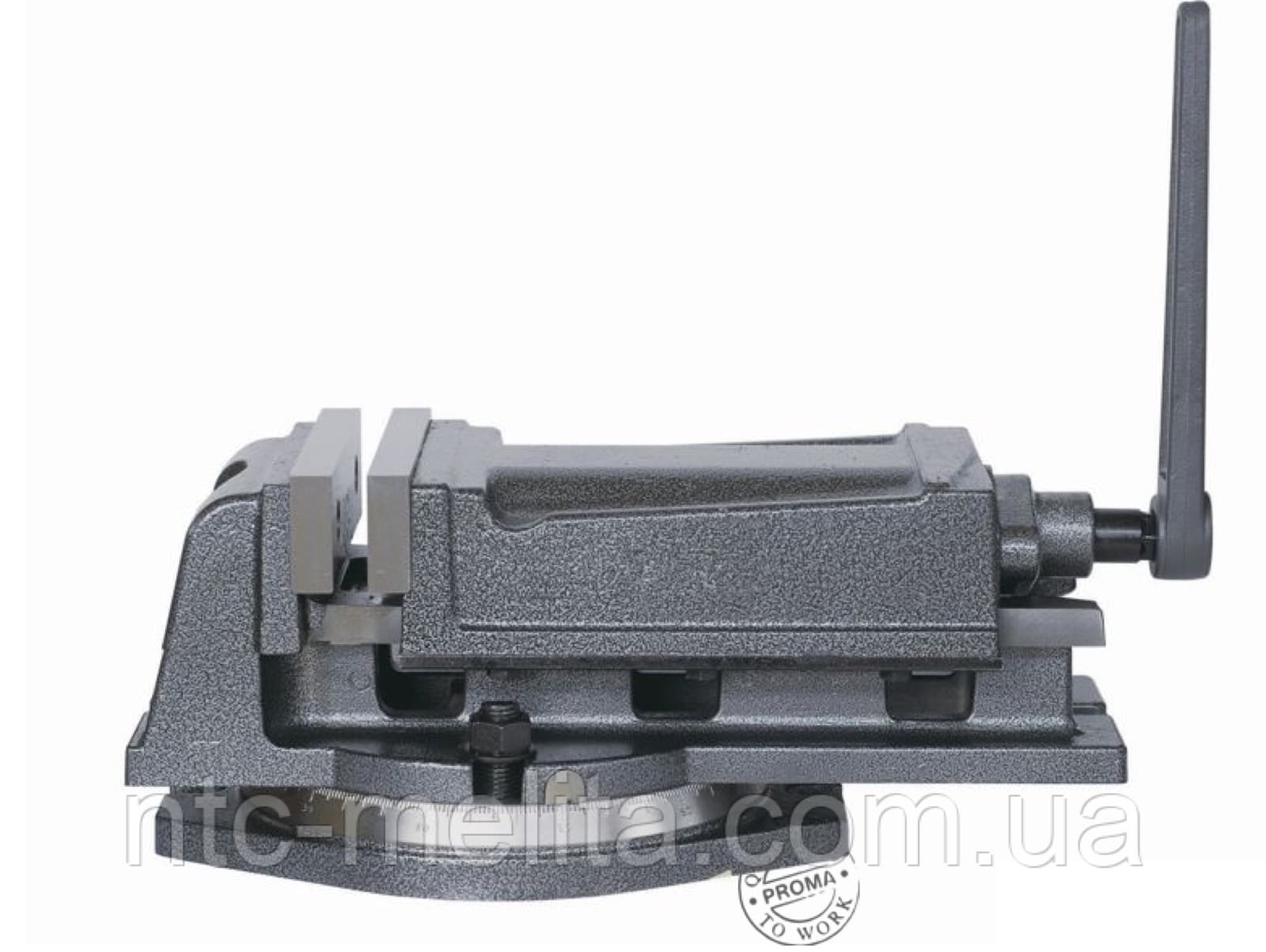
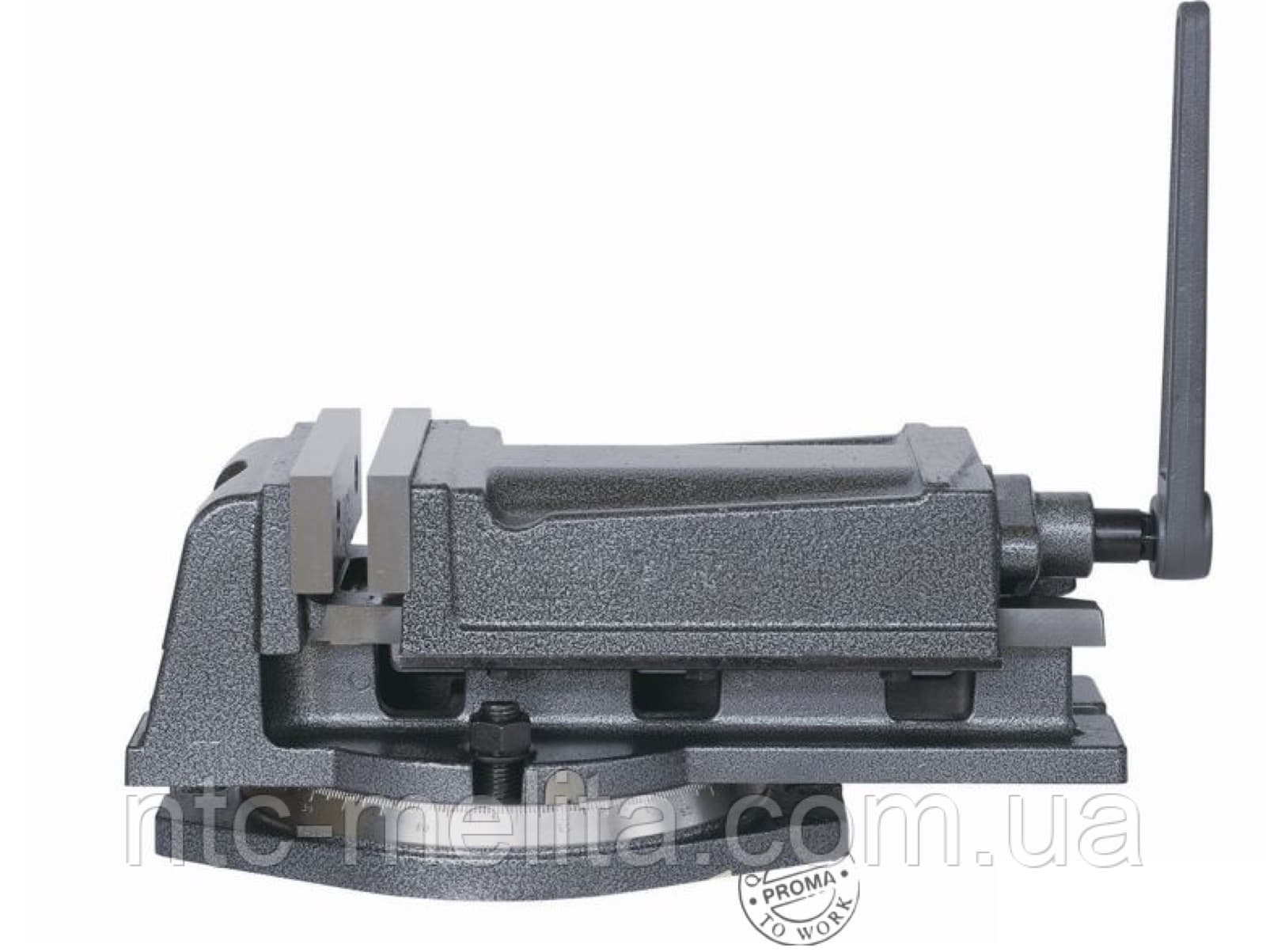
- Swivel vises - the body rotates 360 degrees on a graduated base, so the part can be set at an angle without moving the vise. The trade-off is extra height and slightly lower rigidity.
- Precision and toolmaker's vises - ground jaws and side faces; the vise can be laid on its side or end. For toolroom work, grinding, accurate layout and inspection.
- Cross-slide and compound vises - a vise on two slides with lead screws that moves the part along two axes. Mostly used on a drill press to drill several holes by coordinates without re-clamping.
Jaw width and maximum opening: how to size a vise
Jaw width is the main size of a vise and is what appears in the model name (100 mm, 125 mm, 160 mm). Start with the machine table: the vise must sit on it with room left for clamps and without overhanging the edge. In practice jaw width is usually one third to one half of the table width.
Choose the maximum opening for the largest part you plan to clamp, plus 20-30 percent: at full opening the screw works at maximum extension and clamping rigidity drops. In the catalog the opening varies a lot for the same jaw width - for 160 mm vises it ranges from 120 to 275 mm depending on the model.
The third dimension is jaw height. Low jaws (30-40 mm) hold a tall part poorly during side milling, while high jaws (60-80 mm) eat into the daylight between spindle and table. On a drill press with a short quill stroke, an extra 50 mm of vise height can be critical.
- Measure the table width and the spacing of the T-slots.
- Determine the largest dimension of the part to be clamped and add a margin.
- Check the height from table to spindle with the tool fitted - the vise and part must fit in.
- Mind the weight: a 200 mm vise weighs about 40 kg and a 320 mm one over 100 kg, which is too much for a light bench machine.
Table: machine type and typical jaw width
The guide below is based on the sizes available in the МЕЛИТА catalog (jaw widths from 63 to 320 mm). Always confirm against your machine's manual: table size and T-slot width differ between models.
| Machine type | Typical jaw width | Vise type |
|---|---|---|
| Bench drill press | 63-100 mm | Fixed, swivel, small cross-slide |
| Floor (column) drill press | 100-160 mm | Swivel, cross-slide |
| Radial drill | 160-250 mm | Swivel, fixed |
| Bench milling (drill-mill) machine | 100-125 mm | Swivel, precision |
| Mid-size knee-type milling machine | 125-200 mm | Swivel, precision |
| Heavy milling machine | 200-320 mm | Heavy swivel |
| Grinding and toolroom work | 63-160 mm | Precision, toolmaker's |
Mounting on the table: keys, bolts, alignment
On a milling machine the vise must always be bolted to the table with T-bolts or clamps. The underside of the body usually has a slot for tenon keys that drop into a table T-slot and align the vise with the axis at once. Before buying, check that the key width or the mounting lugs match your table's T-slots - if not, keys can be made to size.
After installation, indicate the fixed jaw with a dial indicator while traversing the table along it. Re-indicate a swivel vise after every angle change; treat the base scale as a reference, not a measuring instrument.
On a drill press the vise is often just placed on the table, but that is acceptable only for small drills and light parts. With larger drills the bit can grab the part and spin the vise with it, so it should be bolted down as well.
Body and accuracy: what to look for
A good machine vise body is cast from grey or ductile cast iron, which damps vibration well and stays stable after machining. The moving jaw slideways should have no play, and the screw should run smoothly over the full opening. An enclosed screw, as on the 160 mm swivel vise with enclosed screw, is better protected from chips and coolant.
On precision and toolmaker's vises the base, jaws and side faces are ground parallel and square. Exact tolerances depend on the model - see the vise's manual. Plain drilling does not need that accuracy, but for fitted slots, grinding and toolroom work it pays off.
If the part has to be machined at an angle in the vertical plane, consider a tilting vise such as the SS-125, which swivels 360 degrees and tilts 0-90 degrees.
What to choose in the МЕЛИТА catalog
A few models that make a good starting point:
- SO-125 swivel vise by Proma - 125 mm jaws, 110 mm opening, 22 kg. An all-round choice for a column drill press or a small mill.
- SO-160 swivel vise by Proma - 160 mm jaws, 120 mm opening, 29 kg, for knee-type milling machines.
- 200 mm swivel machine vise - 200 mm jaws, 150 mm opening, 39 kg, for mid-size and large mills and radial drills.
- TL-100 precision toolmaker's vise - 100 mm jaws, 125 mm opening, for toolroom and grinding work.
- KS-100 cross-slide vise by Proma - 100 mm jaws, 102 mm opening, for drilling by coordinates.
FAQ
What is the best vise for a drill press?
For a bench drill press, a vise with 63-100 mm jaws; for a column drill press, 100-160 mm. If you often drill several holes in one part, a cross-slide vise is handier: the part moves on lead screws without re-clamping.
What is the difference between a swivel and a fixed vise?
A swivel vise has a graduated base, so the body can be turned to any angle in the horizontal plane. A fixed vise is lower and more rigid, which is why it is often preferred for heavy milling in one position.
Can I use a cross-slide vise on a milling machine?
For light milling on a bench machine, yes, but the slides of a cross-slide vise are less rigid than a regular machine vise body. On a knee-type mill the table provides the feed, so a swivel or precision vise is the better choice there.
How much does a machine vise cost?
In the МЕЛИТА catalog swivel machine vises cost roughly 3,400 to 19,700 UAH incl. VAT, precision and toolmaker's vises roughly 4,200 to 20,300 UAH incl. VAT, and cross-slide vises from 4,100 UAH incl. VAT. Price depends on jaw width and accuracy.
How do I know whether a vise will fit my machine?
Compare the vise footprint and key width with the table and T-slot dimensions in your machine's manual. If in doubt, send the machine model and part size via the quote request and a manager will pick a vise.