Diamond Blade: How to Choose for Concrete, Tile and Granite
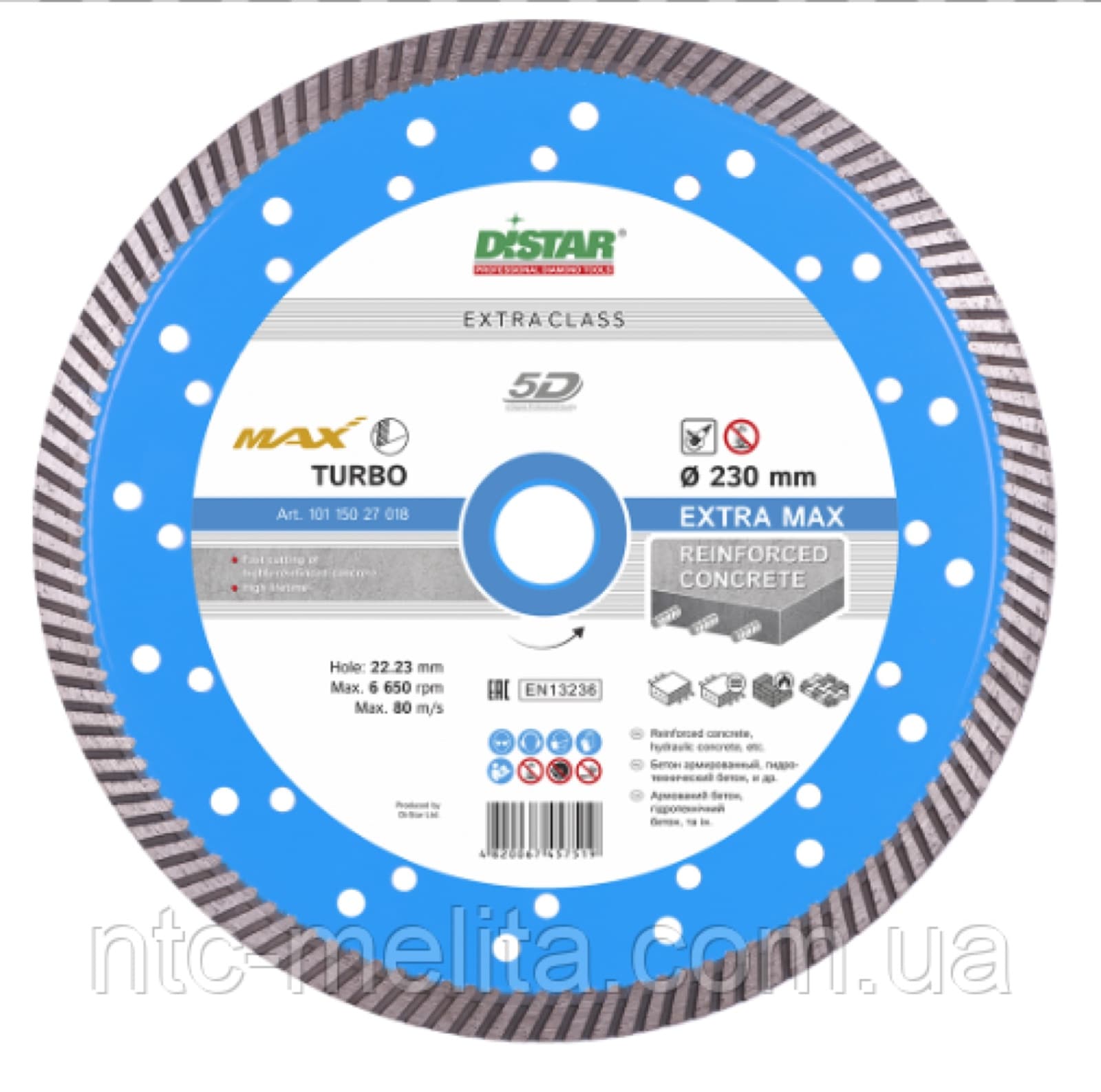
A diamond blade (also called a diamond cutting disc) is chosen by three things: the material, the tool and the cutting method - dry or with water. For concrete and brick with an angle grinder take a turbo or segmented blade, for tile and porcelain stoneware a thin continuous-rim 1A1R blade, for granite a granite turbo blade or a continuous-rim blade on a wet tile saw. Diameter and bore must match the tool: 115-232 mm with a 22.23 mm bore for an angle grinder, 300-600 mm with a 25.4 mm bore for a petrol cut-off saw.
Diamond blade types: segmented, turbo or continuous rim
A diamond blade is a steel core with a diamond-bearing layer on its edge: small synthetic diamond crystals held in a metal bond. The blade does not cut, it grinds the material away. The bond wears gradually and exposes new diamonds until the layer is used up. So the key facts about a blade are which material its bond is designed for and how high the diamond layer is.
By rim shape there are three types, each for its own job:
- Segmented (1A1RSS in the marking) - the layer is split into segments by gullets. The gullets carry away slurry and heat, so the blade cuts concrete, brick and asphalt dry and on large machines. The cut is rougher, with possible chipping at the edge.
- Turbo - a continuous corrugated rim or turbo segments. Cuts faster than a continuous rim and cleaner than a segmented blade. The main choice for concrete, brick and granite with a grinder and no water.
- Continuous rim (1A1R) - a rim without gullets. Gives the cleanest chip-free cut on tile, porcelain stoneware and marble. Classically used with water on a tile saw, but the thin Decor Slim, Razor and Multigres blades are designed by the manufacturer for dry cutting with a grinder.
Which diamond blade for which material: selection table
The bond rule is simple: the harder the material, the softer the bond must be so the diamonds keep renewing. The more abrasive the material (asphalt, green concrete, sandstone), the harder the bond, otherwise its sand eats the layer. That is why a universal blade is always a compromise, and a material-specific blade lasts longer and cuts faster.
Below is a selection by job with the DISTAR blades we sell. Prices are rounded, incl. VAT, at the time of publication. The full range is in DISTAR diamond tools.
| Job | Blade type | DISTAR series | Diameter, mm | Price incl. VAT |
|---|---|---|---|---|
| Concrete, brick, paving slabs with a grinder, dry | Turbo | Extra, Extra Max | 125-232 | from ~860 UAH |
| Reinforced and heavily reinforced concrete, chases | Segmented with turbo segment, BITURBO | Meteor, Super Max | 125-232 | from ~1 800 UAH |
| Granite, sandstone with a grinder, dry | Turbo, turbo segment | Elite, Elite Max, Gabbro Max, Maestro | 115-232 | from ~800 UAH |
| Tile, porcelain stoneware with a grinder | Thin continuous rim 1A1R | Decor Slim, Multigres, Hard ceramics, Razor, Esthete | 115-230 | from ~880 UAH |
| 45° tile mitre cuts | Continuous rim Edge | Edge | 180-250 | from ~3 550 UAH |
| Granite, marble on a wet tile saw or stone saw | Continuous rim 1A1R | Granite, Granite Premium, Marble | 115-400 | from ~800 UAH |
| Concrete with a petrol cut-off saw or floor saw | Segmented | Classic H12, Technic Advanced, Meteor | 300-600 | from ~4 000 UAH |
| Asphalt, green concrete | Segmented for abrasive materials | Sprinter Plus, Green Concrete, STAYER | 230-600 | from ~1 820 UAH |
Diamond blade for concrete: angle grinder or cut-off saw
For an angle grinder on concrete there are two working options. The turbo Extra Max 232 mm (about 1 800 UAH incl. VAT) is recommended by the manufacturer for concrete, reinforced concrete, brick, sandstone and paving slabs, cutting without coolant. The diamond layer is 12 mm high, which means a reserve for long work.
If the concrete has a lot of rebar or is dense monolithic concrete, take a segmented blade with turbo segments, for example Meteor 230 mm - about 3 300 UAH incl. VAT. It costs more than a turbo blade but is designed for reinforced and hydraulic-structure concrete. Such blades cut rebar inside the concrete, but they should not be used to cut separate steel bars.
Petrol cut-off saws and floor saws need 300-600 mm blades with a 25.4 mm bore. Machine power matters here: the manufacturer rates the Technic Advanced series for saws up to 7 kW, Classic H12 for 4-9 kW equipment, Meteor up to 12 kW. For concrete without heavy reinforcement a balanced option is Classic H12 354 mm, about 5 900 UAH incl. VAT; according to the manufacturer, the series lasts up to 400 m of cut on a cut-off saw.
Asphalt and green concrete are a separate case: they are very abrasive, and an ordinary concrete blade wears quickly on them. For them there are blades with a hard bond and protective segments - Sprinter Plus, Green Concrete, and STAYER for a 230 mm grinder. The full range is in blades for cut-off saws and floor saws.
Diamond blade for tile and porcelain stoneware
Tile needs a continuous-rim blade: segments and turbo rims chip the glaze. With a grinder it is convenient to cut with a thin blade, for example Decor Slim 125 mm with a 1.2 mm diamond layer - about 1 100 UAH incl. VAT. The thinner the layer, the less force and the cleaner the edge, but a thin blade does not tolerate twisting or side pressure.
For very hard porcelain stoneware Razor and Hard ceramics fit, for tile with a decorative glazed surface - Esthete with an ultra-thin layer. For 45° tile mitres there is a separate Edge series, 180-250 mm with a 25.4 mm bore - it is for a tile saw, not for a grinder.
Wet tile saws use continuous-rim 1A1R blades with a 25.4 or 32 mm bore. For example, Granite 200 mm (about 1 450 UAH incl. VAT) is intended by the manufacturer for granite and dense sandstone; according to its data, it lasts up to 700 running metres at up to 1.2 m/min. For marble, dolomite and travertine there is the Marble series.
Whether to cut dry or wet is defined by the description of the specific blade, not by the rim type. If the passport says "with cooling", the rim overheats without water and the core may warp. If the blade allows dry cutting, cut in short passes and let it cool at idle. All blades for grinders and tile saws are in diamond blades for angle grinders and tile saws.
Diameter, bore and marking: how to read a blade name
Choose the diameter for the tool, not for the cutting depth you want. The blade must not be larger than the machine guard allows. The exact cutting depth depends on the flange and guard of the specific model.
The main diameter and bore combinations:
- 115-125 mm, 22.23 mm bore - small grinder: chases, tile, shallow cuts.
- 150-232 mm, 22.23 mm bore - large grinder: blocks, kerbs, granite.
- 180-400 mm, 25.4 or 32 mm bore - tile saws and stone-cutting machines.
- 300-600 mm, 25.4 mm bore - petrol cut-off saws and floor saws.
| Part of the name | Example | Meaning |
|---|---|---|
| 1A1R / 1A1RSS / Turbo | 1A1RSS/C3-W | Rim shape: continuous / segmented / turbo |
| First number | 350 | Outer diameter, mm |
| Second number, with a slash | 3,2/2,2 | Diamond layer thickness (kerf width) / core thickness, mm |
| Layer height | 12 in Turbo 232x2.5x12 | Height of the diamond-bearing layer, mm: higher means longer life |
| Bore | 22,23 or 25,4 | Arbor or flange hole diameter, mm |
| Number before the segment code | 48 | Number of segments |
| Segment size | 18x3,2x13+2 | Segment length x thickness x height as designated by the manufacturer |
Diamond blade for metal: can you cut steel
Standard diamond blades for concrete, stone and tile are not intended for steel. When cutting iron at high temperature the diamond wears chemically, the rim dulls fast and the blade heats up. Cutting rebar inside concrete with a reinforced-concrete blade is fine; cutting pipe, angle or sheet is not.
Some manufacturers make vacuum-brazed diamond blades for metal - a different design that this article does not cover. For metal use an abrasive cut-off wheel or a saw, and for regular work a metal cut-off machine.
Typical mistakes in choosing and using a blade
Most broken and "burnt" blades are not defects but the result of one of these mistakes. If you need a hole rather than a cut, a blade will not help: see how to choose a diamond core bit and the separate guide on the core bit for socket boxes.
- The maximum speed on the blade is lower than the grinder's no-load speed. This is not allowed: check both numbers.
- A 230 mm blade on a 125 mm grinder or working without the guard. A blade bursting at such speed causes injury.
- A concrete blade on asphalt or sandstone: the abrasive quickly eats the layer and undercuts the core below the segments.
- A continuous "wet" blade used dry without breaks: the rim overheats, the core turns blue and loses flatness.
- Side pressure, cutting curves, grinding with the face of a cutting blade. For grinding there is the diamond cup wheel, which removes material with its face, not its edge.
- The blade glazed over and stopped cutting on hard granite. Make a few cuts in an abrasive material - sand-lime brick or sandstone - to expose the diamonds.
FAQ
What is the difference between a diamond blade and a diamond disc?
None, it is the same thing. Product names say "diamond cutting disc" or "wheel", while in conversation people say "diamond blade".
Which diamond blade cuts paving slabs?
With a grinder - a turbo concrete blade, for example the Extra Max 232 mm series, which is rated for paving slabs. For large volumes use a petrol cut-off saw with a 300-350 mm segmented blade.
Can a continuous-rim blade cut without water?
Only if the manufacturer allows it: the thin Decor Slim, Razor and Multigres tile blades are designed for dry cutting with a grinder. Granite, Granite Premium and Marble blades are intended for wet cutting on a tile saw.
Why did my diamond blade stop cutting?
Most often it glazed over: the bond got polished and no longer exposes new diamonds, which happens on hard materials. A few cuts in sand-lime brick or sandstone usually restore cutting; if the layer is worn down to the core, replace the blade.
What bore does a diamond blade for an angle grinder have?
22.23 mm is the standard grinder bore, often written as 22.2 mm in descriptions. Blades with 25.4 and 32 mm bores are for tile saws, stone saws and petrol cut-off saws.