How to Choose a Drill Press: Bench, Floor (Column) or Radial
For a repair shop and holes up to 13-16 mm in steel, a bench drill press on 230 V is enough. For series work and holes of 20-32 mm, choose a floor (column) drill press with an MT3 or larger spindle taper, preferably on 400 V. If the part is large and awkward to reposition for every hole, you need a radial drill.
Three types of drill press and how they differ
Drill presses in the MELITA catalog fall into three groups. The difference is not just size: it is how the machine holds the workpiece and what hole it can drill without being overloaded.
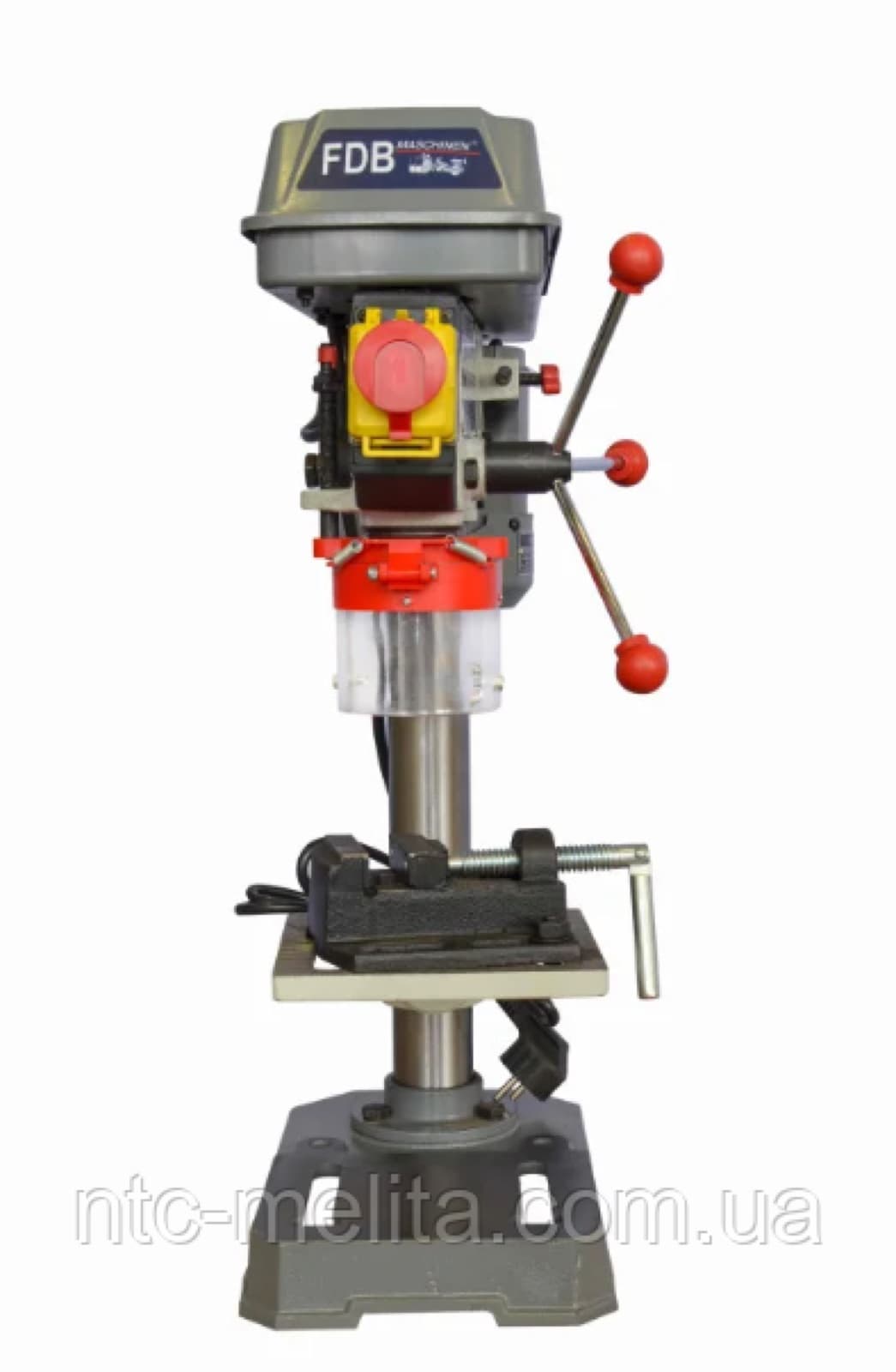
A bench drill press sits on a workbench or a stand. It is compact, runs from a standard 230 V socket and suits small and medium holes: fasteners, brackets, small parts.
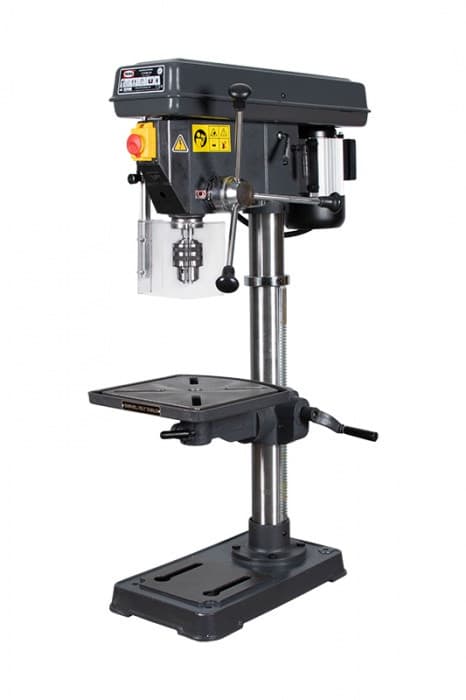
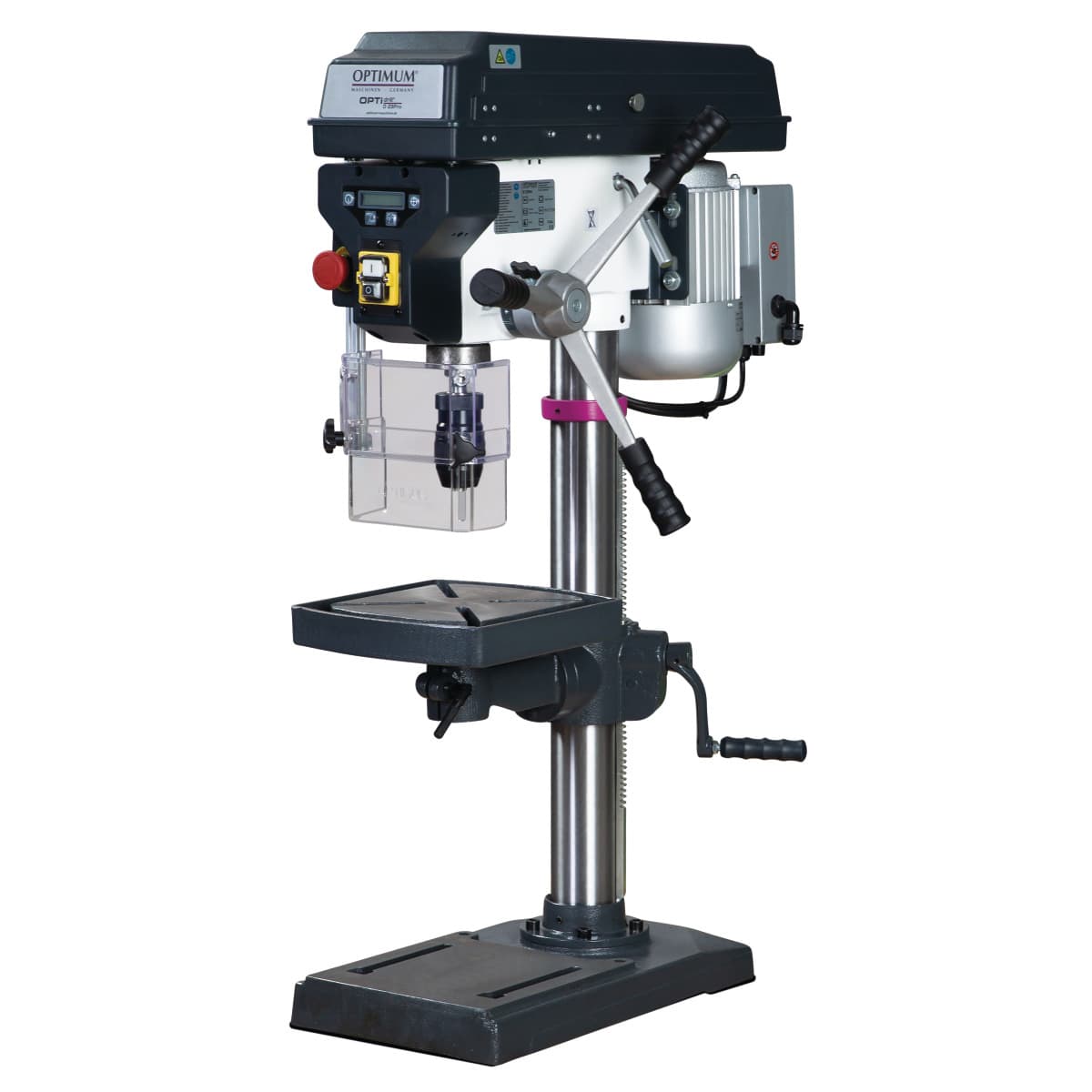
A floor (column) drill press stands on its own base plate. The long column gives more distance between spindle and table, while a stronger motor and a stiffer frame let it drill larger holes and run full shifts.
A radial drill has an arm along which the drilling head travels, and the arm itself swings around the column. The workpiece stays put and the spindle is brought to each hole. That is the key advantage when machining large, heavy parts.
Which specs to check before you buy
A drill press listing is full of numbers, but eight of them really drive the choice. Compare them in the model passports, not by the model name: the number in the name often hints at the drilling capacity, but not always.
- Maximum drilling diameter in steel. Manufacturers quote it for structural steel. In stainless and alloy steel the practical limit is lower, so keep a 20-30% margin for everyday work.
- Spindle taper. Usually a Morse taper: MT2 on bench models, MT3-MT4 on column machines. A larger taper holds larger taper-shank drills without a chuck and transmits force better.
- Quill stroke. This is how deep you can drill in one plunge without moving the table. For through holes in thick parts it is critical.
- Speed range and how it is changed. Belt drive: you move the belt across the pulleys, a handful of steps, simple and quiet. Gear head: levers change speed in seconds and give more torque at low speed, which large drills and tapping need. Some models also offer variable speed.
- Power and supply. 230 V works in any building, 400 V (three-phase) is needed by more powerful machines and is standard in production. Many models come in both versions, so check the supply at the installation site first.
- Table size and T-slots. They decide which vises and fixtures you can clamp. A swivel and tilting table adds flexibility.
- Column diameter. A thicker column deflects less under load, so the hole ends up more accurate.
- Machine weight. A heavier machine vibrates less. A column drill press should be anchored to the floor.
Drill press types compared, based on the catalog
Prices include VAT, are rounded and reflect the MELITA catalog at the time of publication. For exact specs of a given model, see its product page or the machine passport.
| Parameter | Bench | Floor (column) | Radial drill |
|---|---|---|---|
| Price incl. VAT | from ~7,000 to ~35,400 UAH | from ~21,500 to ~62,100 UAH | ~25,000-29,800 UAH, heavier models on request |
| Supply in the catalog | 230 V, some models 400 V | 230 V and 400 V | 230 V on compact models |
| Installation | on a workbench or stand | on the floor, anchored | depends on the model |
| Workpiece position | on the table under the spindle | on the table or the base plate | stationary, the head is brought to the hole |
| Typical jobs | repairs, small parts, one-off holes | series, larger holes, shift work | large, heavy parts with many holes |
| Brands in the catalog | FDB Maschinen, Optimum, Proma | FDB Maschinen, Optimum, Proma | Optimum |
Which machine for which job
Start from the largest hole you drill regularly and from the size of your parts. Price comes second: an undersized machine wears out drills and overheats, while paying for power you never use rarely pays back.
- Repair shop, garage, service center. Holes up to 13-16 mm, mixed materials, a few jobs a day. A bench drill press on 230 V with belt drive is enough.
- Small series and production floor. The same holes in dozens of parts, holes over 16 mm, tapping. You need a floor (column) drill press, ideally with a gear head and 400 V supply, plus a depth stop and a solid vise.
- Large parts: plates, frames, housings. Moving such a part for every hole is slow and unsafe. A radial drill wins here, because the head travels over a stationary workpiece.
Specific models from the catalog
The most affordable option for occasional holes is the FDB Maschinen Drilling 13/50, about 7,000 UAH incl. VAT. For a workshop with steady load, look at the Proma E-1516B/230: a 230 V bench machine at ~25,900 UAH incl. VAT, also listed in a 400 V version.
Among column machines, the OPTIdrill D 23PRO is a popular choice, available in three-phase (400 V) and single-phase (230 V) versions; the 400 V version costs ~41,400 UAH incl. VAT. For heavier work there are the Proma E-2020F/400 (~55,100 UAH) and the OPTIdrill D 33Pro (~62,100 UAH).
If you need reach on a limited budget, consider the compact radial Optimum RB8S: 750 W, 230 V supply, ~29,800 UAH incl. VAT. The heavier OPTIdrill RD4 and RD5 radial drills are supplied to order; ask for the price through a quote request.
Vises, tooling and how to order
Never hold a part by hand on a drill press: as the drill breaks through, it grabs the metal and spins the workpiece. Clamp it in a machine vise bolted to the table through the T-slots. Choose jaw width and vise height to match the table and the quill stroke so you do not lose usable height.
For series holes, cross-slide or compound vises are convenient: the part is moved with lead screws without re-clamping. You will also need a drill chuck, reducing sleeves for the spindle taper and a drill set.
MELITA (NTC Melita LLC), Dnipro, has been in business since 2015. We issue invoices with VAT for companies, deliver across Ukraine via Nova Poshta, Meest or freight carriers, and pickup in Dnipro is free. Machines come with a 12-month warranty. If in doubt, send a drawing or a photo of the part through the quote request and we will match a machine and a vise.
FAQ
Which drill press should I choose for a garage?
A 230 V bench drill press with belt drive. It handles small and medium holes, needs no three-phase supply and takes little space.
Why is a floor (column) drill press better than a bench one?
It is stiffer, has more distance between spindle and table and usually a stronger motor. So it drills larger holes with confidence and stands up to shift work.
Can I plug a 400 V drill press into a regular socket?
No, a three-phase motor needs a three-phase supply. If only 230 V is available, choose the single-phase version: many models, such as the OPTIdrill D 23PRO, come in both.
What do MT2 or MT3 mean in the specs?
That is the Morse taper size in the spindle. The larger it is, the larger the taper-shank drills you can fit directly and the better the force is transmitted.
When do I need a radial drill?
When the part is large or heavy and has many holes. The head moves over the workpiece, so you do not have to reposition the part for every hole.
Can a company buy a drill press with a VAT invoice?
Yes, MELITA issues invoices with VAT. Create an invoice from the cart or send your company details through the quote request.