Bench grinder, belt grinder or tool grinder: which to choose
For chisels, punches and high-speed steel lathe tools a double-wheel bench grinder with 200 mm wheels is enough - from ~10,800 UAH incl. VAT. Knives and wood chisels are better served by a low-speed water-cooled grinder or a belt grinder, because a fast dry wheel overheats a thin edge. Drills and end mills that need a repeatable angle go on a tool grinder, while chamfers, welds and flats are done on a belt grinder.
Bench grinder: what the machine is
Bench grinder, grinding machine, pedestal grinder - in a workshop these all mean the same machine: an electric motor with an extended shaft and an abrasive wheel at each end. In Ukraine it is still often called a nazhdak, after the natural emery once used for wheels. Modern wheels are made of aluminium oxide or silicon carbide.
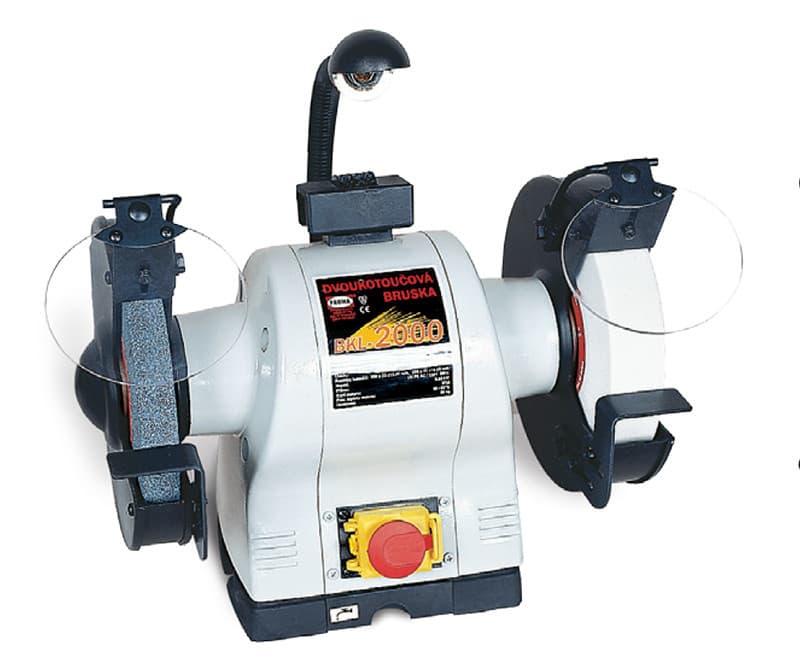
A classic bench grinder has a two-pole motor, so the wheels turn at about 2850-2950 rpm. Industrial models with 300 mm wheels use a four-pole motor at 1450 rpm: with the larger diameter the wheel reaches the required speed anyway. A bench grinder consists of:
- Two wheels: usually one coarse for roughing and one finer for finishing.
- Tool rests in front of each wheel, with an adjustable gap.
- Wheel guards and transparent eye shields over the work zone.
- Spark arrestors on top of the guards. Some models also have a work light and a water tray for cooling the part.
Bench grinder, belt grinder or tool grinder: the difference
These three types are often confused, but each does its own job. A bench grinder removes metal with the rim of a narrow wheel and holds the tool shape only through the operator's hand. A belt grinder works with a long abrasive belt that heats the part less. A tool grinder holds the tool in a fixture and repeats the set angle from one sharpening to the next.
This is how they differ in practice:
| Type | How it works | Used for | Price incl. VAT |
|---|---|---|---|
| Double-wheel bench grinder 150-200 mm | Two wheels on the motor shaft, 2850-2950 rpm | Chisels, punches, screwdrivers, lathe tools, roughing | from ~6,700 UAH |
| Industrial grinder 250-300 mm | Wheels 40-50 mm wide, 380 V | Daily roughing in the shop, large lathe tools | from ~12,100 UAH |
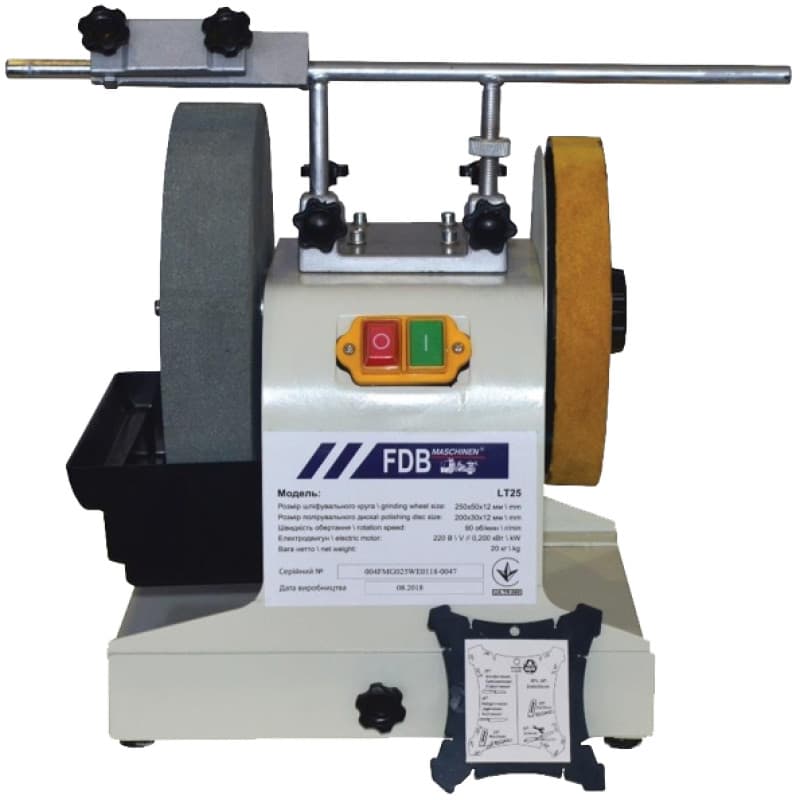
| Low-speed wet grinder | A 250 mm wheel turns slowly in a water bath | Knives, wood chisels, axes without overheating | from ~8,500 UAH |
| Combination grinder with belt | A wheel on one side, a 75 mm belt on the other | Lathe tools plus chamfers and small parts | from ~24,800 UAH |
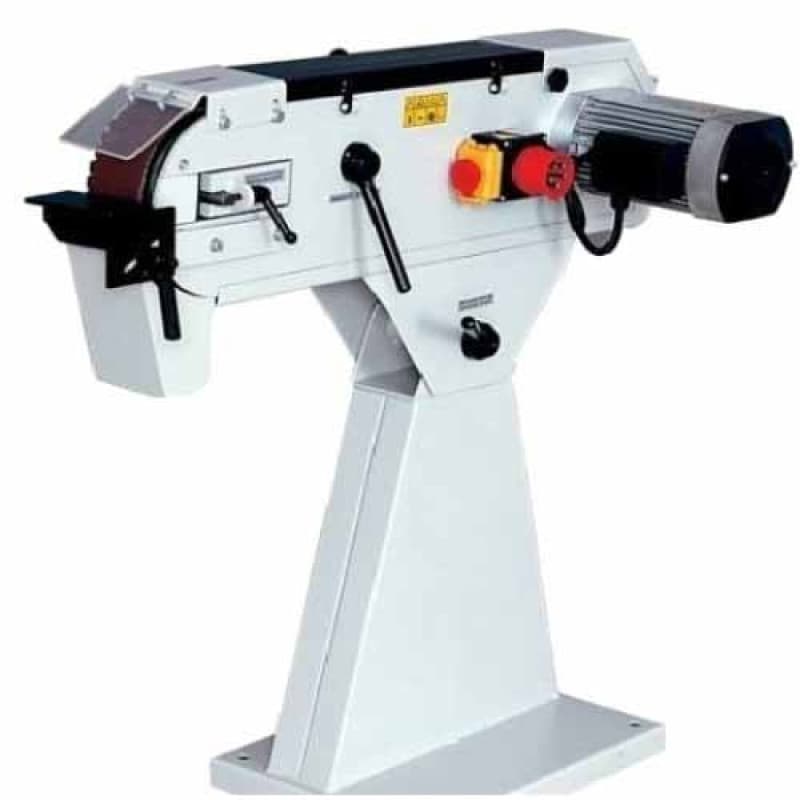
| Belt grinder | Abrasive belt on rollers, about 30 m/s for metal | Chamfers, welds, flats, knives | ~46,200 UAH (for metal) |
| Universal tool and cutter grinder | Tool in a collet or holder, micro feed | Drills, end mills, lathe tools with a precise angle | from ~42,600 UAH |
How to choose a bench grinder: wheel, speed, power
What matters most is not the power on the box but the wheel surface speed. It is calculated as v = π × D × n / 60,000, where D is wheel diameter in mm and n is rpm. A 200 mm wheel at 2850 rpm gives about 30 m/s, a 300 mm wheel at 1450 rpm about 23 m/s, while a 250 mm wheel at 90 rpm in a wet grinder moves at only 1.2 m/s. Then check:
- Wheel diameter and width. A wide wheel (40-50 mm) holds a flat face longer and suits wide lathe tools. For example, the BKL-2000 has 200x25 mm wheels, the industrial LT 2200 300x50 mm.
- Bore. It can be 16, 32, 75 mm or more; replacement wheels are bought for that bore or fitted with the adapter bushings supplied.
- Maximum wheel speed. Every wheel is marked with its maximum operating speed in m/s, which must be no lower than the speed calculated for your machine.
- Power. Roughly 0.4-0.6 kW is enough for sharpening lathe tools and chisels in a workshop. Roughing under load all shift needs a 1.5-2.2 kW motor.
- Voltage. Domestic grinders run on 230 V; industrial ones with 250-300 mm wheels usually on 380-400 V.
- Weight and mounting. A heavy machine vibrates less. A grinder under 20-30 kg must be bolted to a bench or put on a pedestal.
Which wheel to fit: abrasive by tool material
Even the best grinder sharpens badly if the wheel does not suit the metal. Wheels differ in abrasive, grit, grade and bond; the full marking is explained in grinding wheels: marking and selection. For choosing by tool, this cheat sheet is enough:
| Tool material | Wheel | Colour (usually) |
|---|---|---|
| Structural and carbon steel: chisels, punches, screwdrivers | Regular aluminium oxide | Grey, brown |
| High-speed steel: HSS drills, lathe tools, cutters | White aluminium oxide | White |
| Carbide: brazed tool tips, cast iron, non-ferrous metals | Green silicon carbide | Green |
| Finishing carbide | Diamond wheel | - |
| Finishing high-speed steel | CBN wheel | - |
Which to choose for the job: bench grinder, belt grinder or tool grinder
Models from our catalog by typical workshop and shop-floor job. Prices rounded, incl. VAT. All bench grinders are in bench grinders.
| Job | What to buy | Model | Price incl. VAT |
|---|---|---|---|
| Chisels, punches, HSS lathe tools in a garage or workshop | Double-wheel grinder 200 mm, 230 V | Proma BKL-2000 (550 W, 2850 rpm) | ~10,800 UAH |
| Daily roughing and large lathe tools in a shop | Industrial grinder 300 mm, 380 V | FDB Maschinen LT 2200 (2.2 kW, 1450 rpm) | ~36,000 UAH |
| Knives, wood chisels, scissors, axes | Low-speed wet grinder | FDB Maschinen LT25 (250x50 mm wheel, 90 rpm) | ~8,500 UAH |
| Lathe tools plus chamfers and small parts on one machine | Grinder with belt attachment | OPTIgrind GU 25S (250 mm wheel, 75x1016 mm belt, 400 V) | ~24,800 UAH |
| Chamfers, welds, flats, blades | Metal belt grinder | FDB Maschinen BS75 (75x2000 mm belt, 3 kW) | ~46,200 UAH |
| Drills 4-12 mm, end mills up to 12 mm, lathe tools up to 21x21 mm | Universal tool and cutter grinder | OPTIgrind GH 20T (370 W, 380 V) | ~42,600 UAH |
Knife sharpener: why not an ordinary bench grinder
The thin edge of a knife on a dry wheel at 30 m/s heats up in seconds. Temper colours - straw, then blue - mean the metal at the edge has been tempered back and lost hardness. Such a knife dulls quickly however often you sharpen it.
For knives, wood chisels and plane irons choose the LT25 wet grinder: its 250 mm wheel turns at 90 rpm in a water bath, and a 200 mm leather wheel removes the burr and polishes the edge. Professional knife making and fast bevel grinding need a belt grinder, such as the BS75 with a 75x2000 mm belt - choosing one is covered in belt grinder: how to choose. Angles and sharpening sequence for different knives are in sharpening knives on a machine.
Universal tool grinder: when a bench grinder is not enough
A drill sharpened by hand on a bench grinder often has cutting lips of unequal length and cuts with runout. An end mill cannot be sharpened correctly by hand at all. When a shop has a lot of such tooling, the OPTIgrind GH 20T universal tool grinder pays off: it sharpens drills of 4-12 mm, end mills and single-flute cutters up to 12 mm and lathe tools up to 21x21 mm, holding the tool in a collet with micrometer feed.
Dedicated machines for drills and circular saw blades are in sharpening machines, compared in sharpening machine: how to choose. Belt machines for chamfers and flats are in belt grinders and sanders.
Typical bench grinder mistakes and safety
Most wheel failures and injuries on a bench grinder come from a few typical mistakes. Check yourself against this list, and if you need help choosing, describe the tooling and volume in the request form and we will pick a machine and wheels. MELITA has supplied equipment from Dnipro since 2015, with a 12-month warranty on machines, delivery across Ukraine and VAT invoices for companies.
- A wide gap between tool rest and wheel. Keep it to 2-3 mm at most, or a small part gets pulled in between the rest and the wheel.
- Grinding on the side of a straight wheel. An ordinary wheel is designed for work on its periphery; side load can break it.
- A glazed or out-of-round wheel. Dress it with a dressing stick or diamond dresser, or it heats the part and vibrates.
- Aluminium and soft metals on an abrasive wheel. They load the wheel pores, after which it stops cutting steel.
- Overheating the tool. Dip carbon steel in water often, but do not quench red-hot high-speed steel - micro-cracks can appear.
- A new wheel without inspection. Check it for cracks before fitting, and stand to one side while it runs idle after start-up. Wear goggles even with a shield, and no gloves that can be caught.
FAQ
Which is better: a bench grinder or a belt grinder?
A bench grinder is cheaper and better for lathe tools, chisels and roughing. A belt grinder heats the part less and suits knives, chamfers and flats, but costs more.
Which bench grinder should I choose for home and garage?
A double-wheel grinder with 150-200 mm wheels, 230 V and 0.4-0.6 kW. It must have adjustable tool rests and shields, and it must be bolted to a bench.
What is the difference between a bench grinder and a tool grinder?
On a bench grinder the operator's hand holds the angle; a tool grinder clamps the tool in a fixture and repeats the angle. Drills and cutters with precise geometry need a tool grinder.
Which wheel should I use for carbide?
A green silicon carbide wheel, finished with a diamond wheel. A regular grey aluminium oxide wheel barely cuts carbide.
Which grinder do I need for knives?
A low-speed water-cooled grinder or a belt grinder with a fine belt. An ordinary dry grinder at 2850 rpm easily overheats and softens a thin edge.
What speed should a bench grinder run at?
Usually 2850-2950 rpm for 150-200 mm wheels and about 1450 rpm for 300 mm wheels. Surface speed matters more: it must not exceed the speed marked on the wheel.