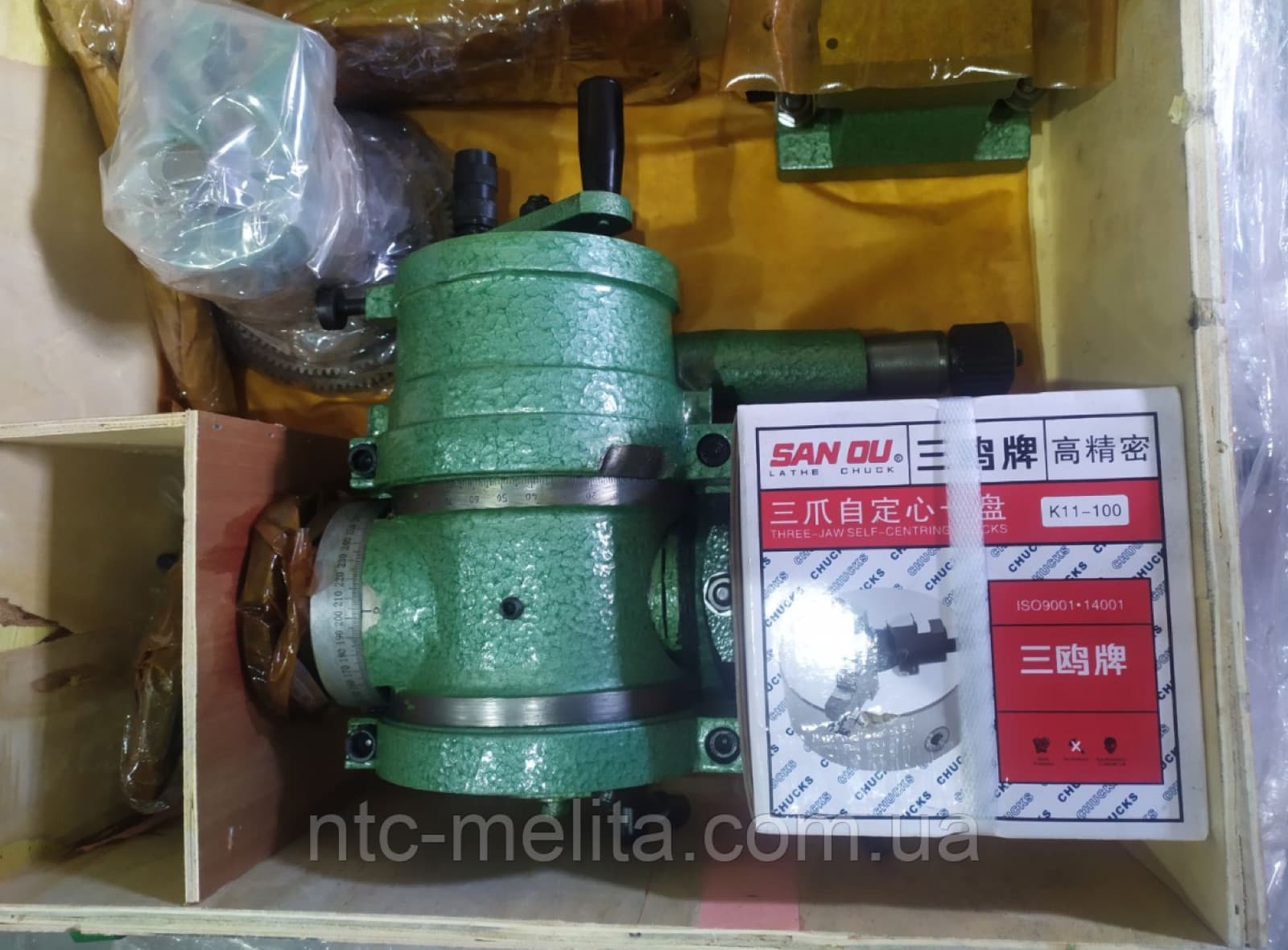
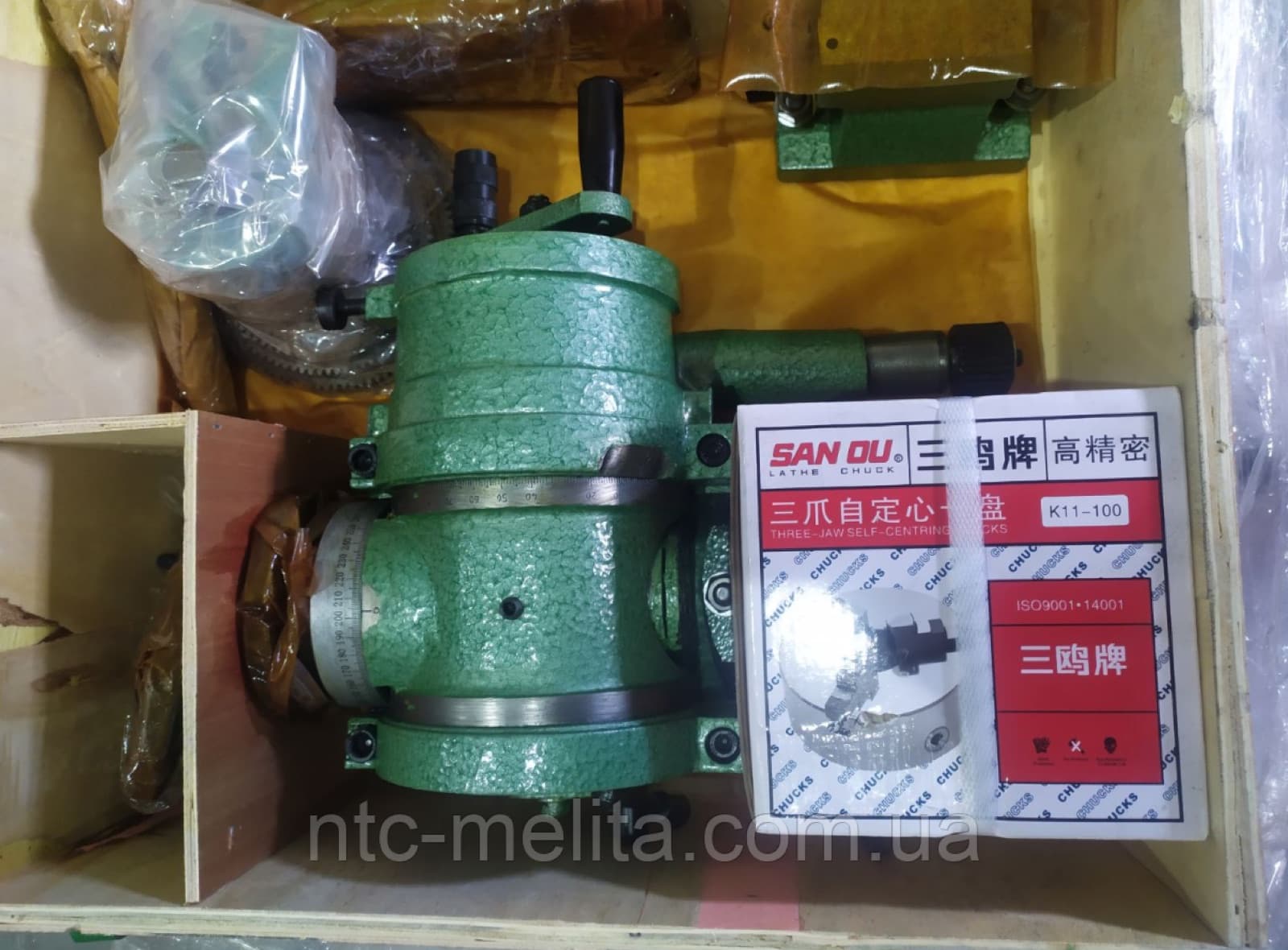
Universal dividing head: how to use it and index calculation
A universal dividing head rotates the workpiece on a milling machine by an exact fraction of a turn so you can cut gear teeth, splines, flats or flutes. Most heads have a 40:1 worm gear, so for each division the crank is turned n = 40/Z times: for Z = 6 that is 6 turns plus 20 holes on a 30-hole circle. For primes such as 61 or 127, where this does not work, differential indexing with change gears is used.
What a dividing head does on a milling machine
A dividing head is a fixture bolted to the table of a metal milling machine. The workpiece is held in the head's chuck or between centres on the head and the tailstock. You mill one section, rotate the part by a set fraction of a circle and mill the next one.
The spindle of a universal head tilts from horizontal to vertical, so it handles both shafts and the faces of discs. The most common jobs:
- spur gears and sprockets with module or disc cutters;
- splined shafts and keyways spaced around a circle;
- flats: square, hexagon, octagon for a spanner;
- flutes on reamers, countersinks and cutters, including helical flutes;
- cams and holes laid out around a circle at a given angle.
Parts of a universal dividing head
Inside the body is a worm drive: a worm on the crank shaft and a worm wheel on the spindle. Most heads have a 40:1 ratio, meaning 40 turns of the crank give one full turn of the spindle. This number 40 is called the head constant and is given in the passport; if your head has a different one, replace 40 with it in every formula below.
The index plate is a disc with several concentric circles of holes, each circle with a different hole count. The plunger on the crank engages the chosen circle. The sector arms mark the required number of holes so you need not recount them. The front of the spindle often carries a plate for direct indexing, and a spindle lock clamps it during cutting. The tailstock supports long parts between centres.
The set of hole circles depends on the maker and model. For example, a common set is 16, 17, 19, 21, 23, 29, 30, 31, 33, 37, 39, 41, 43, 47, 49 and 54 holes. Check the hole circles on your own plates before calculating.
Direct and simple indexing: the n = 40/Z formula
Direct indexing is the fastest: the worm is disengaged and the spindle is turned by hand using the plate on the spindle. With 24 holes you get 2, 3, 4, 6, 8, 12 and 24 divisions, so squares and hexagons need no calculation.
Simple indexing goes through the worm drive. Crank turns per division n = 40/Z, where Z is the number of divisions. The whole number is counted in full turns, and the fraction is converted to a denominator that matches one of the hole circles. Example for Z = 6: 40/6 = 6 2/3, and 2/3 = 20/30, so 6 full turns plus 20 holes on the 30-hole circle. For Z = 18: 40/18 = 2 2/9 = 2 and 12/54, two turns and 12 holes on the 54-hole circle. For Z = 27: 1 13/27 = 1 and 26/54. For Z = 36: 1 1/9 = 1 and 6/54.
The table uses the hole circle set listed above. If you lack a circle, use another one that is a multiple of the fraction's denominator.
| Divisions Z | 40/Z, turns | Crank per division |
|---|---|---|
| 6 | 6 2/3 | 6 turns + 20 holes on the 30 circle |
| 7 | 5 5/7 | 5 turns + 15 holes on the 21 circle |
| 13 | 3 1/13 | 3 turns + 3 holes on the 39 circle |
| 17 | 2 6/17 | 2 turns + 6 holes on the 17 circle |
| 18 | 2 2/9 | 2 turns + 12 holes on the 54 circle |
| 24 | 1 2/3 | 1 turn + 20 holes on the 30 circle |
| 27 | 1 13/27 | 1 turn + 26 holes on the 54 circle |
| 36 | 1 1/9 | 1 turn + 6 holes on the 54 circle |
| 48 | 5/6 | 25 holes on the 30 circle |
| 100 | 2/5 | 12 holes on the 30 circle |
| 61 | 40/61 | not possible by simple indexing, use differential |
Differential indexing for primes (61, 127)
When the denominator does not reduce to any hole circle, as with the primes 61, 67, 71 or 127, differential indexing is used. The index plate is unlocked and geared to the spindle through a train of change gears. As the crank turns, the plate itself moves slightly forward or back and makes up the difference.
The procedure: choose a nearby number Z' that can be indexed simply, set the crank for 40/Z' and fit change gears with the ratio i = 40 x (Z' - Z) / Z'. If i is positive, the plate turns in the same direction as the crank; if negative, in the opposite direction. The direction is set with idler gears.
Example for Z = 61: take Z' = 60, crank 40/60 = 2/3, i.e. 20 holes on the 30 circle. Gear ratio i = 40 x (60 - 61) / 60 = -2/3, for instance a 40 and 60 tooth pair or 24 and 36, with the plate turning against the crank. For Z = 127: Z' = 120, crank 1/3 turn (18 holes on the 54 circle), i = 40 x (120 - 127) / 120 = -7/3. Check which change gears are actually supplied with your head in its passport.
Angular indexing and helical milling
With a 40:1 ratio one crank turn rotates the spindle 360/40 = 9°. Turns for an angle: n = angle / 9°. For example, 35° = 3 8/9 turns = 3 turns and 48 holes on the 54 circle. On the 54 circle one hole equals 10 minutes of arc, and six holes equal 1°.
For helical flutes and helical gears the head spindle is geared to the table lead screw through change gears, and the table is swivelled to the helix angle. This needs a universal head with a drive from the table screw and a machine with a swivel table or swivel head. The gears are calculated from the helix lead and the lead screw pitch of your machine.
Common mistakes and backlash
Most scrap comes from a counting error or backlash, not a faulty head.
- Counting the hole the plunger is sitting in. Set the sector to the required number of spaces, so you see one more hole between the arms.
- Turning the crank back and forth. Always turn in one direction; if you overshoot a hole, back the crank off about half a turn and come up to it again.
- Forgetting to lock the spindle before cutting or to release it before indexing.
- Not checking the hole count of the circle. Count the holes by hand before the first part.
- A worn worm drive: noticeable play when you rock the spindle by hand causes cumulative error. Adjust the clearance as described in the passport.
Which universal dividing head to choose
The number in the model name (D-160, D-200, D-250, D-320, D-400) is the size class of the head: the higher it is, the larger the diameter and weight of the workpiece. Choose by your largest part and by the table size of your milling machine. All models are in the dividing heads section, priced from ~36 000 to ~114 600 UAH incl. VAT.
MELITA has worked in Dnipro since 2015: VAT invoices for companies, delivery across Ukraine by Nova Poshta, Meest and freight carriers, free pickup in Dnipro, and a 12-month warranty on machines. If you are unsure about the size, send a drawing of the part through the quote form.
| Model | Made by | Price incl. VAT, UAH |
|---|---|---|
| UDG D-160A | China | 44 160 |
| UDG D-200 | LOMO | 36 000 |
| UDG D-200A | China | 45 360 |
| UDG D-250A | China | 55 800 |
| UDG D-320A | China | 70 200 |
| UDG D-400A | China | 114 600 |
FAQ
How do you calculate indexing on a dividing head?
Divide the head constant (usually 40) by the number of divisions Z. The whole number is full crank turns; convert the fraction to a hole circle with a suitable count, e.g. 2/3 = 20 holes on the 30-hole circle.
How many degrees is one crank turn?
With a 40:1 ratio one crank turn rotates the spindle 9°. On a 54-hole circle one hole equals 10 minutes of arc.
How do you divide a circle into 61 or 127 parts?
Simple indexing on standard plates will not do it; use differential indexing: set the crank for a nearby number (60 or 120) and let change gears with the ratio 40 x (Z' - Z) / Z' make up the difference.
What if I overshoot the hole?
Do not move the crank back one hole. Back it off about half a turn and bring it up again in the same direction to take up the worm backlash.
Will a dividing head fit any milling machine?
The head is bolted to the table through the T-slots, so it fits most knee-type and universal milling machines. Check that the centre height and the length of the head plus tailstock fit on your table.